🔧Plumbing
Water Under the Kitchen Sink: Finding the Source
By KABLAY Editorial · · 12 min read · Updated:
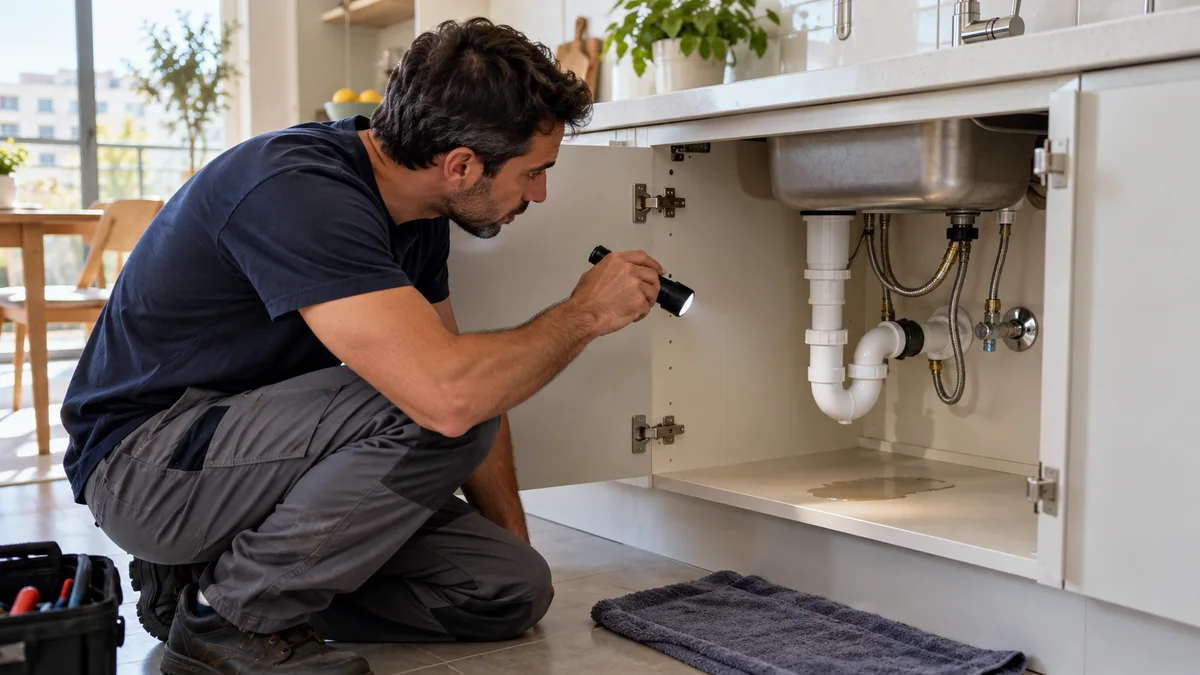
Water in the kitchen sink cabinet does not tell you which fitting has failed. Supply hoses, isolation valves, the sink waste, a trap, a dishwasher connection and perhaps a drinking water filter can all meet in one small space. A drop from a high connection can travel along a pipe and collect below a different part. Ordering a new trap from a photograph of a puddle can therefore produce the wrong repair. Begin by documenting the first wet point and the conditions in which water appears.
This guide helps you brief a plumber without dismantling pressurized fittings. If water is already spreading beyond the cabinet, use the immediate leak response guide and arrange help promptly. The narrower question here is how to investigate moisture under an otherwise ordinary kitchen sink and how to decide what work to approve after inspection.
Record the timing before naming a part
Look inside before using the sink, after normal tap use, after draining a bowl of water and after any nearby appliance has run. You do not need to flood the unit repeatedly to run an experiment. Note whether moisture is present continuously, only while the tap is open, after the drain empties or after a dishwasher cycle. The sequence gives the professional a useful starting point that “the cabinet leaks” cannot provide.
Check the counter around the faucet, the rim of the sink and the outside of the cabinet too. Spilled water can pass through an opening and imitate a pipe leak. That explanation is weak if the same wet mark returns under normal use, so keep observations separate from guesses. Tell the professional what changed recently, whether a filter or appliance was added, and whether any water is near an electrical fitting. Share a short video of an ordinary event if the symptom is intermittent.
Limit damage while keeping the evidence
Empty the cabinet and keep stored items off the wet base. Stop using the sink if water is actively escaping. An accessible, known working isolation valve can be used to stop the relevant supply safely; do not force a seized valve to prove that it works. If moisture is near electricity, avoid touching wet fittings and tell the professional when arranging the visit. Water and appliances make a casual experiment a poor substitute for a controlled inspection.
Photograph the open cabinet before wiping it, then take a close image of the earliest wet area you can see. A towel in a safe position may limit spread but does not fix the cause. If a valve will not isolate the supply or the water continues to escape, describe the situation as urgent. A routine appointment for a presumed washer is not an accurate brief for an active leak.
Pressurized supply has a particular pattern
Supply fittings may drip while the faucet is closed because water remains in the line. The plumber will distinguish a valve body, a hose connection, the hose itself and the parts directly above the sink base. Follow the first visible drop rather than the lowest wet component. Water reaching the trap does not prove that the trap leaks. Tightening every visible nut can damage a different type of seal or shift a sound connection.
The Moen guide to leaks beneath a sink begins with the location and frequency of the water before considering a particular component. Its parts information is model-specific; the method of separating observations is the useful point here. Ask the plumber to identify the actual escape point before replacing a hose or valve. A tap dripping from its spout is a different request, covered in the faucet repair guide.
Drain leaks show up under different conditions
If the cabinet stays dry when the sink is idle but becomes wet after the bowl empties, inspect the outlet, overflow, trap and wall connection. Also check whether water ran across the counter and entered from above. Explain when the drop began relative to normal draining. Do not fill the bowl to the point of overflow just to make a video. An accurate account of everyday use is enough to guide a careful site test.
The Oatey sink installation guide checks drain joints while water runs through them. That illustrates a reasonable handover check, not a universal instruction to tighten every fitting yourself. A worn washer, misaligned connection, cracked plastic and unsuitable trap layout require different repairs. Smearing sealant on the outside of a wet joint may hide a drip without restoring how the assembly is meant to fit.
Appliances and filters share the same cabinet
Dishwasher hoses, a drinking water tap and a filter can add further connections. Tell the plumber what is installed and whether moisture changes after each device is used. Do not disconnect a machine hose to isolate a theory unless the work is being performed with the appliance and supply safely managed. Connections need to be checked against the actual model after they are disturbed.
If a dishwasher was fitted recently, keep the installation record and any photos taken before closing the unit. The dishwasher connection checklist helps distinguish its supply and waste from the sink waste. Do not approve replacement of every pipe in the cabinet solely because the area is crowded. More than one fault is possible, but the contractor should describe each one and its remedy separately.
Condensation and old marks need a different answer
Moisture on a cold pipe can sometimes form without a failed joint. Dark staining on a panel may also remain from an earlier leak that has stopped. Timing, position and repetition help distinguish these situations. A cabinet that becomes wet after each use should not be dismissed as condensation without checking its connections. Conversely, a dry old stain does not prove that water is escaping now. A photograph records appearance, not the cause by itself.
Look at swollen particleboard, separating edge tape and a damp back panel. Stopping the plumbing leak does not restore damaged furniture. Ask separately about drying, cleaning and replacement of cabinet parts. Those tasks may need a different specialist and should not be silently bundled into a plumbing quote. The correct sequence is to stop the water, verify the repair and then decide which materials can be retained.
What the meter can and cannot tell you
Where water escapes continuously from a pressurized line, the water meter may offer a clue when all normal use has stopped. A moving meter does not identify this particular cabinet; other outlets and hidden lines are also downstream. A stationary reading at one moment does not rule out a leak that appears only when the sink drains or an appliance operates. Do not handle an unfamiliar shared building valve as part of this check.
The guide to a moving meter and a hidden leak explains that broader investigation. For a wet sink unit, combine any meter observation with the first wet point and the use history. Share both facts with the plumber without presenting either as a diagnosis. It prevents a service visit from starting with the claim that the meter has already named a defective washer.
Send a useful brief before the visit
Send an overall photograph of the cabinet, a close photograph of the first wet place, a list of connected appliances, a timing description and what you know about the isolation valve. Keep the exact address in the normal private booking channel rather than an open comment beside photographs. If a video is helpful, a short recording showing the start of the symptom is more useful than a long recording of an empty sink.
Tell the professional whether a shelf, bin or filter blocks access and who can remove it. The plumber may bring common consumables, but an exact replacement part depends on the product and what inspection finds. A readable model label is worth photographing without dismantling a fitting. If there is no visible label, say so. A visual resemblance to a catalogue part is not a reliable specification for a pressurized connection.
Compare the complete scope, not a single part price
Ask how the diagnostic visit is priced and whether it is credited to a repair if the provider offers that arrangement. A live supply leak, a drain fault and a dishwasher connection are different jobs. A useful quote separates inspection, parts, labour, access work and a potential return with a model-specific part. Agree any new operation before the work proceeds.
If an installer needs to remove part of the cabinet or shift a heavy appliance, put that in the scope. Clarify who protects the furniture and who restores a disconnected appliance. Replacing a supply hose does not automatically require rebuilding the trap, or the reverse. After inspection, keep a short record of the source, the operation performed, the new part and anything that could not be checked.
Check the repair in ordinary use
With the plumber, look at accessible dry connections at rest, then run the tap and drain in an ordinary way. If an appliance connection was part of the job, agree its normal operating check as well. Keep the cabinet accessible and unloaded during the inspection. Look at its base and back after the test. One dry moment cannot guarantee that no future fault will occur, so ask what to watch over the next normal uses.
If the isolation valve was the problem, have the professional show its normal position and safe operation. Any inaccessible part should be recorded. Do not immediately stack boxes against a joint that may need observation. Retain photos and the work description if moisture reappears, so a later visit can start with evidence instead of a new guess.
A request you can adapt
“There is water inside my kitchen sink cabinet. It appears [while idle / after the sink drains / after the dishwasher runs]. I can provide photos of the whole cabinet, the first wet point and the connections. The isolation valve is [accessible / uncertain]. Please quote diagnosis, agree parts separately and check ordinary use after repair.” Replace the bracketed phrases with what you actually observed rather than assigning a cause in advance.
Use the plumbing service section to compare responses. Once the leak has stopped, treat any drying or cabinet reconstruction as a separately described task. A clear brief makes it possible to assess the finding and understand what you paid to fix.
Internal links
Useful pages on this topic
Frequently asked questions
- Why is the cabinet wet if the faucet does not drip?
- Supply, an isolation valve, the drain or a connected appliance may be responsible. Record when water appears and ask the plumber to show the first escape point.
- Will the water meter locate the leak?
- A moving meter can suggest continuous use but cannot identify this cabinet or an intermittent drain leak. It is one observation alongside an on-site inspection.
- Should the trap be replaced immediately?
- No. First check whether water appears during draining and where it escapes. Replacing a sound trap will not fix a supply or appliance connection.
- What should I send a plumber?
- Photos of the open cabinet and first wet point, connected appliances, leak timing and what you know about the isolation valve. Send the precise address privately.