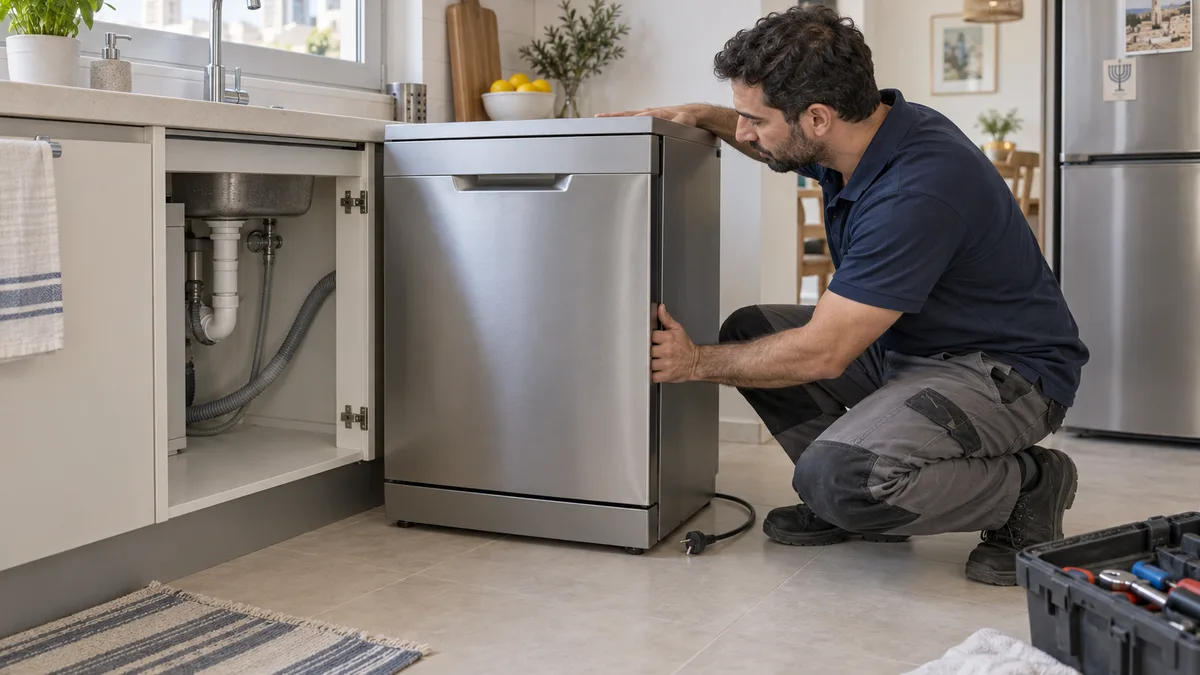
Your dishwasher arrives, but the installer finds no suitable water valve, an unprepared drain and a socket behind the future appliance. In an older Israeli kitchen, delivery and preparing the installation site are often separate jobs. Even replacing an existing machine calls for checks because the new model’s dimensions, hoses and door arrangement may differ.
This guide covers kitchen preparation, responsibilities, quotations and the first operating check. It applies to freestanding and integrated models, a new niche and replacement of an old machine. Exact dimensions, connection parameters and permitted accessories come from your model’s installation instructions. General advice should not override them.
Connection to ready points or kitchen preparation?
A connection job assumes suitable water, drainage, power and space already exist. The installer positions the machine, makes the specified connections and checks operation. Preparation may include a separate valve, compatible trap, cabinet opening, furniture alteration or a new electrical point. Those operations are not automatically included in a retailer’s installation service.
Before booking, provide photographs of the niche and under-sink cabinet, give the exact model and ask which services must be ready. If the retailer supplies installation, clarify its terms, required parts and limits. Understand supplier-specific warranty arrangements before cancelling that visit or arranging alternative installation.
Measurements before purchase
Measure usable width, height and depth, plus the delivery route. The front opening is not the whole space: pipes, plinths, projections and sockets reduce clearance behind it. Check door movement beside cabinet handles, walls and the plinth. The appliance should remain serviceable rather than permanently wedged into furniture.
- Exact model and installation drawing.
- Actual niche dimensions, including obstructions.
- Distance to water, drainage and power.
- Hose route and water-valve access.
- Space for full door opening.
- Furniture-door dimensions and weight for integrated models.
“A normal 60-centimetre machine” is not a complete specification. Slim, standard and compact appliances differ in more than width. Integrated equipment also has requirements for the door and fixings. When a kitchen is being built, give the cabinet maker the selected appliance drawing before manufacturing begins.
Water supply and shutoff access
The plumber needs to assess the existing valve and the connection required by the instructions. Photograph the entire under-sink area, including angle valves, flexible supplies and filters. A photograph of the tap alone cannot show whether a dishwasher point exists. Report a seized or corroded valve before the visit and do not force it.
There should be a clear way to isolate water for servicing. An inlet-hose protection assembly also needs space and the correct arrangement. Avoid an improvised inaccessible assembly hidden behind furniture. Clarify which parts come with the appliance, which the installer supplies and who handles connections if the unit must later be withdrawn.
Drainage is more than inserting a hose
The model’s documentation determines hose position and securing. A compatible outlet, permitted height and length, freedom from kinks and correct trap function all matter. One generic measurement cannot apply to every model. When using a new connection, the installer needs to check that the passage and fittings are ready, rather than merely attaching the hose.
Odour, returning water or an error after the first run can involve installation, appliance or existing drainage. Mention a sink that already drains slowly. Connecting a new machine to an evidently troubled drain without assessment is not a useful way to solve both problems. For a separate blockage, use a kitchen drain request.
Power and the socket
The socket must suit the appliance and installation requirements. A spare outlet in the sink cabinet is not proof of suitability. Do not plan permanent operation through an arbitrary extension lead or multiway adaptor. An absent, damaged or inconvenient electrical point should be discussed before the appliance installer attends.
Creating or altering fixed electrical points requires a person with appropriate current authorisation. Licence scope is explained by Israel’s Ministry of Labor. A plumber can address water and drainage without necessarily undertaking electrical work. Agree the separate electrical scope and price where needed.
Freestanding versus integrated installation
A freestanding machine needs stable positioning and a suitable space. An integrated model also involves furniture securing, a door panel, clearances and coordination with the plinth. Misalignment or an unsuitable panel can obstruct closure and servicing. Do not remove a freestanding model’s top unless its manufacturer allows that installation arrangement.
Bosch’s installation guidance emphasises that methods and dimensions vary by model. Take door-panel, fixing and access requirements from your chosen machine’s documentation rather than transferring another product’s numerical limits.
Can hoses be extended?
Sometimes the intended position is farther from the sink than the supplied hoses allow. Check permitted lengths, heights and accessories before purchase. Extension is not an unrestricted choice of any tubing available in a shop. An unsuitable route can affect filling, drainage, service withdrawal and leak response. Discuss the exact model’s limits before work starts.
Ask to see the intended route through cabinets, edge protection at openings and how pinching will be avoided as the machine is pushed back. Connections should not be stretched so tightly that servicing becomes impractical. If routing or furniture changes are complex, compare another appliance position before committing to installation.
Which specialist does what?
- Appliance installer: fitting and commissioning within supplier terms.
- Plumber: water, valve, trap, drain and corresponding connections.
- Cabinet specialist or handyman: niche and panel within their competence.
- Electrician: fixed electrical points and supply diagnosis.
One person may undertake several parts, but define them explicitly. State who connects the appliance after preparation and who checks the first cycle. Otherwise the plumber can finish the points while the installer waits for an unfinished furniture panel, leaving the resident with a machine in place but no completed service.
What affects the installation price?
The main distinction is connection to existing suitable points versus creating them. Valve and trap replacement, access, integrated furniture, removal of old equipment, permitted extensions and cabinetry affect the quote. A simple connection rate does not describe creating a new position in an old kitchen. Separate labour, parts and other specialists’ services.
Use plumbing price references as a starting point, then request a quote based on photographs and assessment. Ask about VAT, commissioning, return visits, necessary fittings and approval of extra work. If the shop already sold installation, determine what has been paid for and what remains outside that service.
Before the installer arrives
- The appliance is delivered and its exact instructions are available.
- The niche and route to the kitchen are clear.
- The under-sink cabinet is emptied so connections are visible.
- Photographs and existing defects have been shared.
- Electrical and furniture responsibilities are agreed.
- Door panel, fittings and accessories have been checked.
- Removal, first run and extra-cost approval are defined.
Do not disconnect an old machine yourself if safe water isolation and connection preparation are uncertain. Include removal in the work instead. In a rented home, agree cabinet drilling and service alterations with the responsible owner first. Photographs of the starting condition and written approval help keep the scope clear.
Accepting the completed connection
Check stability, opening, clearances and access to water isolation. Run the first procedure required by the instructions together with the installer, including filling and drainage. Inspect accessible connections during operation and afterwards for visible leakage. A machine sitting in its niche without a water check is not evidence of a completed connection.
Have the installer show the valve, explain initial settings and state whom to contact if there is a problem. Keep instructions, work records and warranty terms. If water appears later, stop use, operate only safe accessible isolation as instructed and contact the installer. Do not tighten an unfamiliar fitting while the machine is running.
Problems after installation
If the machine fails to fill or drain, smells or leaks, describe the cycle stage and displayed error. Do not buy a pump from one error code or dismantle a new appliance. The installer or appliance service provider should assess the cause according to the symptom. Accessible photographs and the time water appears are more useful than an assumed diagnosis.
If the RCD trips, stop restarting the machine to experiment and read the electrical-tripping guide. A leaking mixer nearby can be a separate source: the faucet and under-sink connection guide helps describe that issue. Keep appliance faults and existing kitchen defects distinct in the follow-up report.
Example of a complete request
“Petah Tikva, freestanding dishwasher, exact model attached. Niche beside the sink. Existing socket for installer assessment. No separate water valve or drain connection yet. Need water and trap preparation, connection and first operating check. Niche and cabinet photographs attached. No old appliance to remove.” Add your preferred language and access times.
For an integrated model, also state whether the furniture door has arrived, who supplies it and whether an old panel is intended for reuse. Include the installation drawing rather than assuming compatibility. For replacement, explain how the old machine is connected and whether any existing fittings leak or fail to shut off.
Starting on KABLAY
Open the dishwasher connection request or plumber category. For furniture preparation, discuss handyman services. Compare identical scopes and agree who verifies all final connections. Confirm the actual appointment and any supplier requirements before the visit.
Internal links
Useful pages on this topic
Frequently asked questions
- What does a standard dishwasher connection include?
- Connection to suitable prepared points and the agreed checks. A new valve, trap, socket, furniture panel or cabinet alteration may be separate.
- Can the dishwasher be positioned far from the sink?
- Check permitted hose lengths, heights and accessories in the model instructions. Arbitrary extension is unsuitable.
- Can the plumber create the socket?
- Fixed electrical work needs someone with suitable current authorisation. Clarify competence and the separate scope.
- How do I check the installation before handover?
- Perform the specified first run under agreed terms, inspect accessible connections and check drainage, stability, door movement and valve access.