🔧Plumbing
Toilet Cistern Repair in Ra'anana: Checks and Quotes
By KABLAY Editorial · · 12 min read · Updated:
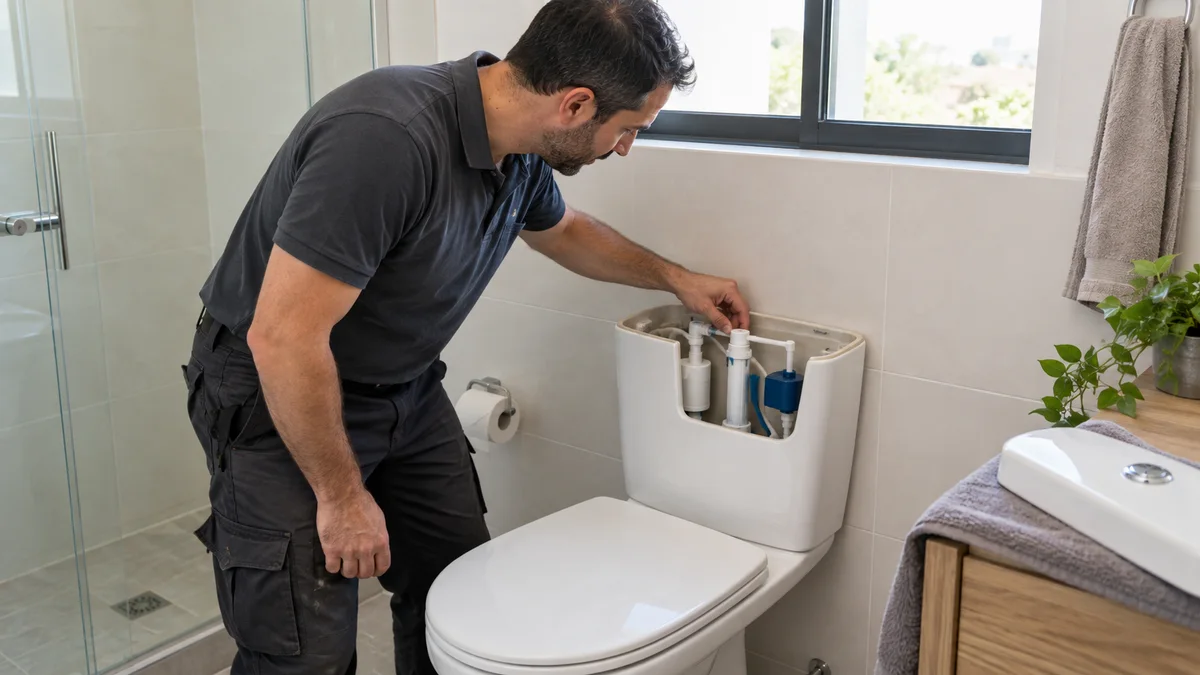
A toilet cistern in Ra'anana that keeps filling, starts again at night or leaves a trickle in the bowl does not automatically need a new toilet. An exposed cistern can often be serviced using separate components. First identify where the water is being lost and which mechanism is installed. A leaking supply hose, water passing through an overflow and a flush closure problem are different jobs.
This guide focuses on an accessible external cistern. A concealed system behind the wall has different access and parts requirements; see the separate concealed cistern guide when preparing that booking. For an exposed tank, a clear symptom description is more useful than assuming that a float needs replacement because you heard a noise.
Describe what happens around a flush
Record whether water runs continuously or the filling starts at intervals without anyone pressing the button. Is a trickle visible in the bowl? Does the noise follow every flush or happen at other times? Mention a sticking button or a change in its usual resting position. A short video with sound and a view of the bowl helps the plumber understand what you observed.
Do not try to prove a diagnosis through repeated flushing. Describe normal use and when the symptom becomes noticeable. If the toilet is temporarily unused, say whether the problem continues. Those external observations are useful without lifting a lid with an unfamiliar button connection or dismantling components while the supply is pressurised.
Separate internal loss from water outside the toilet
Water entering the bowl without a flush differs from drops beneath the cistern or on the floor. Photograph the first point where moisture appears and the supply connection if it is visible. A wet surface does not automatically establish a faulty fill valve. Different joints and seals may be involved, and inspection is needed. The home leak checklist can help with initial preparation.
For an active external leak, stop using the fixture and arrange safe isolation. Operate only a known working shutoff valve. Do not force a seized valve as an experiment. Tell the plumber if the supply cannot be reliably isolated: that connection may need its own repair or replacement before other work can proceed.
The fill and flush mechanisms do different work
The filling assembly admits water and the flush mechanism releases it when flushing. Similar visible symptoms do not always indicate the same part. When water leaves the tank, filling may restart to replace it. When incoming water does not stop as intended, the behaviour may be different. The distinction needs assessment of the actual system rather than a guessed part name.
Fluidmaster’s cistern troubleshooting guide also distinguishes causes involving fill and flush components. Its product details and instructions apply to the stated mechanisms, rather than providing adjustment directions for every toilet.
Ask the plumber to explain the finding and the operation proposed to address it. Cleaning, adjustment, seal replacement and a whole new assembly should be described accurately. Replacing a complete kit can be reasonable, but it is useful to compare that with servicing a specific component when the remaining parts are sound and compatible replacements exist.
Prepare the model information
Photograph the toilet and tank together, the button, accessible markings and any purchase documents. Describe a side or bottom supply entry if it is visible externally. Avoid removing a lid when you do not understand its button connection. Ceramic lids are heavy and fragile, and an internal linkage can be damaged by the wrong lifting method.
Compatibility depends on more than the word universal in an advertisement. Connections, dimensions, height, operation and internal clearance matter. If the model is unknown, agree on identification during a visit followed by parts sourcing. This avoids buying a similar-looking mechanism from a picture that cannot be fitted correctly in your tank.
Consider a part repair or a broader replacement
A local repair is worth discussing when the ceramic body is sound, fixings are usable, the cause is understood and compatible parts are available. Cracked ceramic, damaged connections or several unsuccessful previous interventions can change the decision. Do not attempt to conceal an unidentified crack simply to keep the old fixture; its condition and suitability for use need assessment first.
Compare the total cost instead of the price of one seal. Assessment, components, labour and a return visit may all be needed. If replacement also involves the hose and isolation valve, ask for a separate explanation. Establish what happens if disassembly reveals another fault. New paid work should be agreed before it takes place.
Give useful access details for your Ra'anana address
In the initial request, provide the area or street without unnecessary private information, the building type, floor and access arrangements. Share the exact visit address with your selected provider through the appropriate contact. Mention parking or approach restrictions relevant to carrying tools. These are conditions of your building, rather than one rule applying throughout the city.
If isolation affects neighbours or a shared system, identify who will coordinate timing and access. Do not promise that a common valve can be shut if this has not been arranged. An ordinary external cistern may not need any shared isolation at all. That depends on the installation, rather than the city name in the advertisement.
Request a quote with clear boundaries
Ask for the visit charge and the conditions for proceeding to repair. When the model is unknown, an explained price confirmation after identification is better than a hidden assumption that any kit will fit. Clarify who provides parts and whether materials and VAT where applicable are included. The cost of a possible second visit should be understood beforehand.
- Assessment of the symptom and the location of water loss.
- A compatible part reference or description and the planned operation.
- Hose, shutoff valve and fixings, with inclusion or separate assessment stated.
- Visit count, materials collection and handling of removed components.
- Checks after reassembly and a contact arrangement if the symptom returns.
An inspection offer and an offer to replace every mechanism are not the same job. Ask each provider to define the price coverage. If a whole kit is recommended, establish which components are worn, what the repair is expected to achieve and any remaining limitations. The decision can then reflect the condition rather than the longest line in a quote.
Prepare the room without dismantling the installation
Clear belongings around the toilet, remove the mat and allow access to the supply. Keep documents and any model information available. Show enclosed furniture or a particularly narrow space in advance. Do not remove sanitary fittings or pull connections yourself to make access easier; that can introduce an additional source of leakage.
Say if this is the apartment’s only toilet so the unavailable period can be planned. Availability of the correct component and working isolation influence the schedule more than a fixed promise for every home. After the visit, leave the area accessible for checking and normal use, rather than immediately covering the connections with stored items.
Check ordinary operation after the repair
Check a normal flush, button return and filling stopping in the intended way. If there are two operating modes, ask the plumber to demonstrate both. Inspect external connections and the dry floor after completion. Then notice whether the earlier unexplained refill noise or trickle in the bowl returns when nobody has flushed.
External observation does not replace the installer’s assembly checks. Ask which parts were replaced and keep their description. Avoid changing the adjustments yourself immediately afterward because that makes the result harder to assess. If the problem returns, send a video, the time it appeared and the conditions instead of ordering the same mechanism again without diagnosis.
A noise after the visit needs context
Clarify whether the sound belongs to ordinary filling after use or occurs without a flush. A noise alone does not establish water loss. Compare it with the previous symptom and report the observations. New external water should be treated as an active leak and reported promptly, rather than waiting for a convenient day to see whether it disappears.
Keep photographs, the agreed quote and parts information together. That helps assess a repeat problem and a future service visit. If the cause turns out to be outside the cistern, give the next provider the checks already completed and the parts changed. A useful history prevents the first step from being repeated unnecessarily.
A practical Kablay request
You could write: “Ra'anana, exposed toilet cistern. It fills after flushing and later starts making a filling noise again; a trickle is visible in the bowl. The floor is currently dry. Photos and video are attached and the model is unknown. Please quote assessment, compatible parts and checks after repair. List the visit, components, possible return and shutoff valve work separately.”
Use the Ra'anana plumber page to compare replies to that specific description. A dripping tap has its own faucet repair guide; do not merge two water sources into one assumed fault. A focused request makes it easier to prepare the appropriate repair.
Internal links
Useful pages on this topic
Frequently asked questions
- Does a constantly filling cistern need a whole new toilet?
- Not necessarily. Assess the loss source, fill and flush mechanisms and tank condition. A compatible part can often be serviced, while cracks or other damage can change the plan.
- What should I photograph for a Ra'anana plumber?
- The toilet and cistern together, button, accessible markings and first location of water. Include a short video with the noise and when it occurs.
- Will a universal mechanism from a shop fit?
- Not always. Connections, dimensions and operation must suit the tank. Confirm the model or compatibility with the provider before purchase.
- How should I check the cistern repair?
- Check normal flushing modes, button return, filling stopping and dry external connections. Then watch for refilling without a flush or a returning trickle in the bowl.