🔧Plumbing
Concealed Toilet Cistern in Ashdod: Leaks, Weak Flush, Noise and 2026 Repair Prices
By KABLAY Editorial · · 11 min read
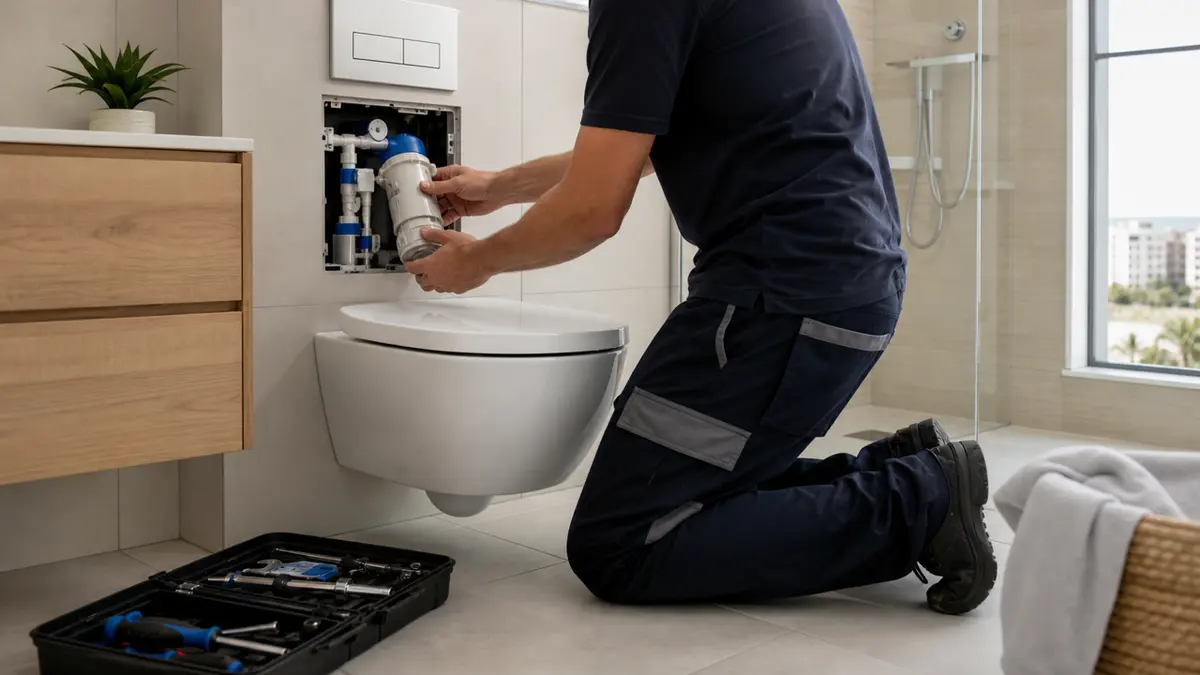
A concealed cistern looks clean and modern, but when it starts leaking or flushing poorly, many Ashdod homeowners panic: "Will they now break all the tiles?" In most cases, no. The flush plate is also the service opening, and through it a professional plumber can reach the float valve, flush mechanism, seals and internal shutoff valve.
This is especially relevant in Ashdod. Newer districts have many wall-hung toilets and concealed cisterns from Geberit, Grohe, Schwab, Sanit and Plasson. Older rovas have many bathrooms renovated over the last decade, sometimes with tight access or non-original parts. Add coastal humidity, scale and daily use, and the same faults repeat often.
Signs of a concealed cistern fault
- Water keeps running into the toilet — usually a worn seal, misadjusted float or flush valve that does not close.
- The tank refills again and again — a short noise every few minutes, even without flushing.
- Weak flush — little water comes out, the bowl does not clear, or you need to press twice.
- Loose or stuck button — the plate does not return, sticks inside or works only on one side.
- Moisture around the toilet or wall — do not assume this is only a mechanism issue; the water source must be checked.
What usually fails
Inside a concealed cistern are several relatively simple components: a fill valve that brings water in, a flush valve that releases water, seals that prevent leakage, a small supply tube and a button that activates the system. Most faults are natural rubber wear or scale/dirt preventing full closure.
Hard water accelerates this. Scale on a seal or float can create a tiny leak that runs all day. It is not only noise: a toilet running for a month can add tens or hundreds of shekels to the water bill. If there is also a wall stain, see the guide to moisture diagnostics in Ashdod walls.
When the wall is not broken
Most faults do not require breaking tiles. The plumber removes the flush plate, opens the service hatch, closes the internal water valve and removes the faulty part. Through this opening it is possible to replace a seal, float, flush valve, button and internal tube. This is especially true for known brands with available spare parts.
The key is not to rush. If a tradesperson immediately recommends opening the wall without removing the button and checking the mechanism, that is a red flag. In a proper system, access to wear parts is designed in advance.
When opening or deeper diagnosis is needed
- Active moisture in the wall or floor — possible supply connection, nipple, toilet bend or waterproofing failure.
- The wall-hung toilet moves — suspicion of an unstable frame or poor installation.
- A crack in the tank or adapter — rare, but requires deeper work.
- A leak after a new renovation — check contractor warranty before private work.
- Sewer smell or recurring blockage — the problem may be drainage, not the cistern. See sewer blockages in Ashdod.
Typical Ashdod scenarios
In newer rovas and the Marina, concealed systems are usually fairly new, but warranty-type problems appear: poorly adjusted buttons, noisy fill valves or mechanisms installed slightly off. In rovas A-D and renovated apartments, the common pattern is non-original parts combined with tight access behind tiles. Near the sea, humidity and salt affect small metal parts, springs and button screws.
In rental apartments another scenario is common: a small issue continues for months because water is "only running a little". Eventually the owner gets a high water bill or the neighbor sees a stain. In that case document, repair and keep a proper invoice. For broader water damage steps, see what to do during a water leak.
2026 prices in Ashdod
- Diagnostic visit for a concealed cistern: ₪180-350
- Simple seal repair or float adjustment: ₪300-450
- Concealed cistern seal replacement: ₪350-450
- Float valve replacement: ₪300-500, not always including the part
- Flush mechanism replacement: ₪400-700, depending on brand and part
- Button or plate support replacement: ₪250-550, depending on brand and finish
- Replacing nipples/connection under a wall-hung toilet: ₪650-950
- New concealed cistern installation: ₪2,000-2,500 for basic labor, before unusual finishing work
- Wall/tile opening and repair in complex cases: ₪900-3,500+
Prices depend on access, brand, spare-part availability, time of day and whether moisture requires additional diagnosis. Ask in advance whether the quote includes VAT and parts.
Common mistakes
- Ignoring a small constant flow — it wastes water and raises the bill.
- Installing a mismatched noname part — it may work for two weeks and stick again.
- Breaking tiles before checking through the flush plate — most cases do not need it.
- Not checking warranty — newer cisterns may have manufacturer or contractor coverage.
- Assuming every wet mark near a toilet is only the mechanism — wall moisture requires source diagnosis, not only a rubber seal.
How to post the job on KABLAY
Write that you need concealed cistern repair in Ashdod, mention the brand if it appears on the flush plate, and describe the symptom: running water, stuck button, weak flush, refill noise or moisture. Add photos of the button, toilet and wall area. This helps the plumber bring the right parts instead of arriving only for diagnosis.
Summary
A concealed cistern should not be frightening. In most Ashdod cases it is repaired through the flush-plate opening without breaking the wall: seal, float, flush mechanism or button. Breaking comes into play only when there is moisture, a faulty connection, poor installation or structural damage. The right sequence is short diagnosis, the correct part, written warranty, and only if there are water signs — deeper investigation.
Internal links
Useful pages on this topic
Frequently asked questions
- Does concealed cistern repair require breaking the wall?
- Usually not. In most faults the plumber removes the flush plate and reaches the parts through the service opening. Breaking is mainly needed when there is moisture, a broken connection or poor installation.
- How much does concealed cistern repair cost in Ashdod?
- A simple seal repair or float adjustment usually costs ₪300-450. Replacing a mechanism or branded part can reach ₪400-700, not always including the part.
- Why does water keep running into the toilet?
- Most often the seal is worn, the float is misadjusted or scale prevents the mechanism from closing fully. It should be fixed quickly to avoid water waste.
- Which spare parts should I ask for?
- If the system is Geberit, Grohe, Schwab, Sanit or Plasson, prefer original or high-quality compatible parts for the exact model. A mismatched part can cause repeated faults.
- What if there is moisture in the wall near the toilet?
- Do not settle for mechanism replacement only. The plumber should check supply connections, nipples, toilet bend and waterproofing. A moisture meter or thermal camera may be needed before opening.