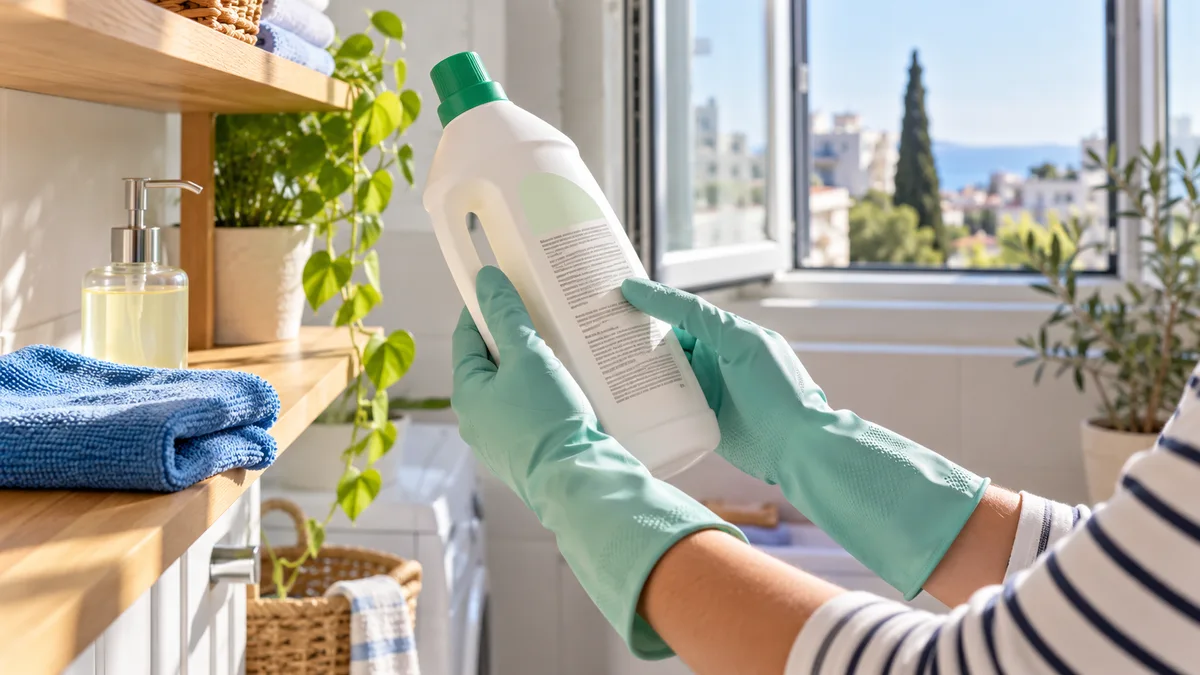
A home may smell “clean” after a job, but fragrance is not evidence that the surface is clean or that the air is safe. Detergents, disinfectants, descalers and degreasers perform different tasks and may affect skin, eyes and airways differently. The risk depends on the particular ingredient, concentration, way the product is applied, ventilation, time of contact and the person's health. That is not a reason to stop ordinary housekeeping. It is a reason to choose the least intensive method that solves the actual problem rather than treating every weekly clean as a heavy chemical operation.
This article explains possible effects; it does not diagnose an illness or label every bottle dangerous. If a cleaner causes severe coughing, burning, dizziness or difficulty breathing, stop using it, move to fresh air and seek medical help according to the symptoms. People with asthma or other respiratory conditions should discuss recurring symptoms and individual limits with a clinician. The instructions on the specific product and the requirements of the surface take priority over a generic internet recipe.
Cleaning and disinfecting answer different questions
Cleaning physically removes dirt and many microbes from a surface. Disinfection is a separate step aimed at reducing the microbes left behind, using a product approved for that purpose. CDC explains that routine cleaning is enough in most homes; additional disinfection may matter when someone is ill or particular circumstances call for it. This distinction prevents an understandable but unhelpful habit: spraying disinfectant over every shelf simply to make a normal room feel sterile.
Remove visible dirt first using a product compatible with the material. If disinfection is genuinely required, check which surfaces and purposes the label covers, whether preliminary cleaning or final rinsing is needed and how long the surface must remain wet. Applying the product and wiping it off immediately may miss the required contact time. Making a stronger solution than directed is another mistake. More concentrated does not mean more effective when the product is used outside its instructions, and it can increase irritation or damage.
The common groups of products at home
Soap and mild detergents remove ordinary dirt and grease. Their properties come from the ingredients, not from a “natural” slogan. Degreasers can contain alkaline agents or solvents that work on compatible hard finishes but may irritate skin or harm paint and coatings. Acidic descalers target mineral build-up where the material permits them; natural stone and certain finishes can be damaged by acids. Chlorine bleach and other disinfectants have particular uses and instructions. They are not general-purpose room perfumes or a required part of every floor wash.
Fragrance does not measure how much soil was removed. Some sensitive people react to scented products, and EPA describes ways certain cleaners and air fresheners can contribute to indoor pollutants. Spraying a product can create more opportunities to inhale droplets than applying an approved product to a cloth, although the label must still permit that method. Choose according to the task and surface rather than an advertising promise of “extra strong freshness.” A product for tiles need not be suitable for a painted cabinet or a food-contact surface.
Short exposure, repeated work and long-term findings
Contact effects can range from dry or reddened skin and irritated eyes to coughing; corrosive products can cause serious burns if handled incorrectly. NIOSH and OSHA describe skin rashes, burns, coughing and asthma among the possible problems associated with some cleaning chemicals. Repeated exposure matters especially in professional cleaning, where workers handle wet cloths, spray products and spend hours in small rooms week after week. A customer who uses a mild cleaner occasionally has a different pattern of exposure.
Long-term research needs careful interpretation. A 20-year cohort study observed a faster decline in certain measures of lung function among women who cleaned at home or at work than among women who did not report such cleaning; the same association was not found for men in that analysis. It is an observational study. It does not establish that any named bottle causes disease in every user, or that outsourcing one task prevents a particular illness. NIOSH notes that work-related asthma linked to irritants can appear after months or years of repeated exposure. Findings from occupational settings should not be casually applied to someone wiping a counter once a week.
The practical response is to control factors you can change: whether a stronger product is needed at all, how much is used, whether the room has fresh air, whether hands and eyes are protected, and how long anyone remains nearby. Employing a cleaning team does not make chemicals harmless. A good team should reduce unnecessary applications and manage exposure for workers as well as residents.
Never combine cleaners to make a “stronger” one
Do not mix chlorine bleach with acidic bathroom products, toilet cleaners, vinegar, ammonia products or other cleaners. Residues matter too: remove one product in accordance with its instructions before any different product touches the same area. CDC warns that mixing bleach or other disinfectants with cleaners can release vapours that are dangerous to breathe. Do not try to neutralise a bad mixture with another household ingredient.
If you notice a sharp chemical smell, cough, burning eyes or shortness of breath, leave the area instead of returning to finish the job. Follow local emergency advice and seek medical care where needed. Do not repeatedly enter a small bathroom to check whether it “has aired out” if breathing is difficult. Keep products in their original labelled containers, out of the reach of children and animals. Concentrate transferred into a drinks bottle creates a serious separate hazard even if no fumes are present.
Ways to reduce contact without becoming a chemist
Remove loose dust and treat the affected spot rather than spraying the entire room. Select a product that fits the material, read the label and use the stated amount. Ventilate while using it when outdoor conditions allow; a recirculating air conditioner is not automatically a fresh-air supply. Use gloves and eye protection if the instructions call for them. Remove residue where directed, dry the surface and wash your hands afterwards. Keep people away from a treated room for the period required by the particular product, not for an arbitrary time suggested online.
Household alternatives have limits too. Vinegar may etch marble or travertine; baking soda and a hard pad can scratch a delicate finish; an essential oil does not make a homemade mixture an approved disinfectant. Our surface-by-surface cleaning guide begins with the material rather than a favourite recipe. For products marketed as less hazardous, examine the actual criteria and instructions. EPA Safer Choice is one example of an assessment programme, but the presence or absence of a US label cannot replace directions for an Israeli product in your hand.
When a professional cleaning team can help
A whole apartment after renovation, stairwells, a long-neglected kitchen or several bathrooms may be difficult to clean evenly and safely in one spare evening. The challenge includes identifying different materials, bringing suitable tools, protecting furniture, ventilating rooms and avoiding wet upholstery or chemical residues. A capable team can divide the work, set up controlled test areas and use appropriate equipment. That can reduce your own time handling dust and products, provided the job is planned well; it does not transfer the health risk into thin air or excuse poor conditions for workers.
Professional service should not mean “stronger and more.” Before accepting a quote, ask which products will be used, whether instructions and safety information are available, which surfaces need a special method, how residues will be removed and when rooms can be used again. Ask to omit unnecessary fragrance and whole-home disinfection if the task is ordinary dirt. If a child, someone with asthma or a pet lives in the home, raise that in advance and plan access to rooms. A company that cannot explain its methods is not automatically safer because it calls itself professional.
Define the job's limits as well. Cleaners remove accessible dirt; they do not repair a chronic leak, replace failed silicone or restore chemically etched stone. For building residues, use a specific post-renovation cleaning checklist. For dark marks near an air conditioner, identify moisture and examine the equipment before ordering repeated cosmetic cleaning. Agree on before-and-after photographs, a trial patch on difficult materials, protection of adjoining finishes and measurable acceptance criteria. Those details protect both the customer and the crew better than a promise of “perfect cleanliness.”
A sensible outcome for the home and the worker
Good cleaning does not depend on maximum concentration or the smell of bleach. It removes a particular contaminant in a way that suits the material without creating avoidable chemical contact. Frequent, sustained work can be associated with skin and airway problems, but the risk is not identical for every ingredient, job or person. Follow labels, never mix products, ventilate, remove residues and stop if symptoms appear. When a job is too large or technically awkward, a trained crew with a transparent plan may be the better option, while you remain clear about exactly what will be done in your home.
Internal links
Useful pages on this topic
Frequently asked questions
- Must an entire home be disinfected every time it is cleaned?
- Usually no. Appropriate routine cleaning is sufficient in most homes; disinfection serves defined circumstances and should follow the label.
- Can bleach be mixed with vinegar or bathroom cleaner?
- No. Combining it with acids or other cleaners may release dangerous vapours. Stop and move to fresh air if symptoms occur.
- Does research show that every cleaner causes chronic illness?
- No. Studies identify associations under certain repeated exposures; risk depends on the product, amount, duration and conditions.
- Why might a cleaning crew help?
- For a large job or difficult surfaces, a trained crew can divide work and control methods. Agree on products, protection and acceptance checks.