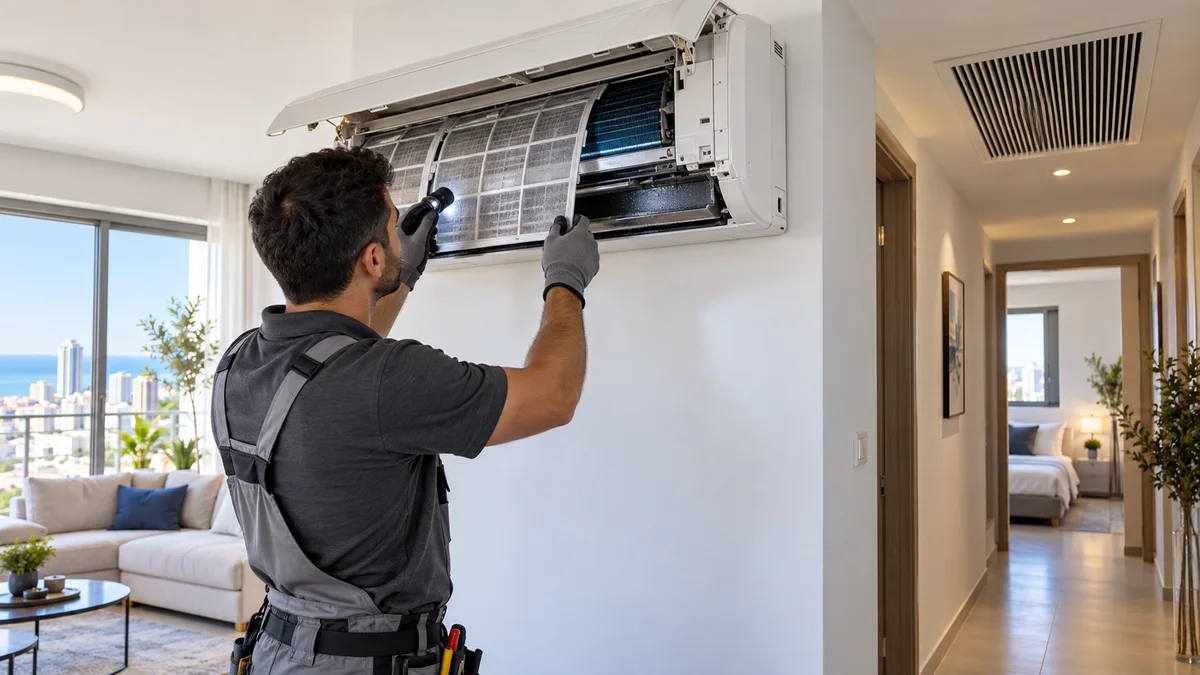
When an air conditioner smells musty, drips into a room or cools poorly, homeowners may be offered a “pipe wash.” That phrase hides several different parts: a removable air filter, cooling coil, condensate pan and drain, air ducts and a sealed refrigerant circuit. A wet ceiling and weak airflow do not have the same cause, and neither is reliably fixed by one universal spray. This guide helps you decide what you can inspect safely, what a technician needs to examine and when a quote for whole-house duct cleaning deserves more evidence.
Israeli homes use wall-mounted split units, mini-central systems that distribute air through a ceiling, and larger systems for spacious flats, offices or shared spaces. A ceiling grille alone does not reveal the full design. Find the model name, manual and access hatch if you have them. Do not open electrical compartments, a closed cooling assembly or refrigerant lines yourself. Turn the system off and request a qualified specialist if water approaches wiring, something smells overheated or a protective breaker trips. Describe the symptom before buying a package of services.
Which “pipe” does someone mean?
The condensate drain carries away water produced as humid air passes a cold coil. A blocked outlet or overflowing tray can cause water to drip from a wall unit or wet drywall above a suspended ceiling. An air duct distributes air between rooms in a mini-central installation; it is not a water pipe. Refrigerant lines join indoor and outdoor equipment in a sealed circuit. They are not flushed with household descaler. If a contractor proposes to clean “the tubes,” ask them to name the component and show what problem was found.
On a wall split, an accessible dust filter can usually be removed without tools, though access to deeper parts varies by model. In a mini-central unit, one filter may be on the return-air grille in the ceiling and another near the internal unit. Tadiran describes this possibility for its systems, so check the actual model before assuming there is only one filter. Several indoor units, zones, dampers or a VRF design make the list of service points longer. A single price “per AC” may not describe the work you need.
Safe checks a homeowner can make
Switch the air conditioner off and follow its manual for removing an accessible filter. Remove loose dust and wash the filter only if that model's instructions permit it. Let it dry completely before reinstalling it. Do not operate the unit without its filter or put the filter back while wet. Wipe an accessible grille gently without pushing dust deeper into the appliance. Electra reminds owners to return washed filters only after they are fully dry. The right inspection interval depends on the model, dust load, people, pets and use; no single calendar rule fits every flat.
Check whether a return opening is blocked by furniture and whether supply grilles are shut. A blocked filter or grille can affect airflow. Photograph the filter before cleaning and observe what changes afterwards. Record which room, operating mode and length of use produces the smell or leak. Photograph fresh moisture on walls or the ceiling. These details make a technician's visit more efficient but do not establish a diagnosis. Stop your own inspection where it requires taking off a panel covering wiring, working at height or opening a ceiling unit.
Dirt beyond the filter
An air filter does not replace attention to the cooling coil, fan and condensate tray. Dirt may collect on damp components, interfere with drainage and contribute to odour. A technician should assess access, show the suspected source and protect electrical parts and finishes before applying water or a cleaner. Ask whether the quote includes the housing, blower, coil, pan and drain, how each part is reached and how operation will be tested after reassembly. “Antibacterial treatment” says little if the person cannot explain physical cleaning and why moisture will no longer linger.
Do not pour bleach, vinegar or foaming household products into a closed air conditioner because an online tip says so. The product may be incompatible with metal, plastic, coil coatings or seals, and an aerosol can be carried into occupied rooms. EPA discusses the unresolved effectiveness and potential problems of biocides and other chemicals inside air ducts. A professional should explain which component the product is meant for, what instructions authorise that use, how residue is managed and when occupants can return.
A condensate leak is a diagnosis, not a stain
If water drips from the unit, photograph where it emerges and check whether a socket, light fitting or switchboard is nearby. Turn the system off when water could contact electricity; do not touch wet electrical components. Possible causes include a blocked drain, poor fall in the line, a damaged pan, ice on the coil or another fault. A wet patch alone does not distinguish these causes. Ask the technician to check the entire route of the condensate and demonstrate that water drains after the repair.
In a mini-central system, water can travel above a suspended ceiling and appear far from the internal unit. Washing the visible stain or painting drywall before the source is fixed will not solve it. Damaged board may need drying or replacement. Decide in advance who provides access to the hatch, protects furniture and restores any opened finish. Our guide to observing hidden leaks shows how to record symptoms, but the AC drain itself should be examined by someone familiar with that equipment.
Does every duct need cleaning?
Dust on the outside of a ceiling grille is not proof of hazardous material throughout the ductwork. EPA's homeowner guide does not recommend routine duct cleaning without evidence as a required annual maintenance task. It suggests considering cleaning when there is substantial visible contamination that is released into the rooms, infestation by pests or apparent growth on hard internal surfaces. If someone claims there is mould, ask to see the location and to identify the moisture source. An appearance alone may not establish exactly what the material is.
Flexible, insulated and porous ducts require different methods from bare metal. Wet or contaminated porous lining may need replacement rather than a harsher wash. Brushing without effective dust collection can release particles into living rooms, while careless equipment may damage a duct. Ask what material is present, how access will be obtained, how furniture and occupants will be protected, how loosened dust will be captured and how the result will be documented. Before-and-after images should show the same identifiable section. Avoid approving biocides or ozone as a routine add-on “just in case.”
Why larger systems need a more detailed brief
A mini-central unit often sits behind a dropped ceiling and serves several rooms. Tadiran explains that its installation requires planned air channels and a condensate outlet, while maintenance includes filter access and keeping airflow clear. A large apartment or office may have more zones, motorised dampers, long flexible runs and several service hatches. Seeing one diffuser does not let a cleaner assess every section. A drawing, model list or on-site survey is more useful than a generic promise to clean “all the pipes.”
Climate and use affect the job without creating a universal schedule. Equipment may run longer during a hot period; humid coastal conditions can make condensate management important; and renovation dust can quickly load filters. These are reasons to observe your system, not proof that every Israeli flat needs annual chemical treatment. Protect air grilles during building work and avoid operating a system in active construction dust. EPA advises limiting the entry of renovation dust into ducts.
What to ask for in a quote and at handover
Give the model, type of system, number of indoor units and rooms, access points, date of the last filter clean, symptoms and photographs. Compare proposals only if they specify the same scope: filters, grilles, coil, fan, pan, drain, accessible ducts and an operating check. Request separate prices for diagnosis, opening ceiling finishes and adding access. A complex mini-central or VRF installation calls for a technician experienced with that system. A regular cleaning crew can handle the room and accessible grilles, but should not imply that it services the sealed refrigeration circuit.
After service, confirm that filters are reinstalled, panels are closed, airflow has returned, condensate drains and the block and ceiling remain dry. Request images of what was found, a list of actions and products used, and a model-specific recommendation for the next inspection. If the unit drips or smells again the next day, report the mode and timing to the contractor. A fragrant room is not proof that the underlying cause has gone away.
The practical rule is simple: maintaining accessible filters and addressing identified dirt make sense; large ducts and closed assemblies should be handled according to condition and system design. A condensate drain, air duct and refrigerant circuit are three different things. A useful job starts with a precise symptom and model and ends with an operating check and no new moisture.
Internal links
Useful pages on this topic
Frequently asked questions
- Can I wash the air conditioner filter myself?
- Yes, if it is accessible and your model instructions permit washing. Switch the unit off and reinstall only after the filter is fully dry.
- Why does the AC still drip after cleaning?
- A blocked drain, damaged pan, poor fall or another fault may be involved. The full condensate route needs checking, not another fragranced spray.
- Must all ducts be cleaned every year?
- Not automatically. Decide from visible contamination, moisture, pests, duct material and inspection findings; EPA does not recommend mandatory annual cleaning.
- How is a drain different from refrigerant lines?
- The drain carries water from the condensate pan. Refrigerant lines form a closed cooling circuit and are not flushed with household cleaner.