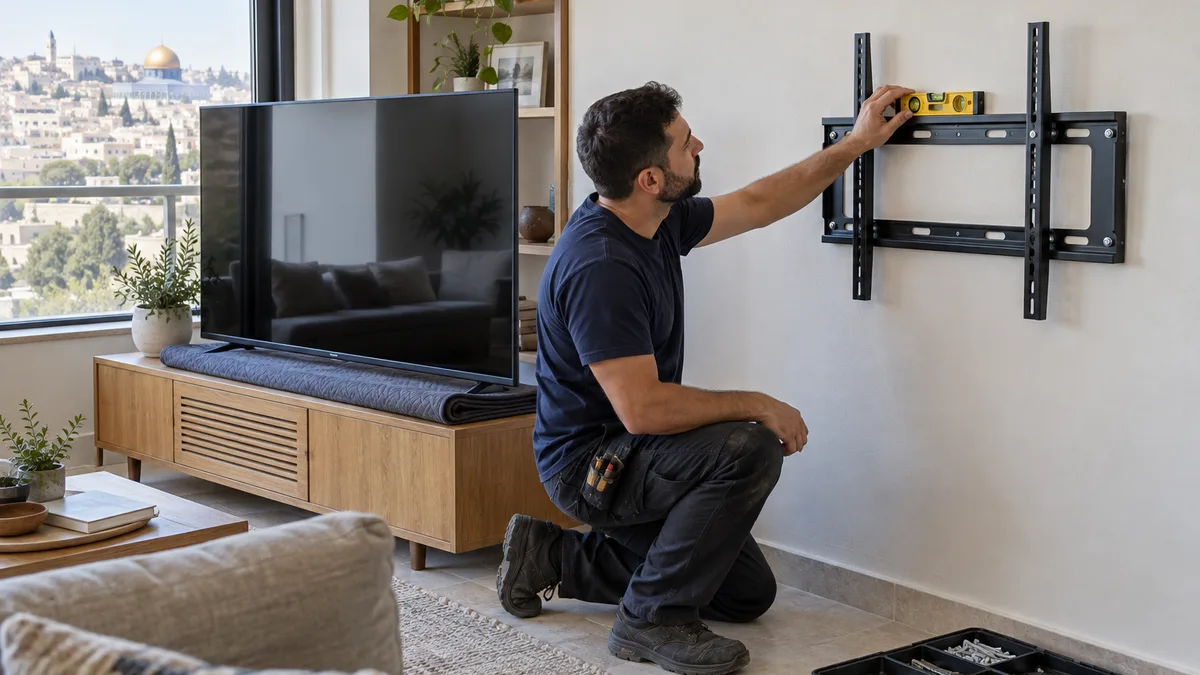
Mounting a television can look like a small job: buy a bracket, drill holes and lift the screen. But the same white paint in an Israeli apartment can cover concrete, solid or hollow blockwork, a partition or drywall lining. Fixings suitable for one substrate cannot automatically be used in another.
This guide helps prepare a service request, choose the mount, agree screen position and inspect the result. It applies to living rooms, bedrooms, rented apartments and drywall walls. Installation depends on the TV model, mount instructions and wall condition. “Universal” on a box does not replace checking all three.
Before buying the bracket
Find the television’s exact model and documentation. Check its weight without the stand, VESA pattern, permitted screws and port locations. Screen diagonal does not establish load or compatibility. Televisions of similar size can differ in weight, rear-panel shape and installation requirements.
- TV model, weight and VESA pattern.
- Wall type and condition at the intended position.
- Fixed, tilting or articulating mount preference.
- Sofa distance, furniture and normal viewing position.
- Power, internet, cables and external devices.
- Responsibility for buying the bracket and fixings.
If you have already bought a mount, send its packaging and instructions. If not, ask the installer to assess the wall and agree a suitable model first. Returning an unsuitable unopened product is easier than dealing with drilled holes and an attempted installation. Do not assume the fixings in the box suit every wall.
Fixed, tilting and articulating mounts
A fixed mount holds the television close to the wall but may restrict access to ports. A tilting mount adjusts the vertical angle within its specified limits. An articulating mount moves the screen outward and sideways, adding demands on the supporting wall and fixing system. Choose according to actual viewing needs.
For an extending arm, consider loading during extension and movement, not only the screen’s weight when folded flat. Ask to see substrate, weight and size limits in the instructions. A long arm should not be chosen merely for convenient cleaning if the wall and mounting arrangement have not been established as suitable.
Concrete walls
Concrete may provide an appropriate substrate for a manufacturer-approved system, but the location still needs assessment. Hidden services, reinforcement, surface condition and anchor parameters matter. A plaster finish is not the structural substrate. A fixing supported only by loose finish does not establish secure TV mounting.
Drilling must avoid pipes and wiring. Tell the installer about water points on the other side, sockets, the distribution board and known routes. Plans and renovation photographs help but do not guarantee that no services are present. An unexpected obstruction requires assessment rather than extra pressure or randomly moving the hole.
Blocks, hollow construction and wall coverings
Block type, cavities, thickness and condition affect the fixing choice. One plastic plug is not a solution for all masonry. The installer should choose a system for the actual substrate and mount, following product requirements. Tile or stone covering also needs appropriate handling, without substituting an assessment of the finish for the underlying wall.
Do not identify construction only by tapping it. Hollow block and a lining in front of concrete can sound similar while requiring different solutions. State that the substrate is unknown if that is the case. A preliminary quote can remain conditional on inspection; agree how reinforcement or a change of location would be approved.
Mounting a television on drywall
Assess the partition construction, framing, reinforcement and approved installation system. A sheet alone, a frame and a prepared structural backing are different supports. A random collection of anchors is not sufficient merely because a screen seems light. An articulating arm particularly needs assessment in its working positions.
The SANUS BLT2 instructions, for example, prohibit mounting that product into drywall alone. That is a limit of the specific product, not a universal ban on every mounting system. Verify your particular bracket, fixings and wall construction.
If reinforcement is needed, agree who opens the lining, prepares support and restores the finish. A basic mounting price may exclude those stages. The drywall guide provides background, while drywall specialists can assess preparation work. Get the mounting and preparation responsibilities coordinated before the television is lifted.
Choosing the screen height
Assess position from your usual seat on the sofa or bed. Mark the approximate screen outline with suitable tape and consider visibility, furniture and circulation. The screen’s top edge and centre are different reference points. Agree exactly which point the installer is measuring before drilling begins.
There is no single correct floor height for every room. Consider viewing distance, tilt, glare, children and walking routes. A bedroom arrangement differs from a living room. Do not copy a showroom installation where people usually stand. Check that the screen will not block controls, furniture use or access to a nearby cupboard.
Cables and ports
List power, antenna, internet, console, sound equipment and other devices before fitting. Rear-facing sockets may need additional space. A very close mount can obstruct connectors. An articulating arm needs routing that avoids tension and pinching through its permitted movement. Cable planning should happen with the chosen mount, not afterwards.
A suitable external channel or an appropriately prepared concealed route can provide a tidy finish; these are separate scopes. Do not hide an ordinary power lead in a wall without checking whether the arrangement is permitted. Fixed sockets and wiring changes require suitable current authorisation, as explained by Israel’s Ministry of Labor.
Mamad and other special locations
A protected room should not be treated as an ordinary partition for every alteration. Channels, structural intervention and services need separate assessment according to the room’s purpose and applicable requirements. State that the room is a mamad and do not include wall chasing as a routine minor part of a TV installation.
Read the protected-room work guide when preparing the request. If wall condition, dampness or cracking is uncertain, establish mounting feasibility first. A bracket should not simply conceal an unresolved defect or transfer load into damaged lining without assessment.
What belongs in the installation price?
Agree inspection, layout marking, appropriate fixings, bracket installation, lifting, retention checks and cleanup. List the bracket itself, reinforcement, furniture preparation, a new socket, cable concealment and wall restoration separately. Larger screens may require an additional person and suitable handling conditions.
Use handyman price references for an initial comparison, then compare equivalent conditions. Ask about VAT, buying parts, removal of the old setup and extras for an unknown substrate. A diagonal-only quote without questions about the wall and bracket leaves major details unresolved.
Preparation before the visit
- Clear the work area and screen-carrying route.
- Prepare the model, instructions and complete mount kit.
- Photograph the wall and its other side where accessible.
- Share known services and renovation history.
- Agree the approximate location and height.
- Prepare cables and a connected-device list.
- Confirm lifting assistance and removal requirements.
Do not lift a heavy screen alone or leave it balanced on a furniture edge. Follow the model’s handling guidance and prepare a protected storage position. In a rented apartment, agree holes and later restoration with the owner before work. Avoid promising that an unknown wall needs only a few ordinary plugs.
Handover checks
Ask the installer to demonstrate screen retention, specified locks and how removal would be handled safely in future. Check allowed movement, level and cable slack together. Inspect mounting areas, finishes and access to connectors. Do not test strength by hanging from the bracket or adding your own load.
Connect the agreed equipment and verify that needed ports remain accessible. Keep the bracket model, instructions and work description. Ask about extension limits, permitted position and future TV replacement. A heavier replacement needs a new compatibility assessment, even if its holes fit the same VESA pattern.
If the screen becomes loose afterwards
A changed position, crack near a fixing, unusual sound or looseness calls for stopping movement and contacting the installer. Do not tighten random screws or attempt to remove a heavy screen from an unfamiliar mechanism. Explain when the change appeared and send photographs from a safe position.
Wall repair or new moisture can also require reassessment. The operating load depends on substrate condition as well as the metal bracket. Moving the system to another room is a new installation: old holes and reused hardware are not automatically suitable. Tell the installer about changes to both screen and wall.
Example: new TV in a drywall living room
The resident wants a large screen on a long arm but does not know whether the wall contains backing. A useful first request gives the exact model, photograph and desired movement. The installer assesses the construction and mounting system before promising a standard installation. If preparation is needed, its opening and restoration are quoted separately.
Compare that with a ready reinforced position where the original construction documents identify the support. It may need different work despite an identical television. The lesson for the request is practical: send both equipment details and wall information, and allow the final method to follow the assessment.
Writing your KABLAY request
“Ramat Gan, TV model and weight attached. Wall believed to be blockwork, exact construction unknown. Want an articulating mount, not bought yet. Existing socket; prefer an external cable channel. Height to be confirmed on site. Please quote fitting, bracket and approval terms for extras after inspection.” Add preferred language and access times.
Open handyman services or a TV mounting request. For a new electrical point, discuss an electrician separately. Detailed information helps compare the proposed work and agree an installation suited to your equipment and wall.
Internal links
Useful pages on this topic
Frequently asked questions
- Can a TV be mounted on drywall?
- It depends on construction, reinforcement and the permitted mounting system. Assess wall, bracket and load; the word drywall alone is not enough.
- Does screen size determine the bracket?
- Also check weight, VESA, screw requirements, rear-panel shape and wall compatibility.
- What is the correct mounting height?
- Agree height from viewing position, screen dimensions, furniture and room use. Confirm the measurement reference before drilling.
- Is cable concealment included?
- Not automatically. Channels, concealed routes, a new socket and wall restoration are separate agreed scopes.