🏗️Drywall
Drywall in Israeli Apartments 2026: Board Types, What to Build, Prices & Common Mistakes — Full Guide
By KABLAY Editorial · · 12 min read
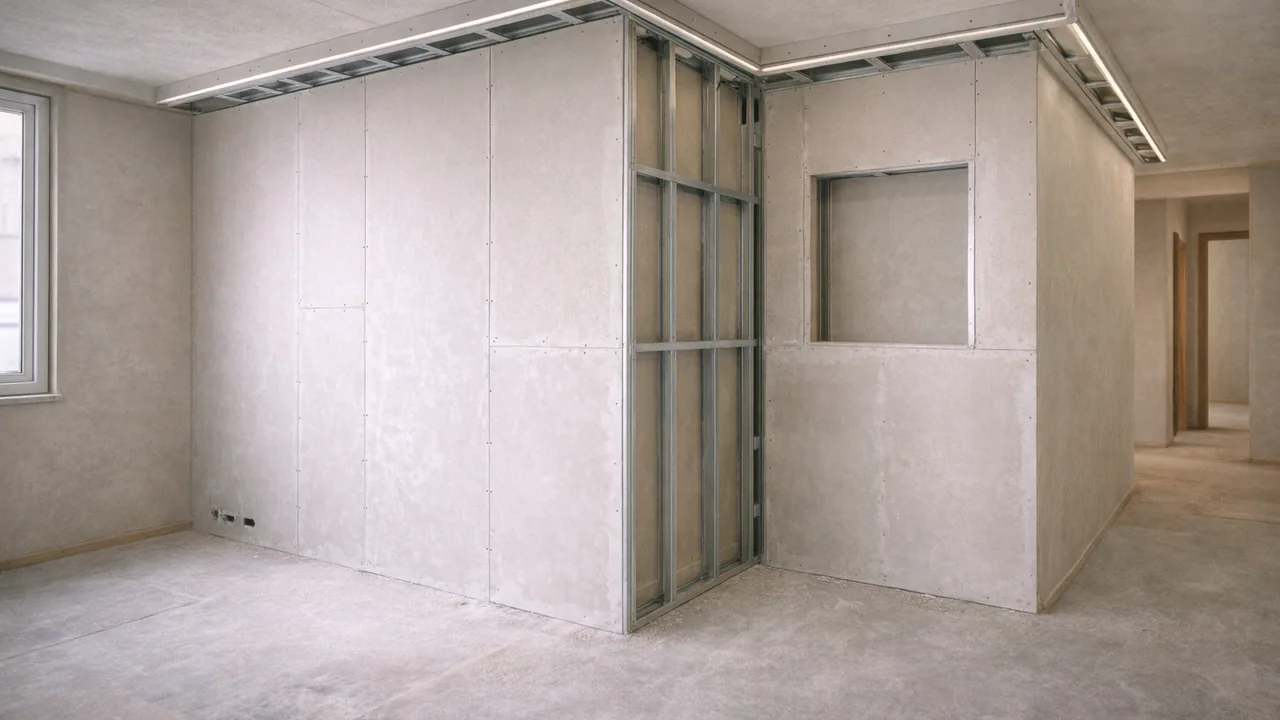
Drywall (גבס in Hebrew, sometimes called drywol) is one of the most versatile materials in Israeli renovations. With drywall you can split a studio into two rooms in 1-2 days, hide an ugly riser pipe, build a floating ceiling with LED strip lighting, or construct a built-in wardrobe — all without dust clouds or concrete work.
But under that simplicity lie real pitfalls: the wrong board type in a bathroom will swell within a year; the wrong stud spacing will leave the wall flexing every time you slam a door. This guide covers everything you need to know about drywall in an Israeli apartment in 2026: from board types to prices to mistakes to avoid.
What drywall is and why it dominates Israeli renovations
Drywall is a gypsum core sandwiched between two layers of dense cardboard. Standard Israeli sheet sizes: 120×260 cm or 120×300 cm, thickness 9.5, 12.5, or 15 mm.
In Israeli conditions (heat, coastal humidity, seismic zone) drywall offers three killer advantages:
- Speed: a partition goes up in one day vs. a week for block masonry
- Weight: does not overload slabs — critical in older buildings and upper floors
- Flexibility: any shape is possible — arches, curved niches, multi-level ceilings
Drywall board types: which one goes where
Israeli suppliers (Home Center, ACE, Kelei Binyan Levi) carry four main types. Picking the wrong one is the most common and most expensive drywall mistake.
1. Standard (white) — גבס לבן
Default board for dry rooms: living room, bedroom, hallway. Price: ₪45-65 per sheet (120×260).
- Use for: partitions and ceilings in dry rooms
- Do NOT use for: bathrooms, kitchens near the sink, unglazed balconies
2. Moisture-resistant (green) — גבס ירוק / עמיד ללחות
Impregnated with a hydrophobic additive. Price: ₪60-85 per sheet. Under tile in a bathroom — mandatory.
- Use for: bathrooms (not the direct shower contact zone), kitchens, laundry rooms, balconies
- Critical: green board is NOT waterproof! Inside a shower niche use a cement board like Aquapanel or an Aqua-board sheet
3. Fire-resistant (pink) — גבס ורוד / עמיד אש
Reinforced with fiberglass and vermiculite. Withstands direct flame for 30-90 minutes. Price: ₪75-110 per sheet.
- Use for: walls around the mamad (safe room), electrical panels, party walls between apartments, kitchens near the gas range
- Code note: in multi-unit buildings, walls between apartments often legally require fire-rated board
4. Acoustic (blue) — גבס כחול / אקוסטי
Higher density (up to 12 kg/m² vs. 8 for standard), often with mineral fibers. Price: ₪90-140 per sheet.
- Use for: bedrooms in noisy areas (near highways), home studios, shared walls with neighbors
- Real impact: 8-12 dB noise reduction vs. standard board — noticeable, not magic
Pro tip: for maximum sound blocking, build the wall with two boards on each side (one acoustic + one standard) with Rockwool mineral wool in between — gives up to 55 dB isolation.
Metal framing: what to know
Drywall alone is just the skin. The whole structure rides on metal profiles. Two standards are used in Israel:
European standard (Knauf, Rigips)
- CW (C-wall): vertical stud 50/75/100 mm — for walls
- UW (U-wall): track profile — attaches to floor and ceiling
- CD: ceiling stud
- UD: ceiling track
Stud spacing — the critical parameter
- 60 cm spacing: standard for residential partitions
- 40 cm spacing: for walls carrying heavy cladding (tile, stone veneer) or hung furniture
- 30 cm spacing: for shower niches, heavy-load shelving
Red flag: if your contractor sets studs at more than 60 cm — the wall will flex. Demand the standard.
What you can build with drywall: 10 ideas
1. Room-splitting partitions
The most common use. Split a studio into a bedroom and living area, carve out a home office, create a walk-in closet. Finished partition thickness: 10-12.5 cm.
2. Drop ceilings
A flat finish over an uneven slab, the ability to hide utilities (A/C lines, vent ducts), and clean integration of recessed lights and LED strips.
3. Multi-level ceilings
Visual zoning: lowered zone above the sofa, higher above the dining table. Eats 7-15 cm of ceiling height — watch out in low-ceiling apartments.
4. Niches and built-in shelves
TV niches with backlighting, shelves above the bed, decorative recesses for vases or art. Fully custom dimensions.
5. Arches and curved forms
Instead of a rectangular doorway — an arch. Instead of a straight wall — a soft curve. Made using flexible 6.5 mm drywall.
6. Built-in wardrobes
Skip the freestanding closet — build a floor-to-ceiling wardrobe from drywall. Saves space, looks like architecture.
7. Hiding utilities
A box around bathroom risers, a chase for A/C cables, a cover for the kitchen gas line. Always include an access panel for shut-off valves.
8. Sound-dampening neighbor walls
If you share a wall with noisy neighbors, add a second drywall layer with Rockwool or Isover wool. You lose 5-7 cm of floor area but gain noticeable quiet.
9. Window and door reveals
After new PVC windows go in, the reveals are often finished with drywall — faster and cleaner than plaster.
10. Decorative and 3D accent walls
A trending solution: 3D geometric shapes on an accent wall, backlit niches, faux brick textures.
Drywall pros
- Fast installation: a 10 m² partition in 1-2 days vs. a week for block
- Clean process: minimal dust and debris
- Lightweight: 10-12 kg/m² vs. 150-200 kg/m² for block walls
- Runs utilities inside: cables, thin pipes
- Excellent base for paint or wallpaper
- Easily repaired: cut, patch, skim-coat, paint
- Sound and thermal insulation when stuffed with mineral wool
Drywall cons
- Low load-bearing capacity: without blocking, each anchor holds 15-25 kg max
- Water-sensitive: even moisture-resistant board fails under direct water contact
- Less sound isolation than solid block walls (without special solutions)
- Vulnerable to impact: an elbow can punch through
- Demands quality install: a crooked frame means a crooked wall forever
2026 prices: what drywall costs in Israel
Materials (boards themselves)
- Standard white 120×260×12.5 mm: ₪45-65 per sheet
- Moisture-resistant (green): ₪60-85
- Fire-resistant (pink): ₪75-110
- Acoustic (blue): ₪90-140
- Flexible (6.5 mm): ₪65-95
Labor
- Simple partition (one layer each side, no insulation): ₪180-250 per m²
- Sound-insulated partition: ₪250-380 per m²
- Flat drop ceiling: ₪180-280 per m²
- Multi-level ceiling with cove lighting: ₪320-550 per m²
- Standard niche or chase: ₪400-900 each
- Arch: ₪600-1,500 depending on complexity
- Built-in drywall wardrobe (no doors): ₪1,800-4,500
Example: 10 m² partition with a door opening
- CW/UW profiles: ~₪350
- Boards (8 sheets, two sides): ~₪450
- Rockwool mineral wool (10 m²): ~₪350
- Fasteners, mesh tape, joint compound: ~₪200
- Labor: ~₪2,500
- Total: ~₪3,850 (₪4,000-6,000 with acoustic upgrade)
Soundproofing with drywall: what actually works
A big expectation of drywall walls is silence. But a thin single-layer partition blocks only 30-35 dB — you will hear your neighbor's conversation.
For real quiet:
- Two drywall layers on each side (total wall thickness 15-17 cm)
- Fill with Rockwool Acoustic or Isover Saint-Gobain (not polystyrene foam!)
- Rubber damping tape between profile and floor/ceiling
- Acoustic sealant at the perimeter (not polyurethane foam)
Such a wall delivers 50-55 dB isolation — you effectively stop hearing neighbors.
7 common mistakes that force redo work
- Green board instead of Aquapanel in the shower. Green is not made for direct water contact — mold appears in 6-12 months
- Stud spacing of 80-90 cm instead of 60. Wall flexes under load, tile cracks
- No blocking for TV or hanging cabinets. Hanging weight on bare drywall without a wooden block or steel plate = everything falls off within a year
- Skimping on joint finishing. Without proper mesh tape and compound, seams crack
- Polyurethane foam in gaps instead of acoustic sealant. Destroys sound isolation
- Polystyrene foam as filler. Zero sound performance, fire-safety issues — use mineral wool only
- No access panel at riser pipes. In 2 years you will need access — and have to tear out the whole structure
How to choose a drywall contractor in Israel
- Request photos of finished jobs — especially corners, joints, reveals. Corner quality reveals the skill level
- Specify profile brand (Knauf, Rigips, Yaron) — cheap no-name profiles are often under-spec and flex
- Ask about stud spacing and board thickness — a good contractor answers immediately with reference to load
- Request an itemized quote: materials separate, labor separate, finishing separate
- Clarify who handles electrical/plumbing inside the wall — sometimes the drywall contractor frames, then the electrician comes, then closes up. Sequence matters
Conclusion: when drywall is the right call
Drywall is ideal for: partitions in dry rooms, ceilings, niches, decorative elements and anywhere speed and cleanliness matter. It is a poor fit for: walls that will carry unplanned heavy loads, direct-contact shower zones, locations with high mechanical impact.
KABLAY is a marketplace connecting clients with independent specialists. KABLAY does not guarantee availability, the number or timing of responses, licensing, documents, price, quality, or outcome; check the specialist and proposed terms before contracting.
Internal links