🔧Plumbing
Weak water pressure in Ashkelon 2026: upper floors, old risers, pumps and pressure reducers
By KABLAY Editorial · · 12 min read
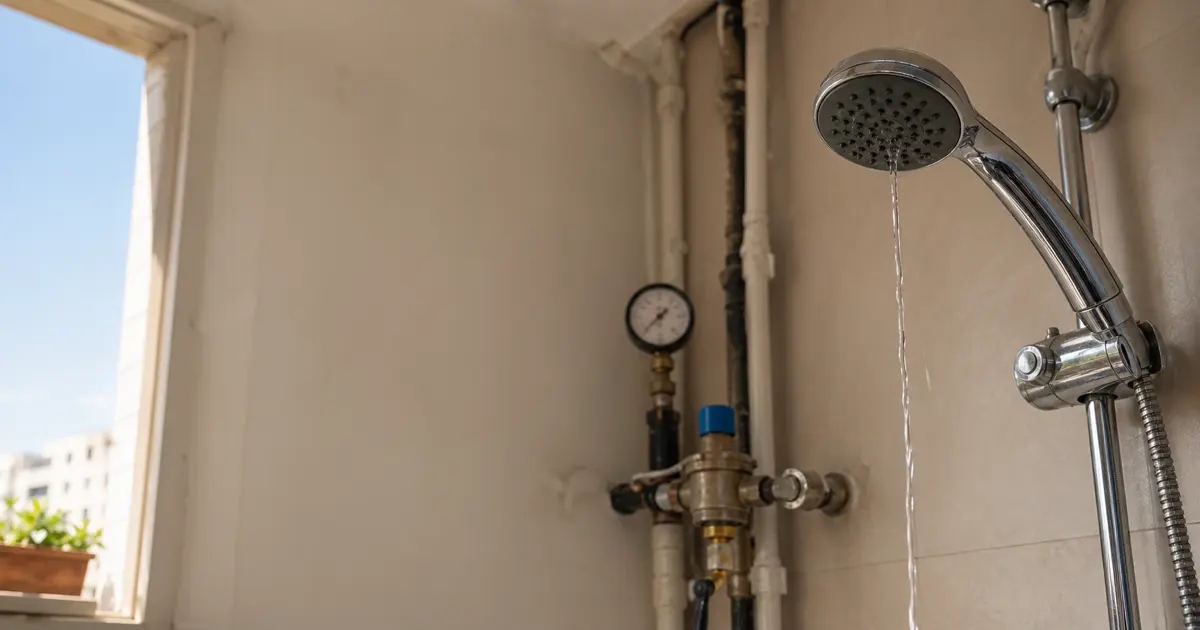
Weak water pressure is one of the most frustrating plumbing issues in Ashkelon: there is no flood, no burst pipe, but every shower becomes a struggle. Sometimes the flow is weak only on hot water, sometimes only in the evening, sometimes only on floors 5-6, and sometimes across the whole apartment. The expensive mistake is calling all of it "low pressure" and installing a pump without diagnosis. In Ashkelon, because of hard water, older buildings and coastal high-rises, the same complaint can come from five different causes.
This article complements the neighborhood-by-neighborhood plumber guide for Ashkelon and the Ashkelon hard-water guide. Here we focus only on pressure: how to tell whether the problem is inside the apartment, in the riser, the solar boiler, the building pump or the pressure reducer, what you can check yourself, and when you need a plumber with a pressure gauge.
Important: if the water meter moves while everything is closed or you see wet stains, do not start with a pump. Read the guide to thermal leak detection in Ashkelon and the task page for hidden leak repair first.
How water pressure should behave
In a healthy Ashkelon apartment, comfortable working pressure is usually 2.5-4 bar at the taps. Below 2 bar you feel it in the shower, washing machine fill and solar boiler. Above 5-6 bar is the opposite problem: excess pressure wears seals, flexible hoses and toilet mechanisms. So the solution is not always "increase pressure"; often it is to stabilize it.
The symptom tells you a lot
- Weak only on hot water — suspect scale in the solar boiler, boiler outlet or hot-water line. See also the solar water heater guide.
- Weak only at one tap — usually a clogged aerator, flexible hose, angle valve or tap cartridge.
- Weak across the whole apartment — suspect a partly closed main valve, clogged inlet filter, stuck pressure reducer or riser issue.
- Weak mainly in the evening — building or neighborhood demand load, poorly adjusted pump, or pipe diameter too small.
- Weak only on upper floors — building pump, roof tank, pressure zones in a tower or an old riser.
- Flow pulses stronger-weaker — air in the line, faulty pump controller, check valve or vibrating pressure reducer.
Why it is common in Ashkelon
Ashkelon has three profiles that create pressure problems. First: older neighborhoods such as Migdal, Ramat Eshkol, Shimshon and old Barnea, with galvanized or iron piping, internal scale and effective diameter reduced over decades. Second: private homes in Afridar, Neve Dekalim and parts of Marina, with long yard lines, filters, irrigation systems and sometimes a private pump. Third: newer towers in Barnea, Agamim and Marina, with staged pressure systems, building pumps, apartment pressure reducers and developer warranty issues.
On top of all this sits hard water. Scale in Ashkelon does not only dirty the kettle; it narrows small passages: aerators, angle valves, heat exchangers, boiler inlets, filters and valves. Many pressure issues look systemic but are solved by a targeted cleaning.
Checks before calling a plumber
- Compare cold and hot water at the same tap. If cold is strong and hot is weak, do not start with a pump; start with the boiler and hot line.
- Open two taps at once. If the whole apartment drops immediately, the problem is inlet or pipe diameter. If one point is weak, it is local.
- Clean the aerator at the tap end. In Ashkelon, 3-6 months can be enough to clog a small mesh with scale.
- Check main valves: near the meter, at the apartment inlet, under the sink. A half-closed valve creates exactly a "low pressure" symptom.
- Ask neighbors on the same floor and above. If everyone suffers, it is not a private apartment issue.
- Watch the water meter while every tap is closed. If it moves, there is a hidden leak; pressure drop can be a symptom. That calls for leak detection, not a pump.
Common causes and fixes
1. Clogged aerators, filters and angle valves
This is the cheapest and most common fix. A small filter at the tap end or inside an angle valve fills with scale and fine grit. Cleaning or replacement costs little and prevents an unnecessary pump job.
- Cleaning aerators across the apartment: ₪150-300
- Replacing an angle valve: ₪180-350 each
- Replacing a clogged or swollen flexible hose: ₪120-280
2. Scale in the solar boiler or hot-water line
If only hot water is weak, in Ashkelon the first suspect is the solar boiler. Scale builds in the tank bottom and outlets, especially in boilers older than 8 years. Sometimes cleaning or replacing the flange/element is enough; sometimes the boiler is near end of life.
- Boiler and hot-pressure inspection: ₪200-350
- Chemical flush or descaling: ₪400-800
- Flange/element replacement with cleaning: ₪450-900
- Solar boiler replacement, 150-200L in Ashkelon: ₪3,800-7,500
3. Old riser or narrowed galvanized piping
In older buildings, the original pipe can look fine from outside and be half-blocked inside. Chemical cleaning can help temporarily, but if the diameter has narrowed substantially, the real fix is replacing a section or the riser.
- Pressure measurement and line check: ₪250-500
- Targeted descaling of an apartment line: ₪500-1,200
- Replacing a pipe section inside the apartment: ₪1,200-4,500
- Building riser replacement: ₪12,000-45,000, depending on height and access, usually through the building committee
4. Weak or poorly adjusted building pump
In buildings of 5+ floors, and especially towers, pressure depends on a pump, frequency controller, tank or pressure zones. If the issue appears on upper floors or at peak hours, do not install a private pump before checking the building system. A private pump can solve a symptom but also draw air, create noise and disturb neighbors.
- Building pump and controller inspection: ₪400-900
- Pressure controller adjustment / pressure switch replacement: ₪500-1,500
- Small apartment booster pump: ₪1,500-3,500
- Building pump or new pressure system: ₪8,000-35,000
5. Stuck pressure reducer
A pressure reducer protects an apartment from excess pressure, especially in towers and areas with pressure swings. When it sticks partly closed, the whole apartment receives weak flow. When it sticks open, excess pressure damages seals and causes leaks. Measure before replacing.
- Pressure measurement before/after reducer: ₪200-350
- Apartment pressure reducer replacement: ₪450-1,200
- High-grade reducer for tower/main inlet: ₪900-2,500
By Ashkelon neighborhood
- Migdal, Ramat Eshkol, Shimshon — first suspect: old risers and piping, scale and narrowed diameter. Involve the building committee if more than one apartment is affected.
- Afridar and Neve Dekalim — check yard line, inlet filter, irrigation, private pump and hidden underground leak.
- New Barnea, Agamim, Marina towers — check developer warranty, apartment pressure reducers and building pumps before private work.
- Vacation apartments in Marina — after months closed, filters and taps clog with grit and scale; start with cleaning and flushing lines.
What not to do
- Do not install a pump before measuring pressure in bar.
- Do not acid-clean old piping without understanding pipe condition; it can open a hole instead of fixing pressure.
- Do not replace a boiler just because "hot flow is weak" before checking outlet, valve and inlet.
- Do not work privately on a shared riser without building committee approval.
- Do not ignore pressure that is too high: it is just as damaging as low pressure.
How a professional plumber diagnoses it
Good diagnosis starts with a pressure gauge, not a guess. Measure near the water meter, after the pressure reducer, at a near tap and a far tap, on hot and cold water. If needed, remove aerators, check angle valves, inspect the boiler and compare with neighbors. If a hidden leak is suspected, move to acoustic or thermal leak detection; if the concern is a sewer line, see the sewer camera guide — but note that sewer cameras do not diagnose fresh-water pressure.
Summary
In Ashkelon, weak water pressure is not one failure but a family of failures. On an upper floor of an older block it may be narrowed piping; in a new tower it may be a pressure reducer; in a private Afridar house it may be a yard-line leak; and on hot water only it is usually the boiler or scale. The right order is: measure, isolate, then repair.
KABLAY is a marketplace connecting clients with independent specialists. KABLAY does not guarantee availability, the number or timing of responses, licensing, documents, price, quality, or outcome; check the specialist and proposed terms before contracting.
Internal links
Useful pages on this topic
Frequently asked questions
- Can I install a private booster pump in an upper-floor apartment?
- Yes, but only after pressure measurement and checking that the issue is not the building pump or shared riser. A wrong private pump can create noise, draw air and affect neighbors. In a shared building, building committee approval is advisable.
- Why is only the hot water weak?
- In Ashkelon, this is usually scale in the solar boiler, the boiler outlet or the hot-water line. Start with boiler, valve and outlet checks before replacing a pump or piping.
- How much does water-pressure diagnosis cost in Ashkelon?
- A basic pressure check with a gauge usually costs ₪200-500. If the plumber needs to inspect a building pump, boiler, pressure reducer and several points, it can reach ₪400-900.
- Can a pressure reducer cause weak flow?
- Yes. If it sticks partly closed, the whole apartment feels low pressure. If it sticks open, pressure becomes too high and leaks appear. That is why pressure is measured before and after the reducer.
- Who pays if the problem is in the riser?
- A shared water riser is usually common building property, so payment goes through the building committee and is divided between owners under the building rules. A private line inside the apartment is the owner responsibility.