🔧Plumbing
Thermal leak detection in Ashkelon 2026: plumber diagnosis without unnecessary demolition
By KABLAY Editorial · · 11 min read
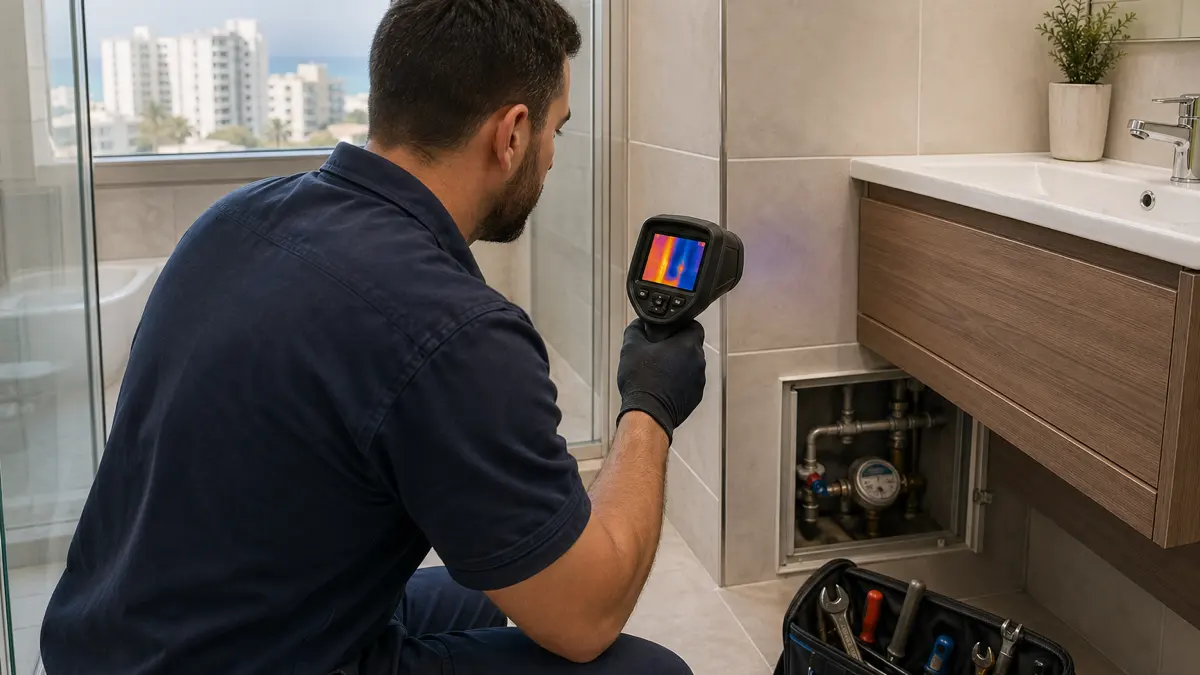
A leak in an Ashkelon apartment does not always look like water on the floor. Often it hides behind tile, inside a drywall partition, under flooring, around concealed plumbing or inside the fill layer below a shower. The owner sees only indirect signs: a yellow ceiling stain, a musty smell, dark grout, swollen flooring, a rising water bill or a complaint from the neighbor below.
In these cases, a thermal camera is one of the most useful tools a professional plumber can bring. It does not photograph the pipe through the wall like an X-ray. It shows temperature differences on the surface. Moisture, evaporation, leaking hot water or an area cooled by water can create a thermal signature that guides the diagnosis.
Useful links before booking: to compare local specialists, open plumbing in Ashkelon; if you already suspect a concealed issue, continue to hidden leak repair. For broader city context, also read the neighborhood-by-neighborhood Ashkelon plumber guide.
Why this matters specifically in Ashkelon
Ashkelon combines several leak-risk factors: coastal humidity, many fully tiled apartments, older buildings with partially renovated piping, and new districts with concealed plumbing behind walls and floors. Near the sea, early moisture signs can be mistaken for condensation, so a real leak may be missed for weeks.
In older neighborhoods such as Migdal, Ramat Eshkol and Shimshon, the cause may be aging piping or a connection that has worked for decades. In Afridar, Neve Dekalim and Marina homes, yard lines and private underground infrastructure also matter. In Agamim and new Barnea, it is worth checking developer warranty and building pressure systems before private demolition.
What a thermal camera can and cannot do
A thermal camera helps identify unusual cold or warm areas, the direction of moisture spread, and suspicious zones around a solar boiler, shower, wall-hung toilet, sink, hot-water line or wet ceiling. It is excellent for narrowing the search area and choosing a precise opening point.
But expectations should be accurate: the camera does not see water directly and does not prove the source by itself. A thermal bridge, air conditioning, sunlight on an exterior wall, a void behind a cabinet or old moisture can look similar. A serious plumber combines thermal imaging with water-meter checks, a moisture meter, pressure testing, trap inspection, shower sealing tests and sometimes acoustic detection.
Where thermal imaging is useful
- Hot-water pipe leaks inside a wall or floor.
- Moisture under bathroom, shower or toilet tiles.
- Leaks around concealed wall-hung toilet frames.
- Water spreading under flooring after a burst pipe or waterproofing failure.
- Ceiling stains after a leak from the apartment above.
- Suspected leakage when the water meter moves while all taps are closed.
- Kitchen, washing machine, dishwasher, trap and tap-connection checks.
How a professional inspection works
The visit starts with a short interview: when the sign appeared, whether it is growing, whether a neighbor complained, whether the bill rose, and whether the issue appears after a shower or only with hot water. Then the plumber checks the simple points: trap, flexible hoses, angle valves, grout, silicone around the bath, boiler and water meter.
Only then does the thermal scan begin. The plumber scans walls, floors and ceilings. If the suspicion is a hot-water line, the line may be warmed by running hot water for a few minutes and watching the heat path. If the suspicion is cold moisture, the plumber looks for areas where evaporation cools the surface. The result should be practical: the risk zone, how confident the finding is, and what should be opened or tested next.
Signs that justify a thermal leak check
- The water meter keeps moving when all taps are closed.
- The water bill rose without a change in use.
- There is a musty smell in the bathroom, toilet or kitchen.
- A new stain appeared on a wall, ceiling or near skirting.
- Grout darkened or started crumbling.
- The neighbor below reports water marks.
- Laminate, parquet or kitchen cabinetry started swelling.
2026 prices in Ashkelon
A basic thermal inspection inside an apartment usually costs ₪400-900, depending on apartment size and the number of areas. Complex leak location with a moisture meter, pressure test or insurance-ready report can cost ₪900-1,800. If opening and pipe repair are needed, that is a separate job: a small pipe-section replacement may start around ₪800-2,500, while more complex floor or wall work can cost more.
What to ask the plumber
- A clear explanation of what the thermal image shows and what remains an assumption.
- Photos before opening, especially if insurance or a neighbor is involved.
- Water-meter and pressure checks before any demolition recommendation.
- A written quote if the repair is more than a small job.
- Warranty on the pipe repair, not only on the diagnosis.
Conclusion
A thermal camera does not replace plumbing experience, but in Ashkelon it can prevent a lot of unnecessary breaking. It helps show where moisture is active, how it spreads and whether the likely cause is piping, waterproofing or an external source. The right order is not guessing and not breaking immediately: measure, scan, check pressure and meter, then open only the targeted area.
KABLAY is a marketplace connecting clients with independent specialists. KABLAY does not guarantee availability, the number or timing of responses, licensing, documents, price, quality, or outcome; check the specialist and proposed terms before contracting.
Internal links
Useful pages on this topic
Frequently asked questions
- Can a thermal camera see pipes through a wall?
- No. It sees surface temperature differences. If a hot pipe or moisture creates a thermal signature, the plumber can infer a suspicious zone, but it still needs confirmation with other checks.
- How much does thermal leak detection cost in Ashkelon?
- A basic check usually costs ₪400-900. A complex location job with a moisture meter, pressure test or insurance report can reach ₪900-1,800, not including pipe repair.
- When is thermal imaging not enough?
- When the leak is very small, the surface is thick, the room is evenly heated, or the moisture source is not active during the visit. Then the plumber combines a moisture meter, pressure test or acoustic detection.
- Do I have to break tiles after the inspection?
- Not always. The goal is to narrow the area. Sometimes the issue is a trap, silicone joint or visible connection. If opening is needed, it should be more targeted.