🔧Plumbing
Plumber in Ashkelon 2026: Afridar, Migdal, Agamim, Marina — a neighborhood-by-neighborhood guide with prices
By KABLAY Editorial · · 13 min read
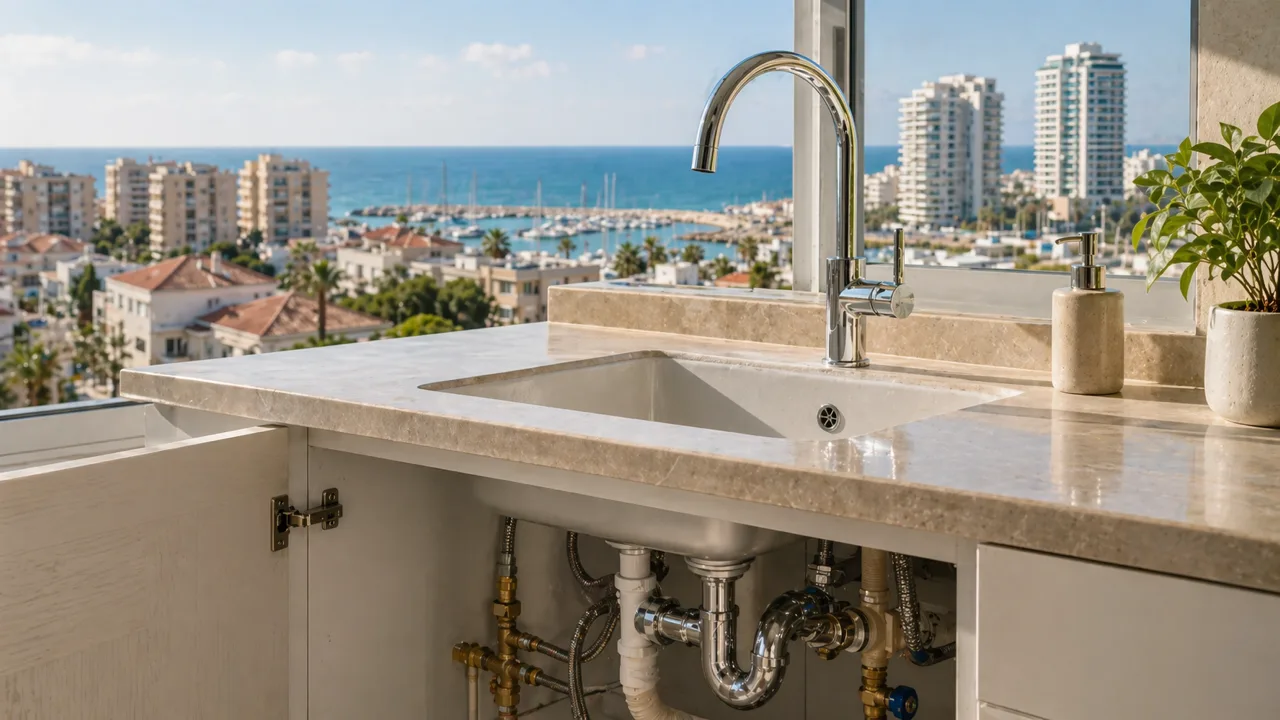
Ashkelon looks like a single city on the map, but plumbing-wise it's at least six distinct cities. Each was built in a different decade, with a different construction type and a different water infrastructure. That means a plumber who excels at servicing a 1975 shikun doesn't necessarily know how to work on a 25-floor Barnea tower; and a tradesman who works in Marina Ashkelon's private villas won't know the nuances of a 1951 Afridar cottage.
This guide breaks Ashkelon down by neighborhood, explains the plumbing problems typical to each area, gives 2026 prices (15-25% below Tel Aviv), and explains how to pick a plumber who specifically knows your building type. It complements the Ashkelon hard water guide — that one focuses on the water chemistry; this one — on the geographic and structural profile of the city.
If the reason for calling a plumber is moisture or a rising water bill: also open the dedicated guide to thermal camera leak detection in Ashkelon and the task page for hidden leak repair.
1. Ashkelon's unique profile
- Some of the hardest water in Israel — 300-400 mg/L calcium. This affects everything: solar boilers, mixers, washing machines. (For protection detail see the dedicated hard-water guide.)
- Sandy-kurkar soil — unlike Tel Aviv (brown soil) and Haifa (rock), Ashkelon sits on fine sand + kurkar shell rock. This affects underground piping: sand movement can cause small cracks in main sewer piping every 15-25 years.
- Sea air without heavy industry — less aggressive than Hadera (which has Orot Rabin), but still warm-salty most of the year. Corrosion of solar boilers and outdoor taps — common.
- IDE Ashkelon desalination plant — one of the world's largest. Water quality is mostly stable, but during maintenance windows there can be small deviations in hardness and taste.
- Cyclical rocket fire since 2001 — affects plumbing mainly through mild vibrations that shorten the life of seals and connections. In areas where rockets landed — pinpoint damage to piping.
2. Neighborhood breakdown
Afridar — the "Afridar Company" neighborhood
Modern Ashkelon's first neighborhood, built from 1951 by the Afridar Company for immigrants from South Africa. Character: mostly small private houses (cottages) and some 1-2 story villas, on 300-500 m² plots. Plumbing profile:
- Original galvanized piping from 1951-1965 — some replaced with polyethylene during 1990s-2000s renovations, many still original. Exhausted lifespan.
- Private solar boiler on the roof — usually one per house. If 15+ years old and not replaced — almost certain to die within 3-5 years.
- Yards with irrigation systems — outdoor taps, simple irrigation computers. Sea air destroys them within 3-5 years.
- Underground sewer piping — private connection to the city line. Small cracks from sand movement usually reveal via moisture stains in the yard or a sudden high water bill. Fix: ₪4,000-12,000 (excavation + section replacement).
- Homeowners own all piping — no vaad bayit. That means every repair is private, no subsidy.
Migdal Ashkelon (old city)
The oldest part, in the northwest of the city. Built 1948-1965, small shikunim. The most plumbing-challenging area:
- Galvanized piping mostly unreplaced. Highest blockage rate in the city.
- 3-4 floor buildings without a pump — weak pressure on the top floor at peak hours.
- Solar boilers aged 15-30 years — most local families replace only after total failure.
- Communal shelter (not MaMaD) — unless the building went through Tama 38 that added MaMaDs.
- Typical issues: blockages 1-2 times per year (₪450-900 to clear), leaks in old connections (₪250-600), solar boilers needing replacement (₪3,800-7,500).
Ramat Eshkol + Shimshon + Neot Ashkelon + old Barnea
Neighborhoods from the second absorption wave (1970-1990). They're Ashkelon's demographic core — 4-8 floor shikunim, mixed population (Russians, Moroccans, Ethiopians, Sabras). Profile:
- Main piping — partly replaced in the 2010-2020 period through vaad bayit renovations, partly not.
- Solar boilers — usually 10-20 years old; some already replaced twice.
- Water pressure varies by building — some with a pump, some without.
- Typical issues: solar boiler replacement every 10-12 years (₪3,800-7,500), blockages every 1-3 years (₪450-900), mixer replacement every 8-12 years.
- Advantage: broad plumber market, strong competition, fair prices.
New Barnea (coastal towers) + HaTzuk
New construction along the coastline, from 2000 onward. 15-25 floor towers. Profile:
- New piping, branded mixers (Hamat, Hansgrohe), new boilers — mostly solar with electric backup.
- Staged pressure systems in tall towers (2-3 pressure zones).
- Direct sea air — solar boilers have shorter lives on upper floors (8-10 years vs 12).
- Typical issues: leaks in hidden piping (requires professional detection ₪600-1,500), pump failures (₪8,000-25,000 for the vaad), early boiler death.
- Most are still under developer warranty for main piping — check the contract before hiring a private plumber.
Agamim (Neve Ilan, Ganei Chen)
Ashkelon's new planned district, built from 2005. Planned construction with shopping centers, parks, schools — all together. Profile:
- New construction — most apartments still under developer warranty (new Sale Law: up to 10 years on main plumbing).
- Aura, Africa Israel, Shikun & Binui — the main developers. Quality varies between projects.
- Typical issues in the first three years: leaking mixers, connections not tightened properly, faulty toilet seals. All under developer warranty.
- After warranty expiry (5-10 years) — joins standard issues of any new apartment.
- Local plumber market — some specializing in "warranty service" for developers, some for private customers.
Marina Ashkelon + Gvat Zion + HaNofesh
The city's most upscale neighborhood. Private villas + luxury towers near the marina. Population: well-off locals + vacation-home owners (some Israelis, some French, some American). Profile:
- 200-400 m² private villas — complex plumbing systems, sometimes with pool, jacuzzi, auto-irrigated garden.
- A small number of villas with private wells (water not treated by Mekorot) — requires special anti-scale treatment.
- Vacation apartments — the "closed-house" problem (dry trap, odor, rust after empty months).
- Plumbing prices here are 15-25% above the Ashkelon average — due to project complexity and the "fast service" market.
- Typical issues: leaks in pool rooms, internal jacuzzi drips, irrigation system maintenance, mixer replacements.
Neve Dekalim (Gush Katif evacuees)
A small neighborhood of single-family homes built after 2005 for evacuees from Gush Katif. 80-150 m² private homes. Profile similar to Afridar but with later construction — relatively new piping, solar boilers aged 15-20 years that will need replacement soon.
3. The 5 most common plumbing problems in Ashkelon
Problem 1: Solar boiler dying early on the coast
Sea air + high water hardness = solar boiler living 8-11 years instead of 12. Signs: insufficient morning heat, rust stains around connections, valve dripping. Replacement cost in Ashkelon: ₪3,800-7,500. Tip: choose a boiler with double galvanization or stainless steel (+₪400-800) — survives 1.3-1.5× longer.
Problem 2: Persistent blockages in old shikunim
In Afridar, Migdal, Ramat Eshkol shikunim. 50-70 year old cast iron piping has built up scale and grease — blockages every 8-18 months. One-time clearance: ₪450-900. Main-line flush via vaad: ₪1,200-2,500. Structural fix: piping replacement (₪25,000-80,000 per building) — requires committee decision.
Problem 3: Leaks from sand cracks in underground piping (Afridar, Neve Dekalim, Marina villas)
Ashkelon-specific. Small sand movements create tiny cracks in underground water or sewer piping beneath the yard. Signs: unexplained moisture stain, sudden rise in water bill, sewer smell in the garden. Detection requires special equipment: acoustic detector or tracer dye. Detection cost: ₪500-1,200. Repair cost (excavation + replacement): ₪4,000-12,000.
Problem 4: Developer warranty defects in Agamim and new Barnea
Most common in 1-3 year old apartments. Leaking mixer, faulty toilet seal, untightened connection. Must contact the developer's warranty department — free within the warranty scope. Don't call a private plumber before checking the contract!
Problem 5: Weak water pressure on upper floors of old shikunim
A 6-floor building without a pump = weak pressure on floor 5-6 at peak hours. Solutions: apartment pump (₪1,500-3,500), floor pump for the vaad (₪8,000-25,000), scale cleaning of apartment piping (₪500-1,200 — temporary).
4. Ashkelon plumber prices — 2026
Ashkelon prices are 15-25% below Tel Aviv, 5-10% below Hadera, ~5% above Beer Sheva. The plumber market is large and competitive — 3 quotes saves a lot.
Visits and callouts:
- Diagnostic visit — ₪150-300
- Daytime emergency — ₪220-380
- Nighttime emergency — ₪380-650
- Shabbat/holiday emergency — ₪550-950
Small jobs:
- Mixer replacement (labor) — ₪180-380
- Under-sink leak repair — ₪220-480
- Trap replacement — ₪160-320
- Toilet cistern replacement — ₪380-850
- Sink unclogging — ₪180-420
Medium jobs:
- Pressure-machine unclogging — ₪450-900
- Electric boiler replacement 50-80L — ₪1,400-3,000
- Hidden leak detection — ₪500-1,200
- Apartment scale cleaning — ₪500-1,200
- Apartment pressure pump — ₪1,500-3,500
Large jobs:
- Solar boiler replacement (150-200L) — ₪3,800-7,500
- Underground yard piping repair (excavation + section) — ₪4,000-12,000
- Water pipe replacement in 3-4 room apartment — ₪5,000-10,000
- Building sewer flush — ₪1,200-2,500
- Full bathroom renovation — ₪8,000-22,000
5. What to check before hiring — Ashkelon-specific
- Experience with your building type — if you're in Afridar, ask for a plumber who worked on 1950-1970 private homes. If you're in Agamim, ask about new-project experience. If in new Barnea towers, ask about staged pressure systems.
- Professional liability insurance — minimum ₪1M. In towers — preferably ₪2M.
- Tax invoice — don't accept cash without invoice. In Ashkelon this is a common offer due to the mixed market.
- Written quote for any work over ₪400.
- Written warranty — minimum 6 months on labor, 12 months on equipment.
- Service language — in Ramat Eshkol and Migdal there's a large Russian-speaking plumber market. In Marina — some French and English speakers. Worth asking.
6. Ashkelon vs neighboring cities
- Ashkelon vs Ashdod: similar prices, but Ashkelon is more diverse in building types. Ashdod has more 70-90 shikunim; Ashkelon also has villas and towers.
- Ashkelon vs Beer Sheva: Beer Sheva is 5-10% cheaper, but no coast and softer water. In Ashkelon hardness strains equipment.
- Ashkelon vs Kiryat Gat: Kiryat Gat is 10-15% cheaper, smaller market. For simple jobs, worth calling someone from there if you have a contact.
- Ashkelon vs Sderot: Sderot is close, similar prices, smaller plumber market.
7. Recommended annual maintenance in Ashkelon
- Once a year: roof check (solar boiler, valves). After a winter storm — an extra check.
- Every 2 years: clean aerators on all taps, replace main seals.
- Every 3 years: cistern check, trap cleaning.
- Every 3-5 years: chemical flush of the solar boiler (₪400-800) — essential in Ashkelon due to hardness.
- Every 5 years (in Afridar and Marina): yard survey for sand cracks (with a plumber — ₪300-600).
- Every 8-11 years: solar boiler replacement (earlier in coastal towers).
Summary
Ashkelon is a city of multiple profiles. A plumber who specializes in Afridar villa solar boilers is not the same one who knows staged pressure pumps in a 25-floor Barnea tower. Choosing the right professional for your location and building type can save 30-50% in cost and prevent repeat repairs.
KABLAY is a marketplace connecting clients with independent specialists. KABLAY does not guarantee availability, the number or timing of responses, licensing, documents, price, quality, or outcome; check the specialist and proposed terms before contracting.
Internal links
Useful pages on this topic
Frequently asked questions
- Which plumber is best for a home in Afridar?
- A tradesman with experience in 1951-1970 private homes and old galvanized piping. They need to know how to work with a private rooftop solar boiler, with a yard irrigation system, and with underground piping connected to the city main. Not the same person who specializes in towers.
- I'm in a new apartment in Agamim — a mixer fault after a year. Who do I call?
- The developer, first and foremost! The new Sale Law grants up to 10 years of warranty on main plumbing and 1-2 years on equipment. Contact the developer's warranty department (details in your contract). Don't call a private plumber first — that would cost you full price instead of being free.
- How much does a new solar boiler cost in Ashkelon?
- An active 150-200L solar boiler costs ₪3,800-7,500 including labor and delivery. For coastal Barnea towers: prefer a double-galvanized boiler (+₪400-800) — lives 1.3-1.5× longer. For Afridar and Neve Dekalim: a standard boiler is enough, just verify Australian/Israeli certification.
- I have a wet stain in the yard — is that a pipe leak?
- Very possibly, especially in Ashkelon due to sand movements creating tiny cracks in underground piping. Acoustic detection is needed (₪500-1,200). If a leak is found — the repair (excavation + new section) runs ₪4,000-12,000. Better to catch early before the bill rises dramatically.
- Why are plumber prices in Marina Ashkelon higher than in Ramat Eshkol?
- In Marina most projects are large villas with complex systems (pool, jacuzzi, auto-irrigation) requiring more specific expertise. Also the "fast service" market for vacation-home owners pushes prices up 15-25%. If your issue is simple (trap replacement, mixer fix), you can hire a plumber from Ramat Eshkol for work in Marina too — often saves 20%.