🔧Plumbing
Plumber with camera (CCTV sewer inspection) in Israel 2026: full equipment review, process, and real market prices
By KABLAY Editorial · · 14 min read
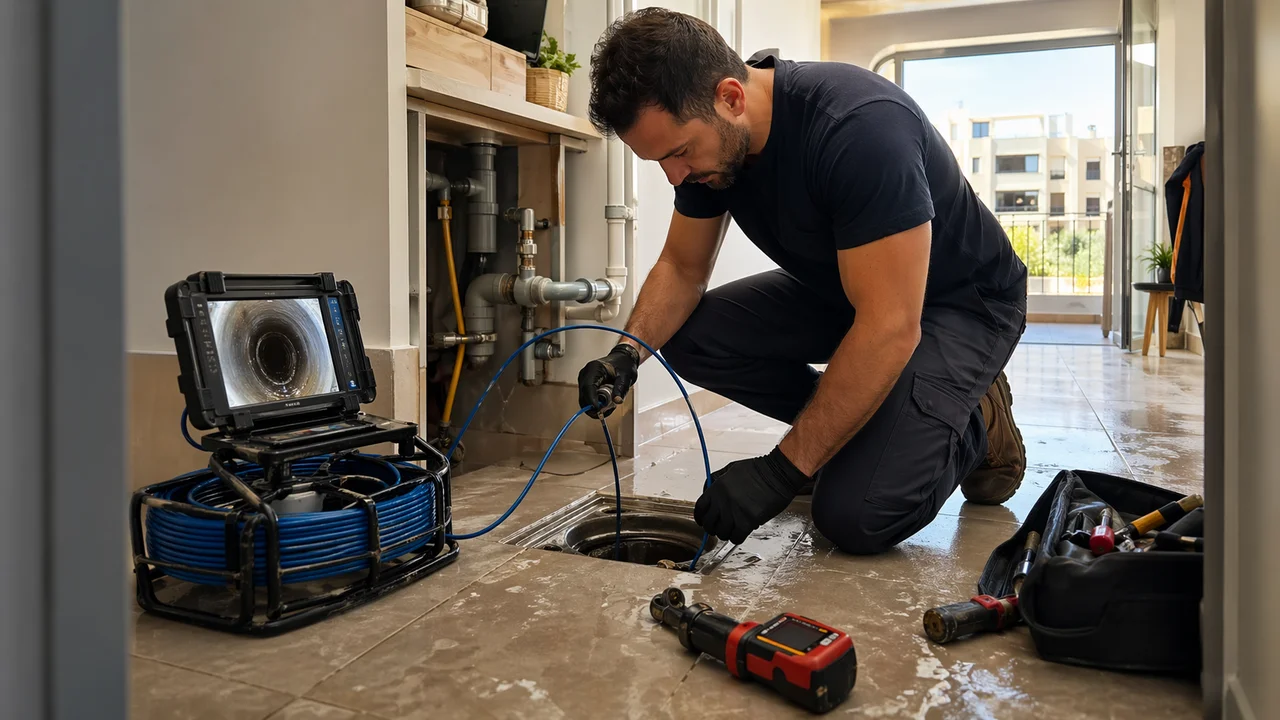
Fifteen years ago, CCTV sewer inspection was a "specialty" service, reserved for extreme cases. Today it's still not standard — most plumbers in Israel do not carry professional sewer camera equipment. The reason is simple: a professional camera kit runs ₪15,000-55,000, plus ₪10,000-18,000 for a sonde locator. This is not gear a "general" plumber buys — it's a business decision. Those who invest, specialize.
This guide is technical. It breaks down every layer of equipment (from the basic push-rod camera to the industrial crawler robot), explains when you actually need a sewer scope (and when it's overkill), walks through a real professional process from start to finish, lists what a written report must contain, and gives 2026 Israeli market prices. On the KABLAY platform you can explicitly tag "camera required" — and your request routes only to professionals who actually own the gear.
1. What sewer camera inspection is — and what it isn't
A sewer camera (CCTV sewer scope, "sewer inspection camera") is a system comprising a miniature camera head with LED lighting, a stiff-yet-flexible push cable ("reel"), an LCD screen with recording, and a sonde locator that transmits a signal so the camera's position can be pinpointed from the surface. It is not the same as "acoustic leak detection" or thermography:
- Acoustic detection: a sensitive microphone that listens for water escaping under pressure inside a wall/floor. Good for pressurized fresh-water piping. Not for sewer lines.
- Thermography: an infrared camera that detects temperature differences. Good for locating hidden hot-water piping or wall moisture intrusion. Doesn't "see" inside the pipe.
- Sewer camera scope: travels inside the pipe and shows you what's there. Good for drainage and sewer pipes (non-pressurized). Not suitable for finding pressurized water leaks.
Fundamental distinction: sewer camera work requires physical access into the pipe — through a drain opening, cleanout, manhole, or by temporarily removing a toilet/trap. No access — no scope.
2. The equipment tiers — technical breakdown
A. Push-rod CCTV — the main workhorse
The most common format in Israel for residential piping (25-150 mm). The push cable is fiberglass coated in plastic, stiff enough to push but flexible around bends. At its tip is a camera head 18-64 mm with LEDs surrounding the lens.
Parameters that matter:
- Head diameter:
- 25 mm (1") — fits through a 32 mm trap, good for sink/shower traps. Limited reach (20-30 m).
- 40 mm (1.5-2") — the standard for residential plumbing (40-100 mm pipes). Passes most Israeli domestic runs. Standard reel 30-60 m.
- 65 mm and up — for commercial/building systems (100-200 mm).
- Reel length: 20 m (entry) / 30-40 m (standard) / 60-100 m (pro) / 200+ m (crawler).
- Self-leveling: an internal gravity weight that keeps the image "upright" regardless of bend. Without it, the image flips around every turn. Critical feature.
- LED lighting: 6-18 LEDs around the lens. Light quality determines whether you can see a 0.5 mm hairline crack or not.
- Sonde (locator beacon): a 512 Hz transmitter at the tip. Without it, you have no way to know where a defect seen on screen is located in the real world.
- Recording: local SD/USB + often WiFi to tablet. A professional report requires a video file.
Common models in Israel:
- Ridgid SeeSnake (Compact, CS6, CS12 series) — US-made, de facto standard. Reliable, parts available.
- Ridgid SeeSnake nanoReel — for very small pipes (25 mm), fits where regular cameras don't.
- Rothenberger Rocam 4 — German, common among professional plumbers.
- Wöhler V-series — German mid-range quality.
- Forbest / Elmera / Vicam — budget models (China/Korea), less durable but much cheaper.
Equipment cost (to the plumber): ₪3,500-12,000 for a budget kit; ₪15,000-55,000 for a professional kit; ₪60,000-90,000 with a sonde and advanced recording system.
B. Sonde locator — without it, the scope is "theoretical"
A sonde is a small 512Hz (or 33kHz) transmitter at the camera tip. The receiver is a separate handheld unit the technician walks above-ground with — it picks up the signal and shows where the camera is, at depths up to 3-5 m.
Why it's critical: say you find a crack or tree root at 18 m of pipe under the yard. Without a sonde, you know there's a problem but don't know where to dig. With a sonde, the technician marks an X on the ground and you dig a 60×60 cm hole, not a 4×4 m area. Excavation cost difference: ₪3,000 vs ₪12,000.
Models: Ridgid NaviTrack Scout (most common in Israel), Ridgid SR-20/24 (pro, up to 6 m depth), Gen-Eye GL (US alternative). Cost (to the plumber): ₪8,000-18,000.
C. Crawler robot (tractor) — for pipes over 100 mm
A wheeled robot with a pan-tilt camera, electromechanical manipulator, high-power LEDs, and a magnet/gear system for wheel swaps by pipe diameter. Used mainly for municipal collectors (150-600 mm) and industrial systems. Rarely relevant to residential Israeli homes.
Models: IBAK Orion (German, global standard), IPEK RovVer X (premium), Insight Vision VuRover (mid-tier). Cost (to the plumber): ₪180,000-750,000. A typical private plumber won't buy one; large firms and municipalities do.
D. Complementary systems
- Dye tracing: a fluorescent dye is injected into the water and followed to its exit. Helps identify illegal sewer tie-ins and line routing.
- Smoke testing: non-toxic synthetic smoke is introduced into piping to see where it emerges (gardens, through doors, through undocumented vents). Used mainly in older systems.
- Acoustic leak detector: a ground microphone for pressurized water leaks. A complementary but separate service, not part of "sewer scoping."
3. When you really need a sewer scope — 7 scenarios
- Recurring blockages (3+ per year) — if unclogging doesn't hold, there's a structural cause (crack, collapse, root, sharp bend). Only a camera can pinpoint the cause.
- Before buying a house/apartment — especially for private homes with a yard. Scoping the underground sewer takes 30-60 minutes and costs ₪800-1,500 — prevents a ₪15,000-80,000 surprise after closing.
- Recurring wet stains in yard or ground floor — if acoustics didn't find a fresh-water leak, the source may be a broken sewer pipe. A camera will locate it.
- After collapse / soil subsidence / tremor — soil settlement can break sewer lines. In sensitive zones (Ashkelon, Ashdod, Beer Sheva) — the scope is justified.
- Tree roots near a sewer line — large ficus, sycamore, cypress within 5 m of sewer pipes. Annual scoping (₪500-900) saves large repairs.
- Illegal tie-ins in older buildings — cases where a tenant connected a kitchen to another tenant's line. Scope + dye tracing resolves it.
- Insurance claim or lawsuit — a documented scope with report is evidence. Insurance won't pay on the plumber's word alone.
When it's not needed:
- A one-off blockage cleared easily (not needed).
- Pressure-water issues (don't flow through the sewer — acoustic is needed instead).
- Leaking mixer, one-time trap clog — standard clearance.
4. Professional process: what should happen at the visit
- Access planning — the technician asks where the problem is felt and decides which access point (external manhole, floor drain, toilet removal, dedicated cleanout) is best.
- Pre-cleaning — if there's a blockage, they usually flush first (otherwise the camera can't see). Some plumbers bundle these services.
- Camera insertion — the head enters the pipe, the tech advances slowly while watching the screen.
- Documentation — the camera records video + flagged screenshots. The tech logs observations with timestamps.
- Sonde location — when a defect is found, they activate the sonde and the tech walks above-ground with the receiver until they pinpoint the spot. They mark an X (with spray paint) on the floor/ground and measure depth.
- Written report — within 1-3 days you receive a PDF with: flagged images (with on-screen distance and time), diagram of the X location with measured depth, written description of findings, and recommended action.
The whole process takes 45-120 minutes for a single issue, 2-4 hours for mapping a building's main line.
5. What must appear in a professional report
- Original video file (SD/USB) — not just cropped stills. If the plumber won't provide the file, or doesn't have a recording system — red flag.
- Timestamped screenshots — for every identified defect.
- Location diagram of the defect on a plan/map (X marked with distance from known corners).
- Depth measurement — for every X marked on the ground/floor.
- Clearly written description: "at 8.2 meters from the access point, a longitudinal crack 15 cm long at 1.4 m depth" — not "there's a problem in the pipe."
- Tiered action recommendation: local repair (excavation + section replacement), internal rehabilitation (CIPP / relining), full line replacement.
- Cost estimate — for each option.
- Signature + date of the professional + contact details.
A report like this is evidence for insurance, a lawsuit, or negotiation with a specific contractor. Without it you have "a story," not a document.
6. 2026 market prices — real ranges
These prices reflect the actual Israeli market (2025-2026). Ranges reflect the gap between periphery (Ashkelon, Beer Sheva, Hadera — the low end) and Tel Aviv / Herzliya (high end). As a rule, scoping prices are relatively stable across cities because the equipment is identical; the main gap comes from the technician's travel time.
Basic scope (short, no written report):
- One point (toilet, sink) — ₪400-800
- Full apartment (several points, up to an hour) — ₪700-1,300
Professional scope with report + location:
- Apartment with written report and location diagram — ₪900-1,800
- Private home with yard + exterior line — ₪1,200-2,500
- Insurance / legal-grade report (engineer-signed) — ₪1,500-3,200
Scope + adjacent service (packages):
- Unclogging + scope afterward (verify the line is clear) — ₪800-1,500
- Root cutting + before/after scope — ₪1,200-2,800
- Main-line mapping for a building (for a vaad bayit) — ₪1,800-3,800
Emergencies and premiums:
- Evening/night surcharge — +40-70%
- Shabbat/holiday surcharge — +60-100%
- Crawler deployment (150+ mm) — ₪3,500-7,000 per day (buildings/municipalities).
💡 Key tip: always demand a written report + the recording file. A plumber who refuses — isn't delivering the full value of the service. If they "fix" the issue and hide the report, 3 months later when the issue returns you have no evidence.
7. 7 red flags
- "Free scope if you book the repair" — sometimes a micro-service that births an unnecessary "big job." Demand the report regardless.
- No recording — "I looked, it's fine / there's a problem" with no file = no value.
- Won't show the equipment — a real pro shows off their gear. If they show up with "a ₪500 camera from China" — not professional.
- Refuses to use the sonde locator — without it, the whole scope is useless for repair.
- Can't explain what's on the screen — thermal crack, mechanical crack, root, sag, grease buildup — each has a distinct visual signature.
- Recommends "treatment" that doesn't match the local defect — if the problem is at 18 m but they want to dig at 4 m — something's off.
- Cash-only, no invoice — off-limits. Without an invoice, the report isn't admissible with insurance or in court.
8. KABLAY: how we connect you to plumbers who actually have the gear
On our platform, tradespeople can tag their profile with:
- "Sewer camera equipment" — verified that they own a professional camera kit.
- "Sonde locator" — those who can deliver a report with precise location.
- "Professional insurance-grade report" — those who have delivered reports accepted by major Israeli insurers.
- "Crawler robot" — firms with industrial gear for buildings and commercial needs.
When you post a task, pick the relevant tags — this prevents offers from people without the gear and brings you closer to those who have it. For a simple apartment scope — the camera tag alone is enough. For an insurance report — you need the first two. For a building — worth adding the crawler.
Summary
Sewer scoping isn't a gimmick — it's a technology that lets you identify a cause, not just a symptom. But it's expensive technology that not every plumber owns. Don't settle: demand the recording file, the written report, and a marked location with depth. Without these, you're paying for "a look" instead of information.
KABLAY is a marketplace connecting clients with independent specialists. KABLAY does not guarantee availability, the number or timing of responses, licensing, documents, price, quality, or outcome; check the specialist and proposed terms before contracting.
Internal links
Useful pages on this topic
Frequently asked questions
- How long does a professional sewer scope take?
- For a single apartment — 45-90 minutes for a full inspection with location. For a private home with a yard — 1.5-3 hours. For building main-line mapping — 3-5 hours. If it takes less than 30 minutes — sonde locating probably wasn't done, and that's a sign of unprofessionalism.
- What's the difference between a push-rod camera and a crawler robot?
- Push-rod is a push cable with a camera head, suited for 40-100 mm residential piping, reel length 30-60 m. A crawler is a wheeled vehicle for 150-600 mm collectors, reach up to 200+ m. For a private home in Israel, it's almost always a push-rod. Crawlers — for buildings and municipalities.
- Is the video file I receive actually necessary?
- Yes, always request it. It's the evidence. Without it, the written report is "the plumber's word." Insurance companies and courts require seeing the video, not just the recommendation. If the plumber refuses — go to someone else.
- I have recurring blockages twice a year. Should I scope or just keep flushing?
- Recurring blockages 2+ times a year are a sign of a structural problem (crack, root, sag, sharp bend). A scope (₪900-1,500 with location) will pinpoint the cause. If you keep just flushing — you'll eventually reach a collapse case, and then the repair is ₪15,000-50,000 instead of a ₪3,000-8,000 targeted fix today.
- What is CIPP and when is it an alternative to excavation?
- CIPP (Cured-In-Place Pipe) = internal pipe rehabilitation using a fiberglass sleeve soaked in resin that hardens inside the pipe. Suited for cracks and fissures in piping that hasn't structurally collapsed. Cost: ₪800-2,000 per linear meter. Pro: no excavation. Con: reduces pipe diameter by 10-15%, and some piping isn't suitable (too small, or with severe sags).