🎨Painting and plaster
Kitchen Cabinet Painting in Israel: Preparation and Quotes
By KABLAY Editorial · · 12 min read · Updated:
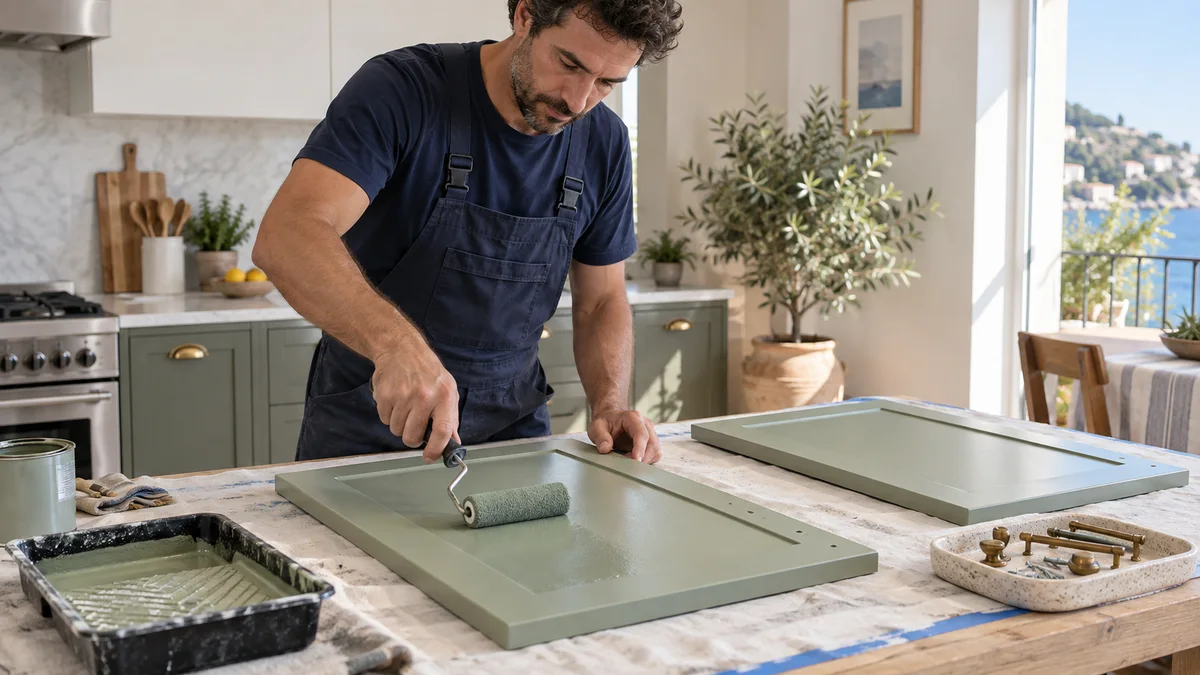
Painting kitchen cabinet doors can refresh an apartment in Israel without replacing the entire kitchen, provided the existing parts are suitable. Paint will not repair swollen board, loose decorative foil or an area that stays wet. Before choosing a colour, assess the substrate, existing finish and repair requirements. Preparation and coating compatibility determine whether this is a sensible refurbishment.
This guide helps you specify a trial, surfaces, removal, drying arrangements and reinstallation. Ordinary room doors have a separate door and trim painting guide. Kitchens need their own plan because of grease, frequent wiping, handles, hinges and temporary limits on storage and cooking access.
Inspect condition before selecting a shade
Look at lower edges, areas near the sink and dishwasher, handle positions and hinges. Swelling, soft substrate, delamination and major chips need a separate decision. Hiding them under a uniform colour is insufficient because the damage remains underneath. If water caused the deterioration, resolve its source before cosmetic work; a fresh finish will not solve a recurring moisture problem.
Photograph the fronts as a whole and each defect closely. Explain which doors fail to close properly, where gaps have changed and what has previously been repaired. Sometimes replacing one damaged part and painting the remainder is practical. In other kitchens, several unsuitable fronts make painting a poor option. Establish this before buying materials and taking every door off.
Distinguish the core from the outer finish
MDF, timber, laminate and decorative foil are not interchangeable descriptions. An MDF core can have a painted, laminated or foil-covered face. A timber door may also carry an unidentified varnish. Do not describe something as wood solely because of its appearance. Share model information and photographs of accessible edges without damaging the item to reveal its construction.
Peeling foil is not automatically a stable surface for another coating. Its removal, the condition underneath and the subsequent coating system need assessment. On smooth existing finishes, compatibility between cleaning, preparation, primer and topcoat is especially relevant. A process used on one surface should not be transferred to another merely because both have the same colour.
List every surface included in the job
“Paint the kitchen” could mean only visible door faces or also their edges and backs, exposed sides, plinths and cabinet frames. Prepare a count and approximate dimensions. A drawer front and a tall pantry door have different areas and handling requirements. Decide what remains in the existing finish and what will be visible when a cupboard is open.
Do not accidentally include cupboard interiors in a general description. Their coating and intended use need explicit agreement. List shelves, decorative panels and parts beside appliances separately. If you are changing handles, establish the new hole spacing and whether old holes need filling. That preparation belongs before the final coating, rather than after it has been completed.
Cleaning and an adhesion trial
Kitchen parts can have grease, care products or other residue that is difficult to see. Those deposits matter before surface preparation and priming. Ask the painter to describe the cleaning sequence and compatible products. A coating applied over residual contamination does not become dependable simply because its container calls it professional.
Sherwin-Williams’ cabinet guidance highlights cleaning and an adhesion check when updating existing finishes. The actual product and working conditions still need to suit your substrate and the selected technical instructions.
Agree on a small test area or separate sample part, then assess it after the required drying stage. A liked colour is only one requirement; the proposed system must also be suitable. If the trial shows poor adhesion or an adverse reaction in the previous finish, revise the plan first. Continuing across the kitchen in the hope that another coat will solve it is not a good response.
Approve a sample for both colour and texture
A phone screen and a small colour card cannot establish how the kitchen will look under your lighting. Ask for a sample on an agreed surface with the chosen sheen. View it in daylight, in the evening and under the room’s artificial lighting. Consider the worktop, splashback and parts that will remain unchanged. Adjacent materials can change how the same shade is perceived.
Discuss the expected texture before booking. Rollers, brushes and spraying can produce different appearances; the method depends on the system and working arrangements. A promise of a factory-like result is difficult to inspect without a sample and criteria. Timber grain and previous substrate marks also do not necessarily disappear under a different colour.
Removal, labelling and hardware storage
Doors and drawers need to return to the right positions. Ask how parts will be labelled and how handles, fixings and hinges will be stored. Photographs of existing gaps and positions can help. Painting does not repair an already sagging hinge. Adjustment or replacement of faulty hardware should be specified separately instead of being assumed to come with every painting job.
Establish which components will be removed and who handles transport if work takes place in a workshop. Edge protection in transit and suitable storage matter alongside coating application. Moving hardware should not be covered in paint. Complex door mechanisms require their manufacturer’s instructions and someone capable of removing and refitting them without impairing operation.
Compare on-site and workshop arrangements
Working at home avoids transport but needs room for preparation, protection and drying; the kitchen may be partly unavailable. A workshop can make some stages easier to organise but adds removal, travel and another visit. Compare the complete sequence rather than only the time spent applying paint. Ask where each stage happens and when the parts can be returned.
Agree on ventilation and protection of food, dishes, appliances, floors and adjoining rooms. Dust-producing preparation and spraying need appropriate arrangements; an open window is not sufficient for every process. Do not disconnect gas equipment or alter electrical connections yourself to make space. If such work is necessary, an appropriate specialist and a separate scheduling step are needed.
Plan when the kitchen can be used
Empty the cupboards that need access before work begins. Establish whether the sink and cooking area can be used between stages. Delay frequent washing of the new finish until the specified care regime permits it. Return of the doors, permissible handling and readiness for everyday service are different stages and should be described separately.
Do not assume that every coating needs the same number of coats or hours. Recoat intervals, temperature, humidity and strength development depend on the chosen system. Ask for the instructions that apply to the actual materials. Doors should not be stacked, forced shut or reassembled earlier than the specified stage simply to shorten the schedule.
Quote for preparation and reinstallation, not only door count
Dimensions, edges, defect repairs, existing finish preparation, application method and transport change the workload. Compare offers against the same list and photographs. If the surface has not yet been inspected, record which items may be revised and how additional work will be authorised. A low figure for coating alone can exclude most of the preparation you need.
- A list of fronts and all surfaces to be refinished.
- Cleaning, preparation, local repairs and the agreed coating trial.
- Materials, shade, sheen and application method.
- Removal, labelling, transport, storage, fitting and adjustment.
- Stage dates, the total and VAT where applicable.
New handles, cabinet body repairs and replacement of damaged fronts need their own descriptions. Avoid hiding them in an undefined kitchen refresh. If removal reveals another defect, ask for a photograph, proposed solution and additional cost before proceeding. This preserves a useful boundary between the agreed work and a new repair.
Inspect after reassembly
Assess the finish under normal lighting from a normal viewing position and compare it with the approved sample. Check the colour, agreed texture, edges and visible runs. Inspect around handles and places where the old layer had defects. Do not judge an unfinished coating as the final result before its specified drying stage.
Open and close doors and drawers, checking gaps, orientation and clean hardware. Doors should not catch each other because of an unagreed change during assembly. Obtain care instructions, the date for normal wiping and a contact for concerns. Keep material details and photographs for possible future local touch-ups, which may need the same preparation and finish information.
A useful request for a Kablay painter
You could write: “I want to refresh kitchen fronts while keeping the cabinets. Door and drawer counts and dimensions are attached. The core may be MDF but the finish needs identification; one area near the sink is damaged. Please provide an inspection, sample and preparation and coating proposal. List faces, edges and backs separately, together with removal, reassembly and kitchen use dates.”
Compare responses in the Kablay painter category by preparation, materials and the complete working plan. If you are arranging cleaning before using the apartment afterward, ensure the new coatings are not loaded or washed too early. A successful refurbishment starts with a suitable substrate and ends with care instructions you can follow.
Internal links
Useful pages on this topic
Frequently asked questions
- Can swollen MDF doors simply be painted?
- Paint does not restore damaged board. Assess the cause and condition first; repair or replacement and resolving the water source may be necessary.
- Do kitchen doors always need removal?
- That depends on the agreed process and surfaces. Clarify removal, labelling, transport, drying and reinstallation to compare the whole job.
- Why is a coating trial useful?
- It helps check compatibility with the existing finish and agree on colour, sheen and texture. Assess it after the required drying stage.
- When can I wash the new fronts?
- Follow the selected coating’s instructions and the painter’s guidance. Touch drying and readiness for normal wiping can be different stages; there is no universal time for all systems.