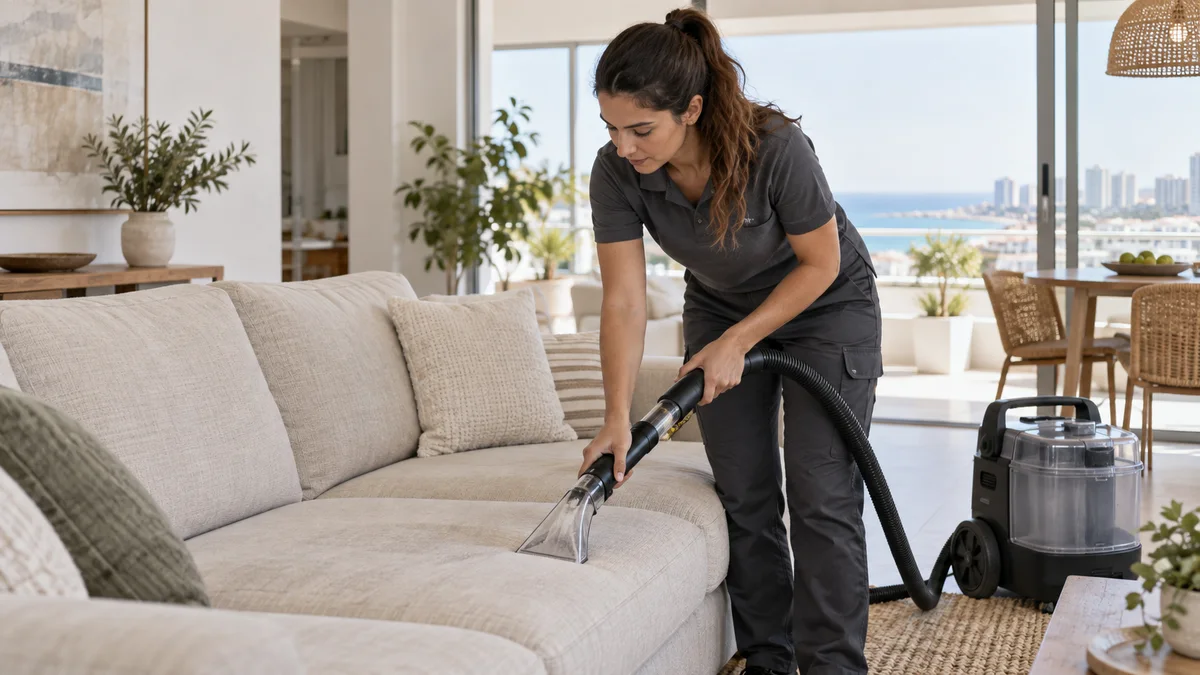
Sofa cleaning in Israel is often booked after a move, a tenancy, a spill or several years of everyday use. Two sofas that look similar in a photograph can nevertheless need different treatment. The upholstery, filling, backing, adhesives and previous stain removal attempts influence the result. A useful booking starts with that information and a defined scope, rather than a promise to make every fabric look new.
This guide explains how to prepare, compare quotes and inspect the result. It is not a recipe for applying a strong cleaner to unknown upholstery. When sofa treatment is part of getting an apartment ready, coordinate it with your cleaning before moving in. Allow enough time for the furniture to dry before using the room or placing belongings on it.
Ask what the advertised cleaning method actually means
Terms such as deep cleaning or dry cleaning are used loosely in household service advertising. The name does not establish whether water will be used. Some providers use extraction, applying a suitable solution and recovering moisture and dirt. Other upholstery requires a different approach. A familiar service name cannot replace checking whether the process suits your particular sofa.
Ask the cleaner to name the proposed method and explain the information used to select it. “We use the same machine on everything” does not explain how the colour, seams and inner layers will be protected. Steam is not automatically a better option because it sounds more powerful. Heat and moisture do not suit every covering or construction, and a guessed fabric description can be misleading.
Find the care information before asking for a quote
A manufacturer’s label, model name, purchase document or care instructions can help identify the material. Photograph the whole label, including symbols and warnings. A removable cover is not necessarily machine washable: shrinkage, finishes and combined materials can restrict treatment. If you have no reliable information, say that the material is unknown instead of presenting an assumption as a fact.
Point out leather, imitation leather, a velvet surface, a wool blend, decorative panels or an unusual texture. Leather needs an assessment of its finish and appropriate care, rather than automatic use of a textile cleaning method. The provider should be able to recommend an inspection first, explain the limits of an approach or decline a method that is unsuitable.
Photograph the sofa and describe its dimensions
Send an overall picture, a close view of the fabric and separate photographs of the problem areas in normal light. Include the length, depth, number of sections and any chaise. A large three-seat sofa with deep cushions and a corner section is a different job from a compact three-seat model. A seat count alone may not describe the area that needs cleaning.
- Specify whether the outer back, arms, sides and both faces of loose cushions are included.
- Show piping, seams, buttons and folds where dirt collects.
- Describe narrow stairs, a floor without a lift or limited space beside the furniture.
- Mention a wooden floor, sensitive surrounding furniture and available water and power access.
Do not move a heavy sofa alone simply to photograph its back. Explain that the surface is currently inaccessible. If cleaning it matters, agree who will arrange safe movement and whether that is included. Modular sections also deserve a mention: separating and rejoining them may require a different arrangement from treating the exposed sitting area.
A stain history is more useful than a stain photograph alone
Explain what was spilled, when it happened and what has already been applied. Drinks, grease, pet marks and an unknown cleaning product do not all call for the same response. Previous treatment is useful information, even if it did not work. Residual detergent or an earlier change in colour can become apparent during the next cleaning attempt.
Wear, fading and damaged pile are different from removable dirt. Cleaning can remove soil without restoring missing dye or the original surface structure. Odour may also involve the filling or a continuing source, rather than just the visible fabric. Agree on a realistic objective before work starts. A responsible assessment can identify marks that may remain rather than concealing that uncertainty in a general guarantee.
Agree on a compatibility test
Unknown or delicate upholstery needs a cautious trial in an inconspicuous area, with the reaction assessed after drying. The absence of an immediate visible mark is only part of the assessment. Colour stability, texture and shape matter too. Ask how the cleaner will check for dye transfer or a change in the material, and what will happen if the trial gives an adverse result.
Kärcher’s upholstery cleaning guide recommends checking water suitability on a hidden area before wet treatment. That is a testing principle, not permission to use any solution on any fabric.
The internal construction matters as well. Kärcher’s professional extractor information considers the compatibility of fibres, backing and adhesives with the treatment. A strong-looking face fabric does not tell you everything about the layers below it. If a test reveals a problem, the cleaner should stop and discuss the options.
Define the surfaces and stages included
Ask whether the service includes removing loose dry dust, treating agreed stains and the main cleaning process. These are distinct stages and are not necessarily all included in every quote. List the surfaces: seat cushions, arms, outer back, side panels and loose cushions. “The whole sofa” can mean something different to each person unless the booking describes it.
Book extra chairs, rugs, mattresses or decorative cushions separately if you want them treated. Adding them on arrival changes the time and price. A pleasant fragrance is not proof that an odour source has been removed. Likewise, ordinary upholstery cleaning should not be represented as a proven medical treatment or a guarantee of sterilisation.
Prepare the room without pre-treating the sofa
Remove clothes, toys and small belongings so the cleaner can reach the furniture. Discuss protection for timber flooring and adjacent surfaces, and identify a suitable position for the machine and hose. The equipment should not block the only route through the apartment. Arrange a separate space for children and pets while the work is taking place.
Confirm ventilation and safe normal access to water and power. Mention a damaged socket or an outlet in a wet area beforehand so another suitable arrangement can be made. Do not mix household products or saturate the sofa in preparation for the visit. That can alter the material’s condition and make the history of the stain harder to interpret.
Plan for drying rather than relying on a fixed promise
Drying depends on the covering, filling, retained moisture, air movement, temperature and humidity. One guaranteed number of hours for every sofa is not a reliable plan. Ask for an estimate for your conditions and allow a margin, particularly in a closed room, humid weather or a coastal apartment. Tell the cleaner if you need the sofa for guests that evening.
Follow the provider’s instructions about cushion positioning and ventilation. Do not cover damp upholstery with plastic or place belongings on it. A surface that feels dry does not necessarily establish that the cushion is ready for use. Ask how to recognise adequate drying and who to contact with a concern. If the furniture remains unusually damp or an odour worsens, report it instead of repeating a wet treatment yourself.
Compare total quotes for the same job
A price per seat does not account for every design. Dimensions, material, access, selected surfaces and local stains influence the workload. Rather than assuming a universal Israeli tariff, send the same description and pictures to the providers you are comparing. Their answers should explain the scope and conditions that lead to a different total.
- Record the total or the conditions under which an inspection can change it.
- Clarify whether the visit, materials and VAT where applicable are included.
- Identify charges for a chaise, loose cushions or an inaccessible outer back.
- List the stains to be treated and any known limits to the likely result.
- Agree how a mark that appears after drying will be reported and assessed.
A newly discovered issue should be discussed before extra paid work proceeds. Contamination or damaged filling beyond the scope of ordinary cleaning needs a separate assessment. Sometimes upholstery repair or replacement is the appropriate option. That possibility is more useful to understand than a promise that every defect will disappear.
Inspect the final appearance after drying
At the end of the visit, check that the agreed surfaces have been treated and that nearby finishes have not been visibly damaged. Assess colour, stain boundaries and odour once the sofa is dry, under comparable lighting. Keep the original photographs. Wet fabric can look substantially different, so a wet result and an older dry photograph are not a fair final comparison.
Look at the seams, piping, previous stain locations and all surfaces included in the booking. If you notice a ring or a new problem, send an overall photograph and a close view, together with when it appeared. Contact the cleaner before applying another product. Additional treatment can obscure the cause and make it harder to assess the work that was agreed.
A practical Kablay request
You could write: “Fabric corner sofa with a chaise needs cleaning. Dimensions and care label are attached. There is an old coffee stain previously treated with this product. Please include seats, arms and both faces of the cushions; the outer back is currently inaccessible. I need a suitable method, total quote and drying arrangements, with an explanation of any stains that may remain.” Replace the details with your own observations.
Use the Kablay cleaning category to describe the job and compare responses by method, coverage and limitations. Useful material and stain information helps the provider plan the work. Clear drying and inspection arrangements help you plan the room. Both are more valuable than choosing solely by a short advertising promise.
Internal links
Useful pages on this topic
Frequently asked questions
- Does sofa dry cleaning always avoid water?
- No. Advertising can use the term for several processes, including wet extraction. Agree on the actual method using the upholstery information and manufacturer’s care instructions.
- Will every stain disappear?
- That cannot be promised in advance. Old stains, missing dye, wear and damaged filling may limit the outcome. Tell the cleaner about stain history and previously used products.
- When can I use the sofa again?
- After adequate drying according to the cleaner’s instructions. Fabric, filling, humidity and ventilation affect the time; one fixed number of hours is not reliable for every sofa.
- When should I assess colour and drying marks?
- Once the sofa is dry under comparable lighting. Keep the earlier photographs and contact the cleaner before applying another product yourself.