🏗️Drywall
Apartment soundproofing with drywall in Israel 2026: the full technical guide — decibels, products, prices, and what actually works
By KABLAY Editorial · · 14 min read
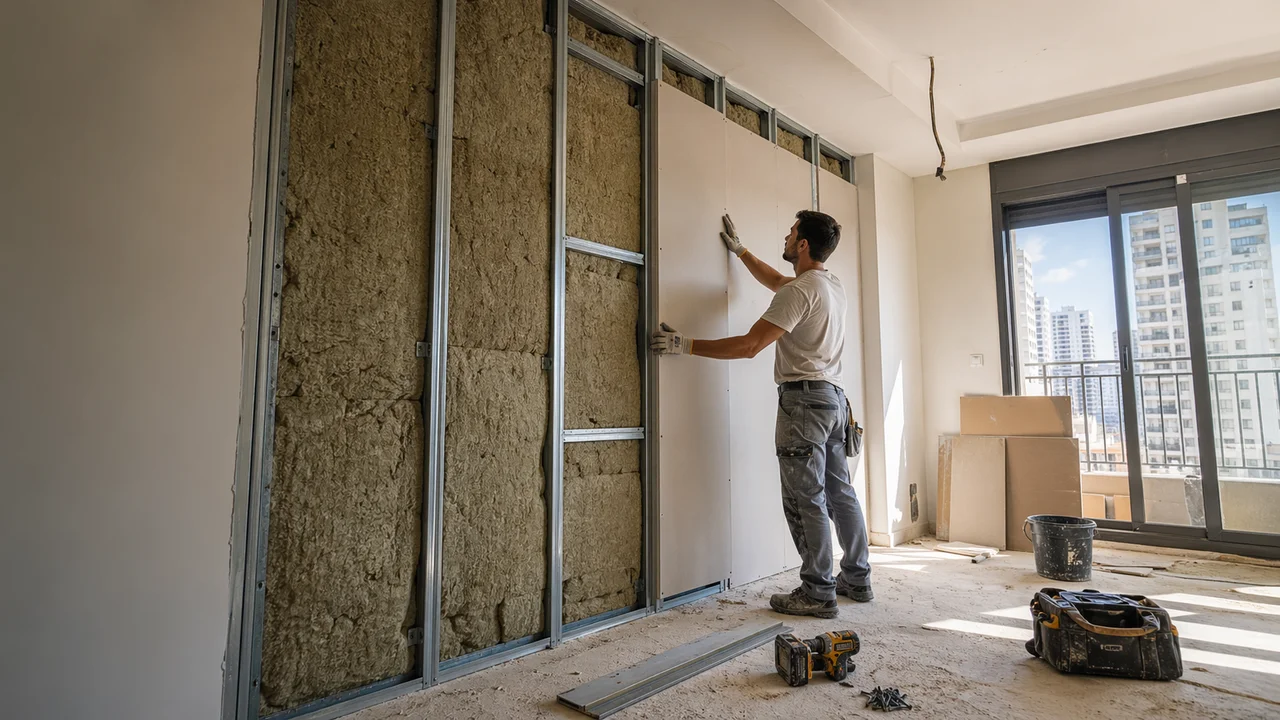
If you can understand what your neighbors are saying — not just hear that someone is talking — your wall provides about 30-38 dB of isolation (Rw). That's what you get in an average Israeli building from the 1970s-1990s: a 10 cm block wall with thin plaster on each side, or a single-layer drywall partition. This isn't "unique" construction; it's the standard.
The "blue acoustic board" Home Center sells as a solution — saves 8-12 dB vs a regular board. Helpful — but not a fix. A truly quiet wall (≥52 dB Rw) needs a system: two drywall layers, mineral wool fill, a profile with rubber damping, and complete elimination of perimeter gaps. And even when you do all that right, there's a second enemy — flanking transmission, sound traveling through floor, ceiling, AC duct, or outlet back-box.
This guide is technical. It answers the question "how many dB do I get for how much money with which materials," with real 2026 Israeli numbers.
1. The science of drywall soundproofing — minimum math
Decibels and Rw: what they actually mean
The decibel scale is logarithmic. Not intuitive:
- +10 dB = sound perceived 2× louder (physically 10× more energy).
- -10 dB = sound perceived half as loud.
- -20 dB = one-quarter as loud.
The wall isolation standard in Israel is Rw (Weighted Sound Reduction Index, ISO 717-1). It's measured in a lab on a full wall section with standardized "pink noise." Real-world mapping:
- Rw 30: regular conversation clearly audible; words fully intelligible.
- Rw 40: conversation sounds like indistinct murmur; occasional words decipherable.
- Rw 50: only loud noise passes (TV at high volume); conversation unintelligible.
- Rw 55+: real quiet; only deep bass (subwoofer) comes through.
The 2026 target for a party wall in a new building: Rw ≥55. In practice, many Israeli buildings don't meet that even in new construction.
"Flanking transmission" — the hidden enemy
Even if your wall is Rw 55, sound can travel around the wall through:
- Shared floor and ceiling (concrete connected to both apartments) — common in shikunim.
- Central AC ducts (between apartments on a shared VRV).
- "Back-to-back" electrical outlet boxes — a direct hole in the wall.
- Window close to the shared wall (noise enters and exits through the window).
- Door perimeter gaps.
The difference between "wall isolation" and "between-apartment isolation" is like the difference between closing your car door and closing all the windows. If even one isn't closed — noise enters.
2. Baseline: Rw of existing walls in Israel
Before planning an upgrade you need to know what you have. These values are actual measurements in Israel:
- Single-layer drywall partition (12.5 mm), no fill, 60 cm stud spacing: Rw ≈ 32-35
- Same wall with 50 mm Rockwool inside: Rw ≈ 40-43
- 10 cm block wall, plaster both sides (standard 1970-1990 shikun): Rw ≈ 36-40
- 15 cm block wall with plaster: Rw ≈ 40-45
- 20 cm poured concrete wall: Rw ≈ 52-55
- 20 cm concrete + 10 cm add-on insulation: Rw ≈ 60-65
If you're in a 1975 shikun with a block wall to your neighbor, your starting point is about Rw 38. Realistic goal: add 15-20 dB = reach Rw 53-58.
3. 5 levels of acoustic drywall wall — each with performance and price
Level 1: Basic partition (Rw 32-35)
- 1 standard 12.5 mm board each side.
- CW 50 mm profile, 60 cm spacing.
- No fill.
- Finished wall thickness: ~8 cm.
- 2026 price: ₪180-250 per m² (materials + labor).
This is the standard for internal room division. Not suitable for walls between sensitive rooms (bedroom/living room).
Level 2: Partition with wool fill (Rw 42-45)
- 1 standard board each side.
- CW 75 mm with Rockwool Flexi 75 mm or Isover Eurobat.
- Rubber damping tape between profile and floor/ceiling.
- Thickness: ~10 cm.
- 2026 price: ₪280-370 per m².
The +10 dB difference from Level 1 sounds 2× quieter. Suitable for bedroom partitions in a private home.
Level 3: Double-layer partition with wool (Rw 48-52)
- 2 drywall boards each side (one standard + one acoustic blue 12.5 mm, or 2× standard).
- CW 75-100 mm with full mineral wool fill.
- Perimeter seal with acoustic silicone (Kinetics SS or Isover sealant).
- Rubber damping tape.
- Thickness: ~13-15 cm.
- 2026 price: ₪450-620 per m².
This is the threshold of "perceived quiet" — a normal conversation on the other side is barely audible.
Level 4: Partition with decoupling (Rw 55-60)
Decoupling = mechanical separation of the two wall sides. Two methods:
Method A: Staggered studs
- Wide UW 120 mm profile.
- 50 mm studs on each side, staggered so that a stud on side A is not connected to a stud on side B.
- 2 boards each side.
- Full mineral wool, woven between studs.
- 2026 price: ₪650-900 per m².
Method B: Resilient channels
- Standard profile attached to studs via a rubber-metal channel (Kinetics RIM, USG RC-1).
- The channel "absorbs" vibration before it reaches the board.
- 2 boards each side.
- 2026 price: ₪700-1,000 per m² (channels aren't cheap).
Both methods reach Rw 55-60 — neighbor noise is inaudible even with TV at normal volume.
Level 5: Room-within-room (Rw 65-70)
For recording studios, professional home studios, or a wall behind a baby who's sensitive to bass. Total separation:
- New wall 5-10 cm away from the existing wall — no physical contact.
- Floating floor on rubber pads.
- Decoupled drop ceiling.
- 3-4 drywall boards each side.
- Mineral wool + Green Glue between boards (vibration damping compound).
- 2026 price: ₪1,500-2,800 per m². This is a ₪30,000-80,000 project per room.
4. Acoustic products in the Israeli market — what to buy and why
Mineral wool (the foundation)
- Rockwool Flexi 50/75/100 mm — stone wool, the global standard. ~₪35-55 per m². Most common in Israel.
- Isover Eurobat Acoustic — glass wool, cheaper alternative. ~₪25-40 per m². Acoustic performance almost identical to Rockwool but handling is less pleasant (skin irritation).
- Knauf Insulation AcousticSmart — mid-tier, less common in Israel.
- Do not use: polystyrene (EPS), polyurethane foam. These are thermal insulation materials, not acoustic — their acoustic performance is zero.
Acoustic drywall boards
- Knauf Diamond Board — dense gypsum board (12 kg/m²). ~₪90-120 per sheet. +3-5 dB vs standard board.
- Rigips Dura / Yaron Premium — similar products, available at Kelei Binyan Levi and Home Center.
- Gyproc SoundBloc (UK import) — premium, ~₪150-180 per sheet. Expensive but common in luxury projects.
Decoupling / damping materials
- Kinetics RIM / RC-1 — resilient channel. ₪18-30 per linear meter. Highest quality.
- USG Resilient Channel — US alternative, cheaper. ₪12-20 per m.
- Green Glue — damping compound between 2 boards. ₪180-240 per tube (covers ~0.5 m² in a thin layer). Adds ~5-8 dB if used correctly.
- Rubber damping tape (Knauf Trennwand / Kinetics) — ₪8-15 per m. Mandatory between profile and floor/ceiling.
Perimeter seals
- Acoustic silicone (Knauf Uniflott Imprägniert, Kinetics SS, Saint-Gobain Acoustic Sealant) — ₪40-75 per 300 ml tube. Mandatory, don't confuse with foam.
- Polyurethane foam — prohibited for acoustic sealing. It hardens, develops tiny holes, and acoustic performance loses 5-8 dB immediately.
5. The gaps that destroy isolation — where 80% of the work fails
A. "Back-to-back" outlet boxes
Two outlets facing each other in a shared wall = a 7×12 cm hole in your wall. Even if the wall is Rw 55, the box itself is a Rw 20 breach. Fix: offset your box by at least 60 cm from your neighbor's. If not possible — fill the box with an acoustic putty pad (Kinetics, Hush) at ₪40-70 per pad.
B. AC ducts
In central AC systems (VRV, ducted) running between apartments, a steel-gypsum duct is an excellent sound tunnel. Fix: flexible acoustic-insulated ductwork (duct silencer) or an acoustic barrier within the duct. Require the designer/contractor to include this.
C. Perimeter gaps around the wall
Between profile and existing wall, between profile and existing ceiling, between drywall sheets — every 2-3 mm unsealed gap destroys 3-7 dB. Fix: acoustic silicone on every seam, even the invisible ones.
D. Room door
A regular interior door — Rw 20-25. If you build a Rw 55 wall with a Rw 20 door — the final wall is effectively Rw ~30-35 (the worst breach dominates). Fix: acoustic door (Rw 35-40), or add a gasket/perimeter seal to the existing door.
E. Shared floor
In shikunim with a shared concrete slab between two apartments, footstep sound from the neighbor above travels through the slab to your wall from below. Fix: floating floor with an acoustic pad. A larger project (₪120-280 per m² of floor).
6. Important metric — measuring actual Rw
Before paying for an upgrade, worth measuring what you have now. Two options:
- Free phone apps (Decibel X, NIOSH SLM) — not accurate for isolation (real Rw requires lab equipment), but give relative indication. Use "before and after" with the same noise source.
- Professional measurement — an acoustician (₪1,200-3,500 per apartment). You get a report with measured Rw, identified flanking sources, and improvement plan. Recommended for new construction or expensive renovation.
7. 7 mistakes people make and lose money on
- Acoustic blue board alone without the rest of the system. Saves 3-5 dB. Not worth the extra ₪40-70 per sheet.
- Filling with polyurethane foam instead of wool. Zero acoustic performance. Prohibited.
- No damping tape between profile and floor. Vibration passes straight through. Loses 5-8 dB.
- Left a gap around an outlet box. 7-15 dB burned.
- Built a Rw 55 wall but left a regular door. The door determines the finish. Rw 30.
- Didn't address the shared floor. Flanking gives another -8 to -12 dB off the "dry" wall.
- Paid for Green Glue and then spread it across the full surface. Green Glue works as a thin (spot) layer — wrong use loses the benefit.
8. What drywall cannot fix
Sometimes the problem isn't the wall, and investment in the wall won't help:
- Noise from an AC duct — the fix is in the duct, not the wall.
- Neighbor's water pump noise — vibration through shared piping. Needs a plumbing solution.
- Drum beats from the upstairs neighbor — solid vibration through the floor. Needs a floating floor in the neighbor's apartment (unlikely) or an insulated floor in yours.
- Traffic noise through a window — the fix is acoustic windows (dedicated double-glazing), not a wall.
9. Realistic packages for an Israeli apartment — 2026 examples
Example A: Quiet bedroom from a living room (private apartment, not between apartments)
Spend: Level 3 only. Rw 48-52. ₪450-620 per m² × ~12 m² of wall = ₪5,400-7,500.
Example B: Shared wall with a noisy neighbor (1985 shikun)
Existing block wall ≈Rw 38. Adding Level 4 (decoupling + 2 boards + wool + Green Glue) reaches Rw 58-62.
- Labor: ₪700-950 per m² × ~15 m² = ₪10,500-14,250.
- Including outlet box treatment + gap sealing + acoustic door (₪2,000-3,500 additional).
- Total: ₪14,000-20,000.
- Realistic outcome: you hear only strong bass; conversation and TV disappear.
Example C: Professional home recording room
Level 5 (room-within-room). ₪40,000-90,000 for a 12 m² room. Acoustician measurement mandatory.
10. KABLAY — how to find a drywall contractor with acoustic experience
Acoustic soundproofing is a distinct skill from building a regular partition. Not every drywall contractor who can build a ₪250/m² wall knows how to build a ₪700/m² wall. When posting a task on KABLAY:
- Explicitly tag "acoustic experience required".
- Request photos of similar jobs + if possible, measured Rw.
- Pros can tag their profile: "Rockwool/Isover certified installer", "staggered stud walls", "Green Glue experienced".
- For Level 4-5, request an itemized quote with every layer and material specified — presented in a way that proves the contractor understands the system.
Summary
Real quiet costs money — but far less than a new apartment. Instead of paying ₪50,000 more for an apartment in a new building with concrete walls, you can pay ₪14,000-20,000 for a Level 4 wall and get similar or better performance. The secret is the system: wool + 2 layers + decoupling + gap sealing + door. Not "a blue board." Don't cut corners on the invisible part — the result is exactly what you won't hear.
Internal links
Useful pages on this topic
Frequently asked questions
- Is adding an acoustic blue board to an existing wall enough?
- Not for real silence. A blue board alone adds 3-5 dB, and a standard Israeli wall is Rw 35-40. You get Rw 40-45 — still hear conversation. Real quiet needs a system: 2 boards each side + stone wool + gap sealing. The blue board is only part of the solution, not the solution itself.
- What is flanking transmission and why is it important?
- Flanking = sound traveling around the wall, not through it. Through the shared floor, AC duct, outlet box, or nearby window. You can build a Rw 60 wall and flanking will drop total isolation to Rw 45. Before investing in the wall, identify flanking sources — usually the wall is only 60-70% of the problem.
- Is it worth hiring an acoustician?
- For a regular apartment (Level 3) — not mandatory. For a large project (Level 4-5) or studio build — yes. Professional measurement costs ₪1,200-3,500 but prevents a ₪20,000+ investment in the wrong solution. A good report identifies the noise source (wall, floor, window) and the optimal fix.
- Does Green Glue actually work?
- Yes, if used correctly. Green Glue is a vibration-damping compound spread thinly between two drywall sheets. Adds ~5-8 dB. Common mistake: spreading it like an adhesive over the full area — doesn't work. Instructions: "dots" pattern. Price: ₪180-240 per tube (covers ~0.5 m²).
- I have noise from the neighbor above. Does a drywall wall help?
- No. Noise from above comes through the floor as impact noise (footfall). The fix: a floating floor in the neighbor's apartment — but you don't control that. Alternative: an acoustic floor in your apartment (₪15,000-40,000 per room). A drywall wall doesn't help because the sound doesn't come through the wall; it comes through the floor.