🪟Tiling
Tile over Tile or Removal in Israel 2026: Prices, Falls and Waterproofing
By KABLAY Editorial · · 13 min read
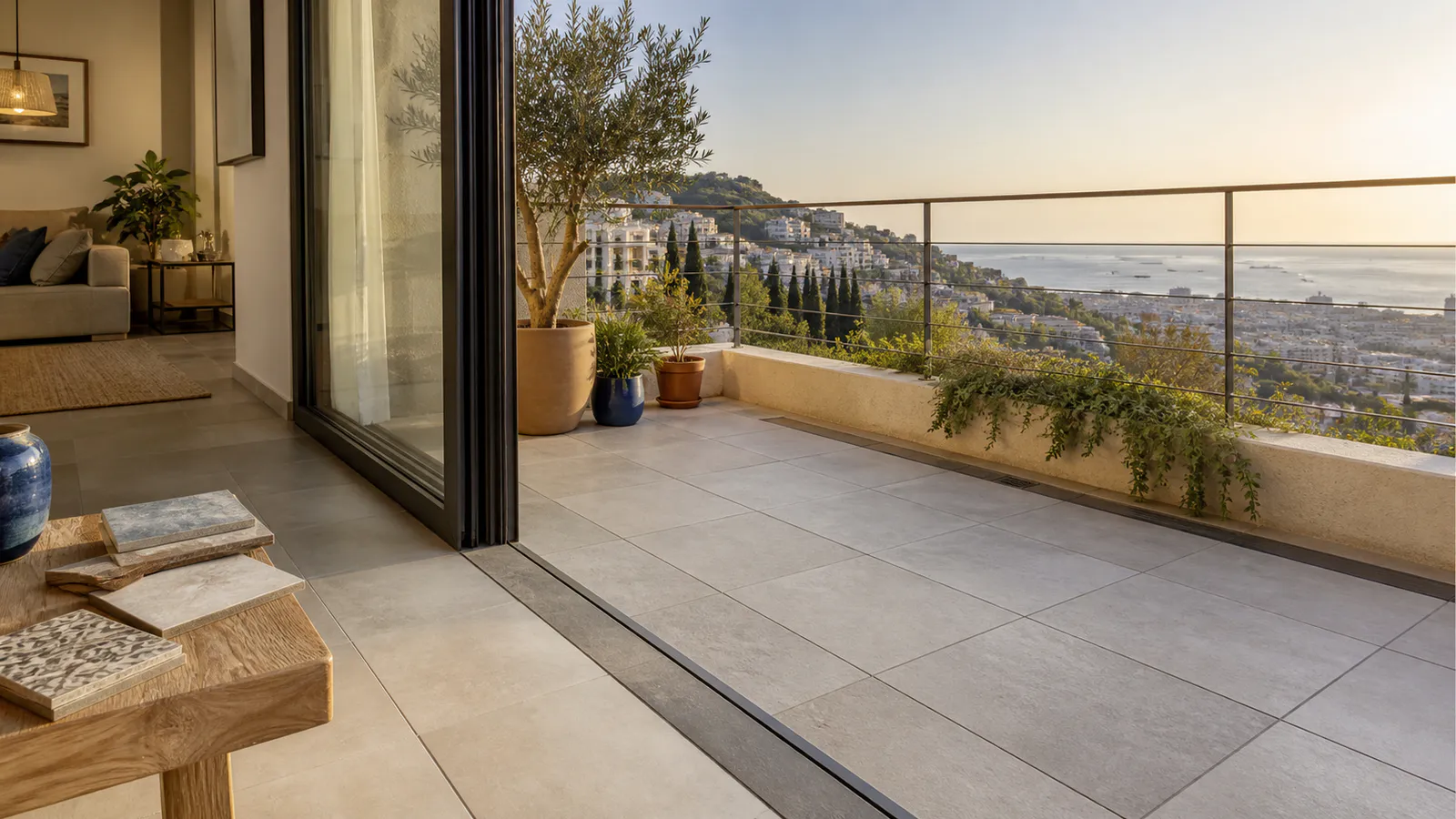
Laying new tile over an existing finish can save demolition, dust and time, but only when the base is stable, levels permit the extra build-up, and drainage remains correct. In a bathroom or balcony, the wrong shortcut can trap a door, raise the floor above its threshold, hold water at the exit or conceal failed waterproofing.
This guide gives a practical decision test, 2026 labor prices and coastal-balcony details. Compare tilers in Israel, or request local estimates with a Haifa tiling task.
When tile-over-tile can work
- The old tiles are firmly bonded, with few or no hollow-sounding zones.
- There is no movement, active crack or settlement in the base.
- The existing fall drains water without ponding.
- The added adhesive and tile will not interfere with doors, railings, steps or thresholds.
- Drains, toilets, cabinets and skirting can connect properly to the new level.
- The surface can be cleaned and prepared with a bonding system compatible with both layers.
Even when the checklist passes, make a bond test in a small area. Smooth or contaminated tile is not a reliable base without preparation specified by the material system.
When removal is the safer choice
- Many tiles move, sound hollow or are already cracked.
- There is damp, odor, a stain below, or no reliable information about waterproofing.
- Bathroom or balcony falls are wrong.
- The floor is already high against adjacent rooms or an entrance door.
- Water, waste or sanitary fixture positions must move.
- There is already more than one finish layer and the base is unknown.
Removal adds noise, dust and disposal, but exposes the substrate so it can be corrected. In showers and balconies, that is often the only honest way to renew waterproofing and falls.
Bathrooms: waterproofing sits below the finish
Tile and grout are not the waterproofing system. Before tiling, test water and waste lines, repair and grade the base, and apply a compatible membrane. Adhesive and tile follow only after the required checks and curing. Coordinate with the guide to bathroom plumbing planning so a new finish is not opened again.
Balconies and Haifa: sun, salt and drainage
Use a matte, outdoor-suitable tile, exterior adhesive and grout, and movement details on an open balcony. In Haifa and other hillside locations, wind-driven rain reaches corners that may look harmless in summer. Near the sea, metal trims and edge details must also suit the exposure.
Do not choose only from a slip rating printed on a box. Ask for a sample, wet it and test it barefoot and with a shoe. Mid-tone material with restrained texture is often more forgiving of dust, scale and hard sun than glossy white or smooth black.
Israel tiling labor prices in 2026
The KABLAY tiling price list gives comparison points of about ₪45/m² for old-tile removal, ₪90/m² for floor leveling, ₪75/m² for wet-zone waterproofing, ₪180/m² for standard floor tile, ₪210/m² for porcelain, ₪280/m² for large format and ₪240/m² for balcony tile. Standard grout is listed around ₪45/m² and epoxy grout around ₪90/m².
These are labor references. Tile, adhesive, membrane, trims, transport, lifting, cuts, waste and substrate repair can be separate. Large format also changes handling, team size and base-tolerance requirements.
Approve the layout before adhesive
- Measure the room and its main sight lines.
- Mark the starting line, axes and perimeter cuts.
- Plan cuts around doors, niches and sanitary fixtures.
- Open several boxes and blend pieces to distribute shade variation.
- Approve grout width, grout color and edge trim.
- In showers and balconies, approve fall direction and drain position before laying.
For material, size and texture choices, also read the bathroom tile selection guide.
How much tile to order and why the batch matters
The allowance follows the layout, not only the area. A straight run of large-format tile in a simple rectangle wastes little; a diagonal, a herringbone, or a narrow bathroom with niches and many corners wastes far more. A sensible starting point is 8–10 per cent on a plain layout and 12–15 per cent where cutting is heavy, but the exact figure belongs to the tiler after the layout, not to the shop before the survey.
Keep a few spare tiles for future repairs as a separate item. A year later the same batch will no longer be on the shelf, and the difference between batches shows on the wall even under an identical product code. Check the batch number on every box at delivery and refuse a top-up from a different one.
- Measuring after removal is more accurate than measuring over old tile.
- Large format needs a flat base and more hands to lay.
- Mosaic, decor pieces and step nosings are separate quote lines.
- Adhesive and grout are chosen for that tile and those conditions, never as a universal product.
- Confirm floor access and a storage spot: a pallet of tile is heavy.
What the quote should include
- Removal or tile-over-tile, and the inspection behind that decision.
- Net area, tile size, layout and joint width.
- Leveling, falls, waterproofing and curing time.
- Cuts, trims, skirting, holes and niches.
- Adhesive and grout suited to tile and exposure.
- Spare quantity from the same production batch.
- Waste, cleaning and protection from the lift to the apartment.
Timing: where the days actually go
Laying is rarely the bottleneck. The time disappears into waiting: screed and leveling have to cure, waterproofing dries layer by layer, adhesive must set before grouting, and grout and silicone must cure before real water. A promise of a finished bathroom in three days usually means one of those stages was skipped or shortened.
Ask the tiler for waiting days as well as attendance days, and for what happens on site in between. If the apartment has only one bathroom, decide in advance where you will shower, and do not book fixture installation for a day when the system cannot yet take the load.
Expensive mistakes
- Buying large format before checking floor and wall tolerances.
- Bonding onto greasy or loose tile without a test.
- A narrow, obvious central cut caused by no layout plan.
- “Zero joint” instead of a designed joint.
- Rigid grout where a flexible perimeter or junction seal is needed.
- Drilling through a new membrane without a sealed detail.
- Aggressive washing before adhesive and grout have cured.
Aftercare: what happens in the first year
Good work only stays good if it is looked after. Hard water leaves limescale on dark glossy tile and on fittings, and a closed bathroom without enough ventilation grows dark marks in the grout lines. In the first weeks, avoid harsh cleaners, metal scourers and sealed rugs laid over the floor: the materials are still stabilizing.
Silicone at corners and at the wall-to-floor junction is maintenance, not a permanent detail. When it darkens, separates or peels, remove it completely, dry the joint and renew it; a fresh bead over an old one fails quickly. Natural materials such as stone or terrazzo may need periodic resealing per the manufacturer, while porcelain usually does not.
The guide to hard water and protecting home systems covers the Israeli water side in detail. Keep a note of the adhesive, grout and silicone that were used: it saves time on any future repair.
How to accept the work
Check lines and joints from across the room and close up. Use a straightedge on doubtful areas and feel for sharp lippage between tiles. Only after the system is ready, pour a small amount of water and confirm it reaches the drain without a pond. Open doors and confirm removable covers and access panels remain usable.
For local comparisons, see tilers in Haifa. After grout and silicone are complete, allow the stated curing time before arranging post-renovation cleaning.
Internal links
Useful pages on this topic
Frequently asked questions
- Can new tile always go over old tile?
- No. The base must be stable, without unresolved damp or widespread hollow tiles, and the added height and drainage must work. A bond test is also prudent.
- What does tile removal cost in Israel?
- The KABLAY price-list reference starts around ₪45/m² for labor. Disposal, access, substrate repair and materials can be additional.
- Does grout waterproof a bathroom?
- No. Grout is part of the finish. The waterproofing system sits below the tile and must be designed and checked before covering.
- What tile works on a balcony?
- Use a matte outdoor tile that remains safe when wet, with compatible exterior adhesive and grout. Test a wet sample instead of choosing by appearance alone.
- How many spare tiles should I keep?
- It depends on size and layout. Agree a waste and future-repair allowance with the tiler, and keep pieces from the same production batch.