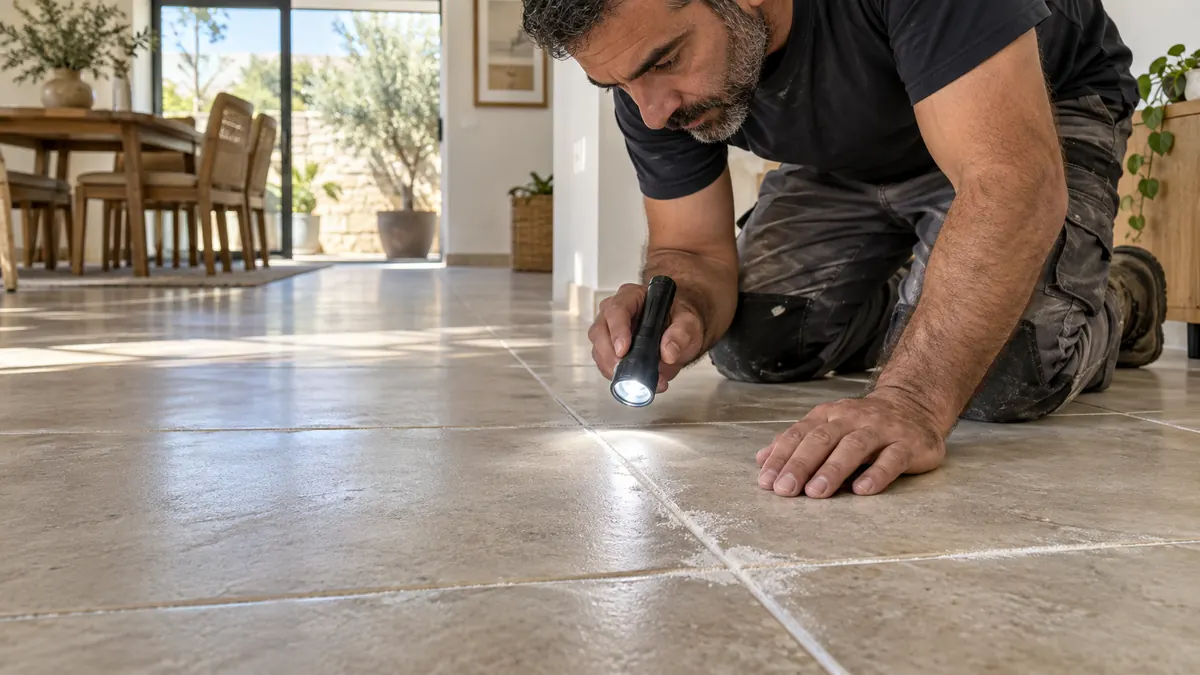
White lines in tile joints do not automatically mean bad grout. On a new floor they may be construction residue; on an older floor, built-up cleaner; in a persistently damp area, minerals carried to the surface by moisture. One chemical will not solve all three. Begin by asking whether the white material returns after cleaning and drying, and where it first appears.
Map the pattern before scrubbing
Photograph the area both dry and wet. Note when it appeared, whether the tile or grout was recently installed, and whether the cleaning product changed. A film over the tile immediately after work suggests installation residue. Powder that returns in the same joints calls for a moisture check. A mark beside a balcony door, shower or cabinet may have a different source. Colour alone cannot identify it; location and recurrence are more useful clues.
How efflorescence forms
The Tile Council of North America explains that water can move soluble minerals toward the surface of cement-based grout, leaving a white deposit as it evaporates. Its next question is where that water is coming from. The council also lists polymer migration and cleaner residue among other causes of white joints. Ordinary periodic cleaning usually does not supply the sustained moisture needed for recurring efflorescence. A stain returning beside a wet wall therefore needs more than repeated surface cleaning.
Start with a small, gentle test
Try a soft dry brush on a small area and vacuum away the loose powder. For a suspected detergent film, rinse only as much as the finish allows, collect dirty water promptly and dry the joint. Do not apply acid casually. Acid can attack cement grout, natural stone, metal and nearby finishes. The TCNA guidance calls for identifying the cause before treatment and cautions that acid cleaning can damage grout.
When to ask a tiler to inspect
Get an inspection if powder returns, joints crumble, tile sounds hollow, a leak is visible or water pools nearby. A tiler should consider joints, floor falls, edges and the route moisture might take before proposing new grout or a sealer. Send photographs after each cleaning, a room plan, surface material, installation age and the list of products used. Ask whether the quote includes moisture diagnosis, a trial treatment and a follow-up check.
Colouring over a joint or sealing it with an unsuitable coating can hide a symptom while leaving moisture in place. At handover, check that the likely cause is documented and that the treatment matches the tile and grout. See our grout guide, then request a tiler with the evidence.
Internal links