🔨Handyman
Shelves and Curtain Rods in Israel: Installation Guide
By KABLAY Editorial · · 12 min read · Updated:
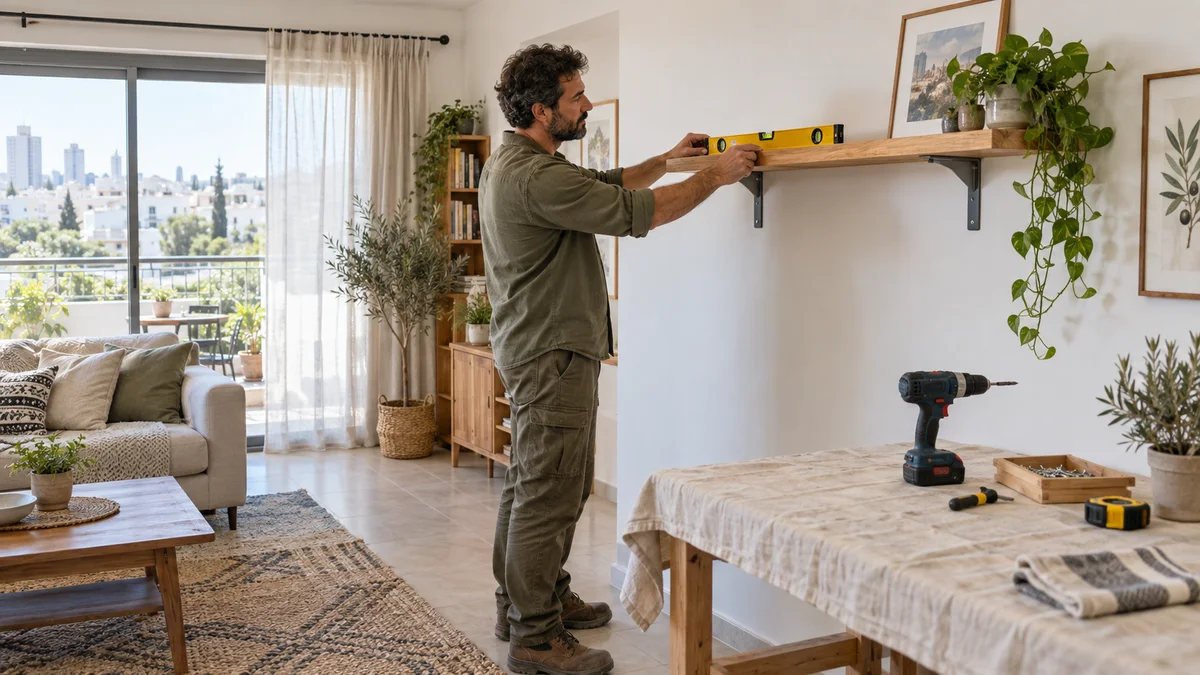
Installing a shelf or curtain rod looks like a short task until the wall turns out to be hollow, the supplied fixings are unsuitable or the curtains obstruct the window. A sound installation starts with the intended use, actual substrate and agreed position. A handyman needs to assess the whole system: item, brackets, fixings, wall and expected load, rather than simply drilling holes for the plugs in the box.
This guide helps you prepare a booking in Israel and inspect the finished work. For other small household jobs, see the guide to handyman services. Here the focus is shelves and curtain rods: avoiding unnecessary holes, agreeing on limitations and getting a useful quote before installation starts.
Describe what the shelf will hold
A shelf for two light ornaments is a different job from a book shelf of the same length. Give the item’s dimensions, depth, own weight and intended contents. A deeper shelf creates different leverage, and the placement of objects affects the connections. “Normal household weight” is too vague to communicate what you plan to put on it.
Keep the instructions for the shelf, brackets and mounting system. Load limits depend on the installation conditions, not just the number of fixings. You cannot automatically add several anchor ratings and treat the total as the permitted shelf load. Ask the installer to explain the limits of the assembled system and the alternatives if the expected contents exceed them.
Identify the real wall construction
A painted finish does not establish whether the substrate is concrete, hollow block, plasterboard or several layers of lining. A tiled surface does not identify the backing either. Share any reliable information from renovations, construction photographs or accessible existing areas. If the construction is unknown, make assessment part of the booking rather than guessing confidently.
With plasterboard, the partition structure, board layers, available reinforcement and support locations matter. With block walls, the type and condition of the block matter. A suitable solution may involve another location, different brackets or prepared reinforcement. Keeping a mark from a layout drawing does not make an unsuitable wall capable of supporting heavy furniture.
Fischer’s plasterboard fixing page illustrates how published properties relate to a particular product and substrate. An individual anchor table is not a universal rating for any partition or completed shelf.
Approve the layout before drilling
Show the intended height and width on a photograph or simple drawing. Check cupboard doors, windows, radiators, switches and walking routes. For shelves above a desk or worktop, consider access to the contents and what sits underneath. An arrangement that looks balanced on an empty wall may be awkward once the room is used normally.
For a curtain rod, provide the window width and show where the system should finish. Opening sashes, window handles, the sill projection and gathered fabric all affect clearance. Ask to see the item’s position or the marked points before the first hole. This makes it easier to avoid a result that is level and neatly mounted but placed differently from what you expected.
Hidden utilities need an assessment
Wiring and pipes may be near sockets, switches, plumbing fixtures and air-conditioning equipment. Their routes cannot reliably be guessed from the wall’s appearance. Share known service routes and relevant renovation history. The installer should consider the context and available checking methods; a detector giving no signal does not by itself guarantee that no service is present.
If the selected location is uncertain, establish a suitable alternative or involve an appropriate specialist first. Do not make a deeper trial hole yourself to find out. Work affecting unknown utilities or the structure of a protected room should not be treated as routine shelf hanging without assessment of the conditions and applicable constraints.
Visible brackets and floating shelves have different geometry
Exposed supports are easier to inspect, but their shape and compatibility with the shelf still matter. With a floating shelf, hidden rods, depth and the connection to the shelf influence stiffness. Ask whether the chosen model can be installed on that particular wall and what parts are required. A bracket that looks similar is not necessarily an interchangeable replacement.
Adhesive or mounting tape does not become an equivalent substitute for a specified mechanical system simply because you would prefer no holes. An adhesive system needs its own manufacturer’s conditions and limits. For books, heavy objects or shelves above a sleeping area, an unexplained assurance that it will hold is not a useful description of the supporting system.
Curtain rods experience regular movement
Curtains are pulled, gathered and sometimes snagged. Consider the way they are used as well as their weight, span, supports and mechanism. Explain whether you have a light curtain, heavy drapes or several tracks. A ceiling installation needs assessment of the actual ceiling substrate; a decorative suspended lining is not the same as the structural ceiling above it.
Check that brackets, end pieces, rings, runners and stops are compatible. Find out about missing components before the visit. A powered system that requires mains connection may need separate qualified work and should not be described as a simple mechanical rod. For a complex system, provide the instructions as well as a photograph of the packaging.
Agree who supplies the fixings
Send photographs of the complete kit, the model marking and the parts list. The plugs supplied in a box may not suit your wall. Having a kit does not necessarily mean installation can proceed without other components. Agree who purchases appropriate fixings and what happens if the assessment reveals a different substrate or missing part.
If you buy the item, clarify whether assembly, shortening or extra supports are needed. Not every model permits a change of length. Removing an existing rod, repairing old holes and moving brackets should be listed separately. A television mount has a different specification; use the television installation guide when combining that job with a handyman visit.
Prepare access and protect the room
Clear the area beside the wall and provide a safe route through the room. Remove fragile belongings and agree on floor and furniture protection and collection of drilling dust. For high work, describe the height and space available for suitable access equipment. An improvised chair placed on a sofa should not become the arrangement for completing the task.
Clarify who moves heavy furniture and whether assistance is needed. Show the wall access without requiring someone to stand on a sill or reach across a bed. Before drilling, check the marks and item orientation together. Keep children and pets away from the tools and open working area while the installation is taking place.
Compare quotes by scope
Several items in one visit may have different pricing conditions from separate small bookings. The wall, height, support count, assembly, alteration and access influence the work. Compare responses to the same description, rather than only an advertised amount per shelf. An assumed average tariff without dimensions and wall information can hide more than it explains.
- Number of shelves and rods, dimensions and work location.
- Substrate assessment, marking, installation and specified fixings.
- Assembly, shortening, parts collection or another visit where needed.
- Removal of existing items, hole filling and painting, with their inclusion stated.
- Total amount, VAT where applicable and approval of newly discovered complications.
For old holes, define the expected finish. A small patch does not necessarily include an invisible paint repair across the wall. If you want a finished decorative repair, agree the area and colour separately. This lets you compare the offers accurately instead of resolving the difference after the installation has already been completed.
Inspect ordinary function without an extreme load test
Check the position, level, surrounding finish and any visible movement during normal use. Do not test strength with someone’s body weight or a sharp pull. Ask the installer to explain the permitted load and how objects should be arranged within the agreed specification. If a fixing moves or the wall starts to break around it, stop using the item and report it.
For a curtain rod, move the curtain along its full working length and check for snagging, clearance and window opening. For a shelf, check access to adjacent doors and correspondence with the approved marks. Keep the product instructions and agreed limits. A few minutes of inspection together is more useful than a destructive improvised test after the installer leaves.
A clear Kablay request
You might write: “Install two shelves for books and one mechanical curtain rod. Dimensions, kit photographs and intended contents are attached. The wall construction is unknown and needs assessment. Proposed positions are marked; a socket is nearby. Please include suitable fixings, floor protection and working dust cleanup, and list old-hole repairs or parts collection separately.” Replace the example with your actual conditions.
Use the Kablay handyman category to describe the items, wall and access. Compare responses against that defined job. A successful installation is one that suits the real load, construction and position, with limits you understand. Those details can be prepared before anyone arrives with a drill.
Internal links
Useful pages on this topic
Frequently asked questions
- Will the supplied wall plugs suit every wall?
- No. Fixings must suit the actual substrate, item and load. Parts in the kit may need to be replaced after the wall is assessed.
- Can a heavy shelf be installed on plasterboard?
- That depends on partition construction, reinforcement, the fixing system and the intended load. Assessment may lead to reinforcement, another location or a different system.
- Can I add the load ratings of several anchors?
- Not automatically. The completed system also depends on the shelf, brackets, geometry, load distribution and substrate condition.
- How should I check the finished installation?
- Check position, level and normal use within the agreed load. For curtain rods, check curtain movement and window clearance. Do not use body weight or sudden pulls as a test.