🔨Handyman
Loose Bathroom Cabinet: Fixings and Safe Repair
By KABLAY Editorial · · 12 min read · Updated:
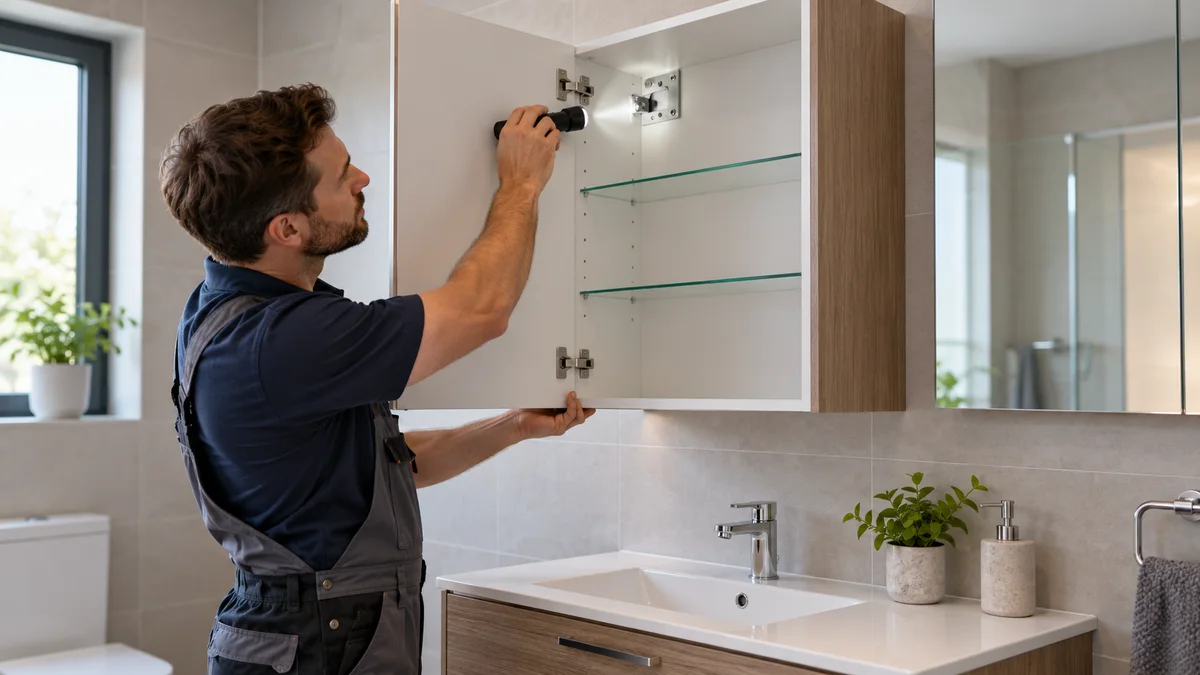
A wall cabinet in the bathroom may begin to move when its door is opened although the visible tile still looks intact. “Just tighten two screws” is a tempting request, but the motion may come from a bracket, fixing, wall, cabinet panel or damaged backing. Tile covers the structure; it does not itself make every screw suitable to carry the cabinet. Until the cause is known, stop loading the unit and avoid pulling it to test strength.
This guide helps you prepare a safe inspection and remounting request. The general guide to shelves and wall fixings covers new installations. A bathroom and an existing loose object add questions about concealed services, tiled surfaces and how any new fixing point affects the wall's moisture protection. The right repair has to address these details, not only silence a rattling door.
Start without a force test
If the cabinet rocks visibly, stop using it and avoid leaving heavy items inside. Empty it carefully if this can be done without pulling the body. Where it seems close to falling, move away and arrange help rather than reaching underneath it. Do not tighten a loaded cabinet while it hangs on uncertain fixings. An improvised person holding it in place is not a durable safety measure, particularly when it has a glass door or mirror.
Keep children away until the unit is assessed. If it hangs above a sink, do not stand or lean on the basin to reach the top. An overall photo taken from a safe distance and a short video of normal door use, only if safe, may help a contractor. Do not deliberately shake it for the camera. The aim is to preserve the evidence and stop using the item, not to make the defect look dramatic.
If the unit already tilts over the basin, tell the contractor how it blocks access. Do not remove glass shelves or doors from an unstable body unless the fixing method is understood. Ask how the location should be kept safe until the visit and whether prompt assistance is appropriate. The bathroom should not simply return to normal use while a suspended object remains unreliable.
Identify which part actually moves
From a safe position, note whether the whole cabinet moves relative to the wall or only a hinged door moves. Has the rear rail pulled away from the body? Is there a gap between tile and mounting plate, a tilt in the cabinet or a crack near a fixing? These observations change the quote. A loose hinge is a different task from a failing wall fixing.
Explain when movement began: immediately after installation, after the cabinet was filled, after bathroom work or gradually without an obvious event. Say whether the gap changes during ordinary opening. Do not pull out shelves or hang from the door to produce stronger evidence. If part of the cabinet has already come away, warn the installer before arrival so a safe removal and assistance can be planned.
Tile does not reveal the wall behind it
Behind a ceramic finish there may be concrete, block, board, a partition or an added facing layer. The fixing has to engage a suitable structure according to the cabinet and wall system. A tidy tile face does not prove that a previous anchor was appropriate. IKEA guidance on bathroom wall cabinets emphasizes choosing fixings for the actual wall material. That principle is helpful; it is not an instruction to use one IKEA kit on every wall.
Provide the cabinet manual, installation drawing and any photographs from the first installation. If packaging from the old fasteners remains, show it without assuming the printed specification proves correct installation. A hole can be enlarged, the base can be weak, or the actual wall can differ from the original assumption. The professional should assess the support point and cabinet condition before choosing replacement hardware.
Concealed services and wet-area layers
Water pipes and electrical cables may pass behind bathroom tile. A new hole a few centimeters away is not automatically safe without understanding the routes. Explain where taps, lights, sockets and accessible service points are located. A drawing can help, but the actual position still needs assessment. Do not make an extra “insurance” hole before the point and method have been decided.
An intervention in a wet area may also affect how the wall is protected against moisture. Treatment of an opening depends on the actual construction and cabinet instructions. If a tile has cracked, a joint stays wet or there are water marks behind the unit, rehanging may be only part of the job. The guide to grout and silicone joints offers questions for a separate finish repair, but it cannot replace assessment of the fixing.
The cabinet itself may be the weak link
The wall rail can remain in place while its connection to a wood-based cabinet panel becomes loose. A stronger wall anchor would not solve that. Have the installer inspect the back panel, carcass joints, hinges and any deformation. Bathroom moisture may have damaged the unit. Swelling alone does not identify the water source, but it matters when deciding whether the body can be reused safely.
A door that rubs neighboring furniture may reflect a hinge problem or an out-of-square cabinet rather than the wall. Do not wedge an arbitrary piece of plastic under a corner to make it look level. Establish that the cabinet can carry its intended load, then level it and adjust the door. A cosmetic alignment is a poor outcome if the main fixing still moves behind it.
Reuse the old holes only after assessment
Remounting may be possible where the unit is intact, the support is suitable and compatible hardware can be installed according to its instructions. Old holes are not automatically reusable. If they are enlarged or enter a weak layer, the installer needs a plan to restore the support or select a verified new point while accounting for services. “Hang it back in the same holes” cannot be promised before inspection.
If the cabinet itself is damaged, discuss replacement of a part or the entire unit. A quote for new furniture includes dimensions, lifting, removal of the old cabinet, disposal and assembly as applicable. Do not buy a heavier replacement before the wall and fixing method are understood. The product choice has to fit the location, access and manufacturer requirements.
Know when another trade is needed
A handyman or installer can inspect the body, visible fixings and access. If the tile backing is weak or wet-area layers must be opened and reinstated, a tiler or another relevant specialist may need to join the work. A damaged pipe belongs to plumbing, while electrical work calls for an appropriately qualified electrician. Do not hide these steps under the single line “screw cabinet to wall”.
Agree the sequence before removing the unit. Who decides when a concealed problem is found? Who restores tile and protection? Who checks the working cabinet at the end? One contractor may organize several activities, but the scope and responsibilities should be clear. For the customer, the boundary between inspection and repair matters more than which worker happened to arrive first.
Send the right photos and product details
Photograph the room, complete cabinet, visible bracket, point of movement and nearby taps, sockets and lights. Include dimensions, model, installation age and whether there is a mirror or glass. Note whether the door can be removed according to the product's instructions. Say if the unit hangs over a basin. Send your precise address through the normal private booking channel, not an open comment attached to photos.
Explain whether the cabinet can safely be emptied and whether two people can reach it. If a fixing is almost out and the object could fall, that fact is more important than a neat close photograph. Do not conceal it to obtain a low quote for routine hinge adjustment. The installer may need to plan a controlled removal rather than merely bring spare screws.
Separate diagnosis and possible repair costs
Ask for inspection to be described separately from possible removal and remounting. The quote should address appropriate fixings, wall assessment, old holes, tile protection, door adjustment and cleanup. If the method can only be chosen after the unit is taken down, agree how further work will be approved. A bathroom with damaged tile or furniture cannot honestly be priced as an uncomplicated new install without conditions.
Ask who supplies parts and how their suitability will be checked against the manual. Do not assume that every generic screw set in a box works for your wall. If a base needs reinforcement or wet-area protection needs restoration, price and trades should be discussed before that section is closed. Photographs of intermediate conditions can later show what was actually repaired behind the cabinet.
Accept the result without hanging on it
After work, the unit should sit in the agreed position without visible movement during normal door opening and closing. Check level, clearances, hinges and the neighboring tile. Ask which support points were used and what happened to the original holes. Acceptance does not mean hanging body weight from the cabinet or overfilling it. Intended loading depends on the product and the wall, not on how solid it feels after one forceful tug.
If wet-area work was included, inspect the agreed restoration of the facing and joints. Keep the hardware details, photographs and a brief description of the substrate for future work. Any hidden part that could not be assessed should be recorded. You are accepting normal safe use of the whole installation, not only a door that no longer squeaks.
A request you can adapt
“The wall cabinet in my bathroom moves during normal opening. It [has/does not have] a mirror, and there is a visible gap at [location]. I can share photos of the full unit, bracket, tile and nearby services. We have stopped using it. Please quote a safe inspection of the fixing, wall and cabinet, then agree remounting, any new holes and tile reinstatement separately.” Replace the brackets with actual details rather than guessing which anchor failed.
Compare responses in the handyman service section by how they plan to assess the wall, treat the wet area and handle a hidden defect. “Just tighten it more” does not explain why the unit began to move. The outcome should restore intended use without causing new finish damage.
Internal links
Useful pages on this topic
Frequently asked questions
- Can I simply tighten a loose bathroom cabinet?
- Movement may come from the wall, bracket or cabinet body. Stop loading it and arrange an inspection rather than pulling it to test strength.
- Why does intact tile not prove a sound fixing?
- Tile conceals the substrate, while suitable hardware depends on the wall and product. The support point behind the facing needs assessment.
- Can the old fixing holes be reused?
- Only after checking their condition, the wall, hidden services and cabinet instructions. Enlarged holes may call for another plan.
- How should a remounted cabinet be checked?
- Check position, normal opening without movement, neighboring tile and the agreed wet-area restoration. Do not hang from the unit.