🔧Plumbing
Plumber in Hadera 2026: sea air, the Orot Rabin industrial zone, and common problems — a neighborhood-by-neighborhood guide
By KABLAY Editorial · · 12 min read
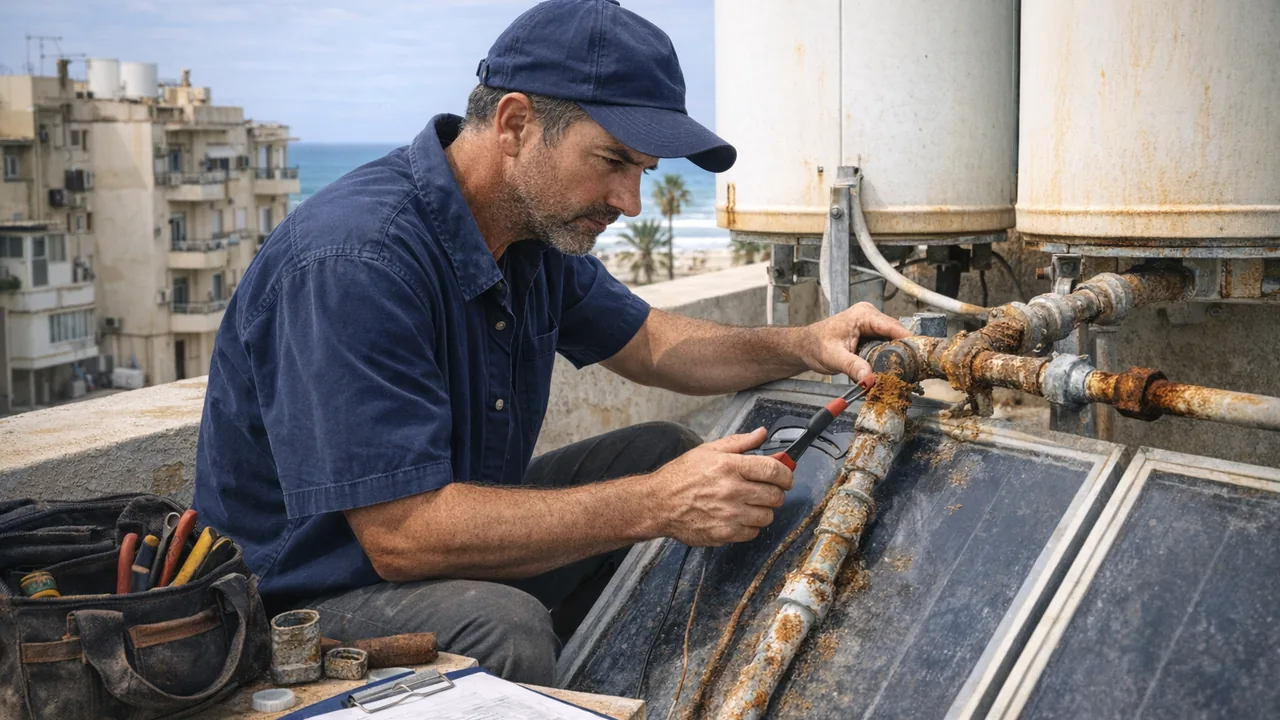
On Israel's plumbing map, Hadera is a completely "mixed" city. It has absorption-era neighborhoods from the 1950s (Bet Eliezer, Shikun Rambam, the old center) where rusted metal plumbing is standard. It has a coastal strip (Givat Olga) where salty sea air destroys a solar boiler in 6-8 years instead of 12. It has very new construction (Park Hadera, Ahuzat Hadera, Pardes HaEshkolot) where problems are developer-warranty issues rather than corrosion. And it has two giant industrial neighbors — the Orot Rabin power station and the IDE Hadera desalination plant — that affect air quality, water pressure, and sometimes hot water temperature.
This guide breaks Hadera down neighborhood by neighborhood, explains which problems are typical in each area, gives 2026 plumber prices (usually 10-20% below Tel Aviv), and lists the critical checks before you hire anyone.
For a Hadera-specific next step: open plumbing in Hadera; if the issue started as a leak or pressure drop, the task guide for leak repair is also relevant.
1. Hadera's unique profile — what most guides miss
Most plumbing guides talk about "Israel" in general. Hadera does not fit that profile because three factors combine here that do not combine anywhere else:
- A direct seafront 1-3 km from most neighborhoods — salty air with 70-85% humidity most of the year. Salt + humidity = accelerated corrosion of any exposed metal.
- The Orot Rabin power station (coal + gas, 2,590 MW) — 7 km north of the city. Although the gas conversion has cut emissions, the air still contains higher-than-average sulfur and nitrogen particulates. This affects outdoor taps, rooftop plumbing, and solar boilers.
- The IDE Hadera desalination plant and connection to the Ashkelon desal plant — Hadera is one of the main junctions in Israel's water grid. The result: water pressure can be inconsistent, and the water gets mineral additions depending on system maintenance. Hadera water hardness: 180-230 mg/L (medium-high — less than Ashkelon but more than Tel Aviv).
The practical outcome: typical Hadera plumbing problems include early solar boiler death, corroded service-balcony connections, moderate-to-heavy scale in taps and pipes, and occasional "strange water taste" periods — usually not a health issue, but a signal that you should check your home filter.
2. Neighborhood breakdown: what to expect by location
Old Hadera center + Bet Eliezer + Shikun Rambam
Hadera's oldest neighborhoods — built 1948-1965. This is the toughest plumbing terrain in the city:
- Main water piping: galvanized iron from the 1950s. Some buildings' vaad bayit replaced it with polyethylene; many did not.
- Sewer piping: some cast iron with rubber gaskets, some replaced with PVC plastic. In buildings that have not undergone major renovation, blockages 1-2 times per year are normal.
- Solar boilers: valves are not always working properly. A shikun rooftop can hold 8-12 boilers of wildly varying condition.
- Water pressure: often inconsistent on upper floors. Some buildings install a small pump on the water panel (₪1,500-3,500 installed including electrical work).
Givat Olga
Hadera's coastal neighborhood. Large Russian-speaking population, which shapes the plumber market (a significant share speaks Russian). Technical profile:
- Aggressive sea air — salt in the air damages anything metal: outdoor taps, rooftop valves, solar boiler bodies. Solar boiler lifetime in Givat Olga is closer to 8 years vs the 12-year national average.
- Mixed construction: 1970s-80s buildings near the shore + newer construction (2005+) slightly inland. Plumbing quality varies dramatically by age.
- High share of "vacation apartments" — apartments left empty for months. Typical problem: the "closed-house syndrome" — standing water, rust, sewer smell after returning. Ask a neighbor or house-sitter to run all drains every 2-3 months when empty.
- Outdoor taps (beach shower, irrigation) — a weak point: sea air destroys them in 3-5 years. Solid brass taps cost more but last twice as long.
Ahuzat Hadera + Park Hadera + Pardes HaEshkolot
The new neighborhoods (2008+). Opposite profile from the shikun:
- New piping, branded taps (Grohe, Hansgrohe, Hamat), mostly new solar boilers.
- Main issues: developer warranty defects. 10-15% of apartments show some issue in the first 1-2 years: a leaking mixer, a seal not tightened properly, a wrong fixture connection.
- New Hadera developers vary in quality — some use excellent subcontractors, some use bottom-dollar ones. Check reviews for your specific project (Zemach Hamerman, Inbal-Or, Shikun & Binui — afterward).
- Critical document: the acceptance protocol (defect report) you signed on handover day. Anything not listed there will be hard to prove you received the apartment with.
Ahuza / train-station area (Bet Sefer HaRealy) + Neve Haim
1970s-90s construction zones. A "middle" state:
- Main piping — partly replaced (often around 2015-2020 as part of major vaad bayit renovations), partly not.
- Solar boilers — usually 8-15 years old, meaning they are at end-of-life or will need replacement within 2-3 years.
- Typical issues: blockages every 2-3 years, cistern leaks, scale in taps (requires disassembly and cleaning every 2-3 years).
3. The 5 most common Hadera plumbing problems
Problem 1: Solar boiler dying early (especially in Givat Olga)
The single most common reason for a plumber visit. Sea air + high humidity + Orot Rabin emissions = corrosion of the tank body, valves, and exposed piping. Early signs: cold water instead of hot in the morning, rust stains on the roof, mild dripping from the valve. Full replacement cost in Hadera: ₪3,800-7,500 depending on type (horizontal/vertical, 150-300L capacity). Tip: ask for a boiler with double galvanization or stainless steel — costs ₪400-800 more but survives 1.5× longer in a coastal area.
Problem 2: Recurring sewer blockages in older buildings
In the center, Bet Eliezer, and Shikun Rambam — this is a recurring experience. External piping (cast iron or old plastic) has accumulated scale and grease, and every 8-18 months a blockage arrives that requires a pressure machine (WC-Jet). Standard Hadera price: ₪450-900 for a one-time clearance, ₪1,200-2,500 for a building main-line flush. Structural fix — replace piping with PVC or HDPE plastic — is a vaad bayit project (₪25,000-80,000 for the building).
Problem 3: Weak water pressure on upper floors
Especially in Givat Olga and the center — 4-6 floor buildings without a pump, where the top floor gets very weak morning/evening pressure (peak usage). Solutions:
- Small apartment-level pump — ₪1,500-3,500 installed. Enough for 2-3 people.
- Building-level pump via vaad — ₪8,000-25,000 (requires committee decision and municipal approval). Better solution, but takes months to arrange.
- Scale removal from apartment piping — ₪500-1,200. Temporary solution but sometimes raises pressure by 30-40%.
Problem 4: Sewer smell in Givat Olga vacation apartments
Typical for apartments left closed for months. Source: a dry trap (the water in the U-trap evaporated, opening a sewer-gas passage). Very simple fix: pour a bucket of water into every drain (kitchen sink, bathroom sink, shower, balcony drain) every 2 weeks when the apartment is empty. If the smell persists — a plumber diagnosis (₪250-450) to check for hidden cracks in the sewer piping.
Problem 5: Small under-sink leaks + scale in taps
Routine maintenance. About every 2-3 years — seal replacement, aerator cleaning, sometimes a full mixer replacement because scale damaged the internal ceramics. Cost: ₪150-600 for fix/cleaning, ₪350-900 for mixer replacement (labor + basic part).
4. Hadera plumber prices — 2026
Hadera prices are 10-20% below Tel Aviv and 5-10% below Netanya. But 20%+ above Ashkelon and Ashdod — because Hadera's plumber market is smaller and competition is less fierce.
Visits and callouts:
- Diagnostic visit (one hour) — ₪180-350
- Daytime emergency (08:00-18:00) — ₪250-400
- Nighttime emergency — ₪400-700
- Shabbat/holiday emergency — ₪600-1,000
Small jobs:
- Kitchen/bathroom mixer replacement (labor only) — ₪200-400
- Under-sink leak repair — ₪250-500
- Trap replacement — ₪180-350
- Aerator + seal cleaning — ₪150-300
- Toilet cistern replacement — ₪400-900
- Sink unclogging (manual/cable) — ₪200-450
Medium jobs:
- Pressure-machine unclogging — ₪450-900
- Electric boiler replacement 50-80L (turnkey) — ₪1,500-3,200
- Hidden leak detection (audio/thermography) — ₪450-1,000
- Apartment water-line scale removal — ₪500-1,200
- Apartment pressure pump installation — ₪1,500-3,500
Large jobs:
- Full solar boiler replacement (150-200L) — ₪3,800-7,500
- Building main-line sewer flush (via vaad) — ₪1,200-2,500
- Water pipe replacement in 3-4 room apartment — ₪5,000-10,500
- Apartment sewer-line replacement — ₪3,500-7,000
- Full bathroom renovation (plumbing + tiling + fixtures) — ₪8,000-22,000
💰 Hadera-specific tip: on jobs over ₪1,000, the price difference between a Givat Olga plumber and an Ahuza/Park Hadera plumber can be 15-25% — because Givat Olga plumbers can visit several apartments per day with a nearby office ("coastal pricing"). Comparing 3 quotes saves a lot.
5. What to check before hiring a plumber in Hadera
- License + professional liability insurance — plumbers in Israel don't legally need a license (unlike electricians), but ₪1-2M liability insurance is standard among professionals. Don't work with someone who doesn't have it.
- Tax invoice — in Hadera the "cash, no invoice" offer is very common. Don't fall for it — without an invoice there is no warranty and you cannot file a claim.
- Written quote before any work over ₪400 starts. Without a written quote, the final price can jump 30-50%.
- Written warranty — minimum 6 months on labor, 12 months on replacement equipment.
- Reviews from your specific area — especially important in Hadera. A plumber who only works in Park Hadera (new construction) doesn't necessarily know how to deal with 1955 iron piping in Bet Eliezer. Ask specifically: "have you worked in my neighborhood?"
6. Hadera vs neighboring cities
- Hadera vs Netanya: Hadera is 5-15% cheaper, but the plumber market is smaller. Netanya has more "boutique" fast-service firms. Hadera has more veteran tradesmen who know the neighborhood.
- Hadera vs Haifa: similar prices, but Haifa's sea-air corrosion is worse (Haifa oil refineries). Hadera's problems are clearer: sun, sea, one industrial source.
- Hadera vs Pardes Hanna-Karkur: almost identical prices, but the agricultural zone around Pardes Hanna has well-water issues (not in public water, but in homes with private wells — rare in Hadera itself).
7. Recommended maintenance schedule for a Hadera home
- Once a year: roof check — solar boiler, valves, exposed connections. Especially in Givat Olga, after winter.
- Every 2 years: clean aerators on all taps, replace main seals.
- Every 3 years: cistern check — internal plastic parts dry out.
- Every 5 years: solar boiler chemical flush (₪400-800) — removes scale and boosts heating efficiency 20-30%.
- Every 8-12 years: solar boiler replacement (in Givat Olga — earlier, 6-8 years).
- The moment you have an unexplained sewer smell, wall moisture stains, or a water bill suddenly 2× higher: plumber immediately.
Summary
Hadera is a city of geographic and infrastructural contrasts. 1955 neighborhoods share the city with 2024 construction. Sea air attacks your roof, and a power station adds more particulates. But with proper maintenance, knowledge of which problems are typical in your area, and 3 quotes before any large job — you can live in Hadera with plumbing that does not produce surprises.
KABLAY is a marketplace connecting clients with independent specialists. KABLAY does not guarantee availability, the number or timing of responses, licensing, documents, price, quality, or outcome; check the specialist and proposed terms before contracting.
Internal links
Useful pages on this topic
Frequently asked questions
- How long does a solar boiler last in Hadera?
- On average 10-12 years, but in Givat Olga and other coastal zones — 6-8 years due to salty sea air and Orot Rabin emissions. A boiler with double galvanization or stainless steel lasts 1.5× longer.
- Why do blockages keep recurring yearly in older buildings?
- Iron/old-plastic piping in 1950-1980 buildings has accumulated scale and grease. Spot unclogging (₪450-900) is temporary; the structural fix — piping replacement by the vaad bayit (₪25,000-80,000).
- Does a plumber in Hadera legally need a license?
- Unlike an electrician, plumbers in Israel are not legally required to hold a state license. What is mandatory: ₪1-2M professional liability insurance and a tax invoice. Without both — do not work with them.
- How much cheaper is a Givat Olga plumber vs a Park Hadera one?
- For jobs over ₪1,000 the gap can reach 15-25%. A Givat Olga plumber usually prices at "coastal rate" because they service several apartments a day in one area.
- What is the water hardness in Hadera and how to handle it?
- 180-230 mg/L — medium-high. Solutions: a main filter at the apartment inlet (₪1,500-4,000 installed), scale cleaning of the water line every 5-7 years (₪500-1,200), chemical flush of the solar boiler every 5 years.