🔧Plumbing
Tree Roots in Sewer Pipes in Israel: Causes, Diagnosis, Removal and 2026 Prices
By KABLAY Editorial · · 14 min read
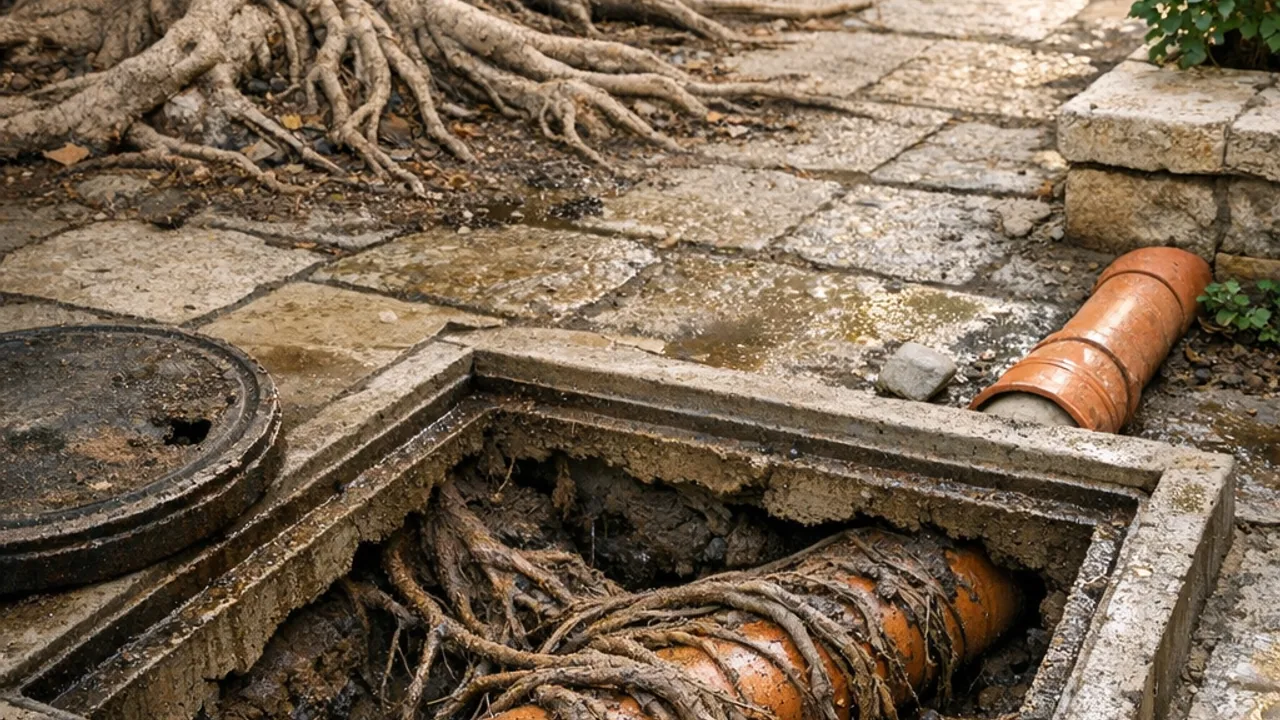
Tree roots in the sewer are one of the most underestimated — yet most expensive — utility problems in Israel. On professional plumber forums in Tel Aviv, Haifa, Petah Tikva and Rishon LeZion this is consistently a top-three cause of major failures, after grease and so-called "flushable" wipes. The danger is that root growth is invisible for years — by the time roots are visibly blocking the pipe, the repair is no longer ₪300 for a snaking but ₪3,000-30,000 for a replacement or trenchless reconstruction.
This guide explains how and why roots get into sewer pipes, which Israeli trees are particularly aggressive (spoiler: municipal ficus trees), how to tell that roots are the actual cause of your blockage, what the removal methods are and what they cost in 2026, how to protect a house or villa for the future, and who pays when a neighboring tree damages your pipe.
When roots or a deep blockage are already obvious: open the task guide for hydrodynamic drain cleaning and the main plumbing page to compare specialists and equipment.
How roots get inside a pipe: the mechanics
Tree roots actively search for water and nutrients — a process called hydrotropism. A sewer pipe is ideal: it is warm and wet inside, rich in nitrogen, phosphorus and organic matter. An intact pipe is inaccessible to them — roots cannot pierce PVC or HDPE. But any hairline crack, joint, loosened coupling or corroded cast-iron section is a "water here" signal. A hair-root (0.1 mm) enters a 0.5 mm crack within a week or two, and then grows inside the pipe like a sponge, thickening and catching every bit of debris.
A typical timeline:
- Year 1-2 — a thin "beard" of 3-5 mm, liquid still passes but debris sticks
- Year 3-5 — a dense mass covering 30-60 % of the bore, slow drainage, smell, periodic clogs
- Year 5-10 — 70-90 % blockage, regular emergency calls, the crack widens under root pressure
- Year 10+ — pipe rupture, ground subsidence above the line, a real failure
Why this is so common in Israel
1. Municipal planting of ficus and sycamores
In the 1960s-1990s, across the whole country — Tel Aviv, Haifa, Rishon, Petah Tikva, Ashdod, Beer Sheva — tens of thousands of ficus trees (ficus retusa / microcarpa) and sycamores (shikma) were planted along the streets. They give dense shade, need almost no watering and look good. But the ficus root system spreads 20-30 meters from the trunk and actively looks for pipe cracks. In older neighborhoods almost every other sewer failure is "a ficus".
2. Old infrastructure
Israel has a massive amount of cast-iron and clay sewer pipe from the 1950s-1980s: the old Ashdod rovas, Holon shikunim, Kiryat Eliezer in Haifa, Neve Amal in Herzliya, old Rishon center. In local climate these pipes last 50-70 years at best, and salty groundwater plus roots accelerate the decay. Thousands of joints and couplings are thousands of entry points for roots.
3. Private villas with fruit and ornamental trees
In a villa or private house (Raanana, Savyon, Ofakim, Yokneam Illit, Kfar Saba, moshav plots) the problem doubles: the owner himself planted mango, avocado, carob (charuv), fig, eucalyptus or a "majestic" melaleuca — and ten years later its roots are inside the septic tank or the line to the municipal collector.
4. Climate
The Israeli climate creates an extreme moisture gradient: 6-7 months a year the soil is bone-dry, while the sewer pipe inside is consistently humid. Roots that would spread laterally in Europe grow deep and down here — straight toward the pipe, as to an oasis.
Israel's most pipe-aggressive trees
- Ficus (ficus retusa / microcarpa) — the main villain of Israeli streets. Roots 20-30 m, extraordinarily aggressive to pipes. Many municipalities stopped planting new ficus after the 2010s.
- Sycamore / shikma (ficus sycomorus) — a close relative of ficus, planted along old highways and boulevards. Same problem.
- Poplar (tzaftzefa) — up to 40 m of roots, the most aggressive moisture-seeker in the world. Rarely planted in cities, but common in older kibbutzim and the south.
- Willow (arava) — literally loves water. Within 10 m of a sewer, it will find the pipe eventually.
- Eucalyptus — widespread in the center and south. Roots are aggressive water-seekers.
- Date palm (dekel tmarim) — a surprise to many: its roots are not particularly deep, but dense and massive, and they break couplings with pressure.
- Avocado, mango, carob (charuv) — innocent on city streets, but a problem next to a septic tank in a private garden.
Rule of thumb: any tree with a trunk over 20 cm in diameter, growing within 3-5 meters of a sewer, is a potential threat. For ficus, poplar and willow the safe distance is 10-15 meters.
Signs that roots — not grease — are the problem
These signals distinguish a root blockage from an ordinary one:
- Recurrence 1-3 months after snaking — grease and hair do not come back that fast, roots do
- Slow drainage from all points at once — not a single sink, but the whole system
- Gurgling in the toilet when the washing machine or shower runs — partial blockage downstream
- Wet patches or soil subsidence in the yard above the sewer line
- Sewer smell in the garden, especially in summer
- The tree or shrub above the pipe looks "too healthy" for the season — it is getting extra water and nutrients from the pipe
- After snaking, the plumber pulled out white, hair-like threads — those are roots
The only definitive confirmation is CCTV camera inspection.
Diagnosis: CCTV sewer camera
A small camera on a flexible cable (8-15 meters, extended versions up to 60 m for the street portion) is inserted through a cleanout or the toilet. The operator sees on the monitor exactly where the roots are, what fraction of the bore is blocked, whether there are cracks, displacements, sags or corrosion.
- Price: ₪400-800 for a live-view inspection; ₪600-1,200 with recording and a written report for insurance or vaad bayit; ₪1,000-1,800 with above-ground location tracking (for planning spot repairs)
- Duration: 30-60 minutes
- Mandatory: before any repair over ₪2,000, before buying an older home or a first-/second-floor apartment in older neighborhoods
Removal methods and 2026 Israeli prices
1. Mechanical cutter (snake with root head)
A standard steel cable with a replaceable root-cutter head. The cable spins, the cutter shaves roots off the inside of the pipe. For light to medium root masses it is fast and cheap.
- Fits when: first attack, "beard" up to 60 % of bore, roots up to 5 mm
- Price: ₪350-700 for a home line, ₪700-1,400 for a common riser or line to the manhole
- Result: problem returns in 6-18 months — roots regrow
- Downside: does not remove the cause, the crack remains
2. Hydro-jetting with a root-cutter nozzle
A nozzle with rotating side jets at 250-400 bar cuts roots and flushes them out. Stronger than snaking and buys more time.
- Fits when: dense root masses, 50-90 % blockage, long runs, street section
- Price: ₪1,200-2,500 for a single home or apartment line; ₪2,500-5,000 for the street portion to the municipal manhole
- Result: 2-4 years without trouble, sometimes longer
- Downside: does not address the root cause; in old cast iron, high pressure can breach a weakened wall
3. Chemical suppression (copper sulfate / RootX / foaming root killer)
A concentrate is poured into the toilet or cleanout — copper sulfate, metallic salt, foaming "root killer". It blocks root growth without killing the tree (in the correct dose).
- Fits when: prevention after mechanical cleaning; houses with a septic tank — only septic-safe formulations
- Price: ₪150-400 for DIY application; ₪500-1,200 professional with proper dosing for the system volume
- Result: roots do not regrow for 12-24 months
- Critical: never pour copper sulfate into a septic tank — it kills the anaerobic bacteria and the septic "stalls". Many Israeli villas have septic tanks — use only septic-safe products
4. Spot repair — section replacement
If the camera shows a crack or a broken coupling, the section is excavated, the bad length is replaced with new PVC or HDPE, and the trench is backfilled. On private property this is half-day to full-day work; in a street it is more complex.
- Fits when: crack is localized to a 50-150 cm section
- Price: ₪3,000-8,000 on private property; ₪6,000-18,000 in the street with municipal coordination
- Result: 30-50 trouble-free years on that section
5. CIPP — trenchless pipe relining (shikum tzineret)
A modern method: an epoxy-impregnated felt or fiberglass "sock" is pulled through the pipe, inflated with steam or compressed air, the resin cures — and a seamless new pipe forms inside the old one. No digging of yards or streets.
- Fits when: pipe is mostly intact but has many joints, cracks and roots; paved driveways; runs under the foundation, a road or a tree
- Price: ₪1,500-2,500 per linear meter. For a 10 m line — ₪15,000-25,000; 20 m — ₪30,000-50,000
- Result: 50-year claimed service life, roots have "no entry points"
- Upsides: no landscape damage, 1-2 days of work
- Downsides: not every Israeli plumber has the equipment (as of 2026 — available in Tel Aviv, Haifa, Jerusalem, Rishon, Netanya, Ramat Gan); unsuitable if the pipe has already collapsed
6. Full line replacement — dig-and-replace
When the pipe has failed along its whole length: an excavator digs a trench, new PVC/HDPE is laid, the trench is backfilled, and the landscape is restored.
- Price: ₪8,000-20,000 for a private home (10-25 m of line), ₪15,000-40,000+ for a villa with a long driveway, ₪25,000-100,000 for the street portion with pavement reinstatement and municipal approvals
- Duration: 2-7 working days + landscape restoration
- Result: 50+ years with HDPE
Who pays: the Israeli legal picture
Private home / villa
Everything within the property line — the owner's responsibility and expense. Even if the tree whose roots damaged the pipe belongs to a neighbor or stands on municipal land: courts almost always rule that the property owner must protect his own pipes with barriers and monitor the trees.
Apartment building
- Inside the apartment — the apartment owner pays
- Common riser — the vaad bayit, costs split among residents
- From the building to the municipal manhole — legally part of the common property, so the vaad bayit. However, if you can prove a municipal tree (street ficus / sycamore) caused it, you can file a claim with the municipality — occasionally partially covered
A municipal tree that damaged your pipe
In theory, the municipality. In practice, compensation is hard to win:
- A camera recording of the damage with root identification is needed
- An independent botanist's opinion — that specifically these roots belong to that tree — is advisable
- Damage must be documented before repair (photos, video, a municipal commission report)
- File with the city improvements department (agaf shipur pnei ha'ir) or landscaping department; if refused — administrative court
- Success rate in practice: around 15-25 % of cases, usually partial compensation
Prevention: 6 rules
- A physical root barrier — a 2-4 mm HDPE sheet placed into the soil down to pipe depth +30 cm, on the tree side. Installed during repair or planting. Price: ₪200-400 per linear meter with material
- Safe planting distance — a tree with a max canopy of 3-5 m: at least 3 m from the pipe; 5-7 m canopy: 5 m; 8+ m (ficus, willow, eucalyptus, poplar): 10-15 m
- Replace old cast-iron and clay with HDPE — a seamless pipe with no couplings, a root cannot get through
- Scheduled camera inspection every 2-3 years when trees are present (₪400-800)
- Scheduled hydro-jetting every 3-5 years where there is risk (₪800-1,500)
- Chemical treatment every 6-12 months after roots first appear — cheap insurance (₪150-400 DIY, ₪500-1,200 professional)
When DIY will not help
Removing roots on your own is essentially impossible. Folk remedies (salt water, vinegar, cola) do not work — the concentration is too low. The one DIY step that does help is applying a foaming root killer as prevention after a professional cleaning: buy it at ACE or a specialty store, pour it per instructions into the toilet for an overnight dwell.
Everything else — diagnosis, cutting, jetting, relining — requires a pro with the equipment.
How to pick a plumber for a root problem
- Has a CCTV camera — without a diagnosis you do not know the scale of the problem, and any repair is blind
- Has a 250+ bar jetter with a root-cutter nozzle — a plain snake only "trims" roots
- Experience with your building type — a private villa and an apartment building require different approaches
- Transparent staged quote: diagnosis first, then options with prices, then the work
- Offers options — a good plumber will show 3 variants (fast-and-cheap / reliable / permanent), not a single "all-in" number
- Written warranty — on jetting at least 6 months, on CIPP at least 5 years, on replacement 10+ years
- Experience with municipalities — if the tree is municipal, the plumber should be able to prepare a claim-ready report
KABLAY is a marketplace connecting clients with independent specialists. KABLAY does not guarantee availability, the number or timing of responses, licensing, documents, price, quality, or outcome; check the specialist and proposed terms before contracting.
Bottom line
Roots in the sewer are not a "rare horror" but a predictable consequence of having a large tree in or near your property while the sewer pipe is 20+ years old. The good news — you can keep the problem under control for ₪800-2,000 per year (regular jetting + chemicals). The bad news — if you let it escalate to a rupture under the foundation or under the road, the bill will run ₪30,000-50,000.
The golden rule: at the first signs, do a camera inspection, not another snaking. Investing ₪500-800 in a camera once will save tens of thousands over the next five years. In older urban neighborhoods and in villas with big trees, an inspection every 2-3 years and jetting every 3-5 years are mandatory items on the house maintenance checklist.
Internal links
Useful pages on this topic
Frequently asked questions
- Does copper sulfate actually kill roots in a pipe?
- Yes — copper sulfate at the correct dose (typically 0.5-1 kg for a whole system) blocks root growth for 6-18 months. Important caveats: strictly forbidden with a septic tank (it kills the bacteria); it accelerates corrosion in old cast iron; and it does not cut roots that are already inside — it only prevents new ones. Use it as a follow-up to mechanical cleaning, not as a replacement.
- Do I need to cut down the tree if its roots get into the pipe?
- Almost never. The problem can be handled differently: an HDPE physical barrier between the tree and the pipe, CIPP relining (a root will not pass through seamless polymer), scheduled chemical treatment. Cutting the tree is a last resort, it usually requires a permit for a municipal tree, and it is a shame on ecological and aesthetic grounds.
- A municipal ficus damaged my pipe — will the city cut it down?
- Most likely no. Israeli municipalities protect street trees: a strong case is needed (collapse risk, documented major property damage, botanist opinion). However, the city will often agree to prune the roots on their side and allow you to install a root barrier at your expense — a practical middle path.
- How often should I schedule jetting if there is a big tree nearby?
- Every 2-3 years. If you have already had a root blockage — annually. ₪800-1,500 per year is cheap compared with ₪20,000-50,000 for an emergency pipe replacement under your foundation or driveway.
- Does CIPP relining really last 50 years?
- In Europe and the USA the method has been in use since the 1970s, with lines still working after 40+ years. In Israel CIPP arrived at scale in 2010-2015, so 50 years of local experience is not yet provable — but the material is the same. The key conditions: correct preparation (full root and scale removal) and a certified contractor with a warranty of at least 5 years.
- Can I identify a root problem without a camera?
- You can strongly suspect one: blockage returning 1-3 months after a cleaning, slow drainage from every point at once, wet patches in the yard, a "too-healthy" tree above the pipe. But only a camera (₪400-800) pinpoints the exact location, scale and pipe condition. Without a camera any repair is guesswork — and usually leads to spending more in the end.