🔧Plumbing
10 Common Home Plumbing Problems in Israel — What They Actually Mean and How to Fix Them (2026)
By KABLAY Editorial · · 15 min read
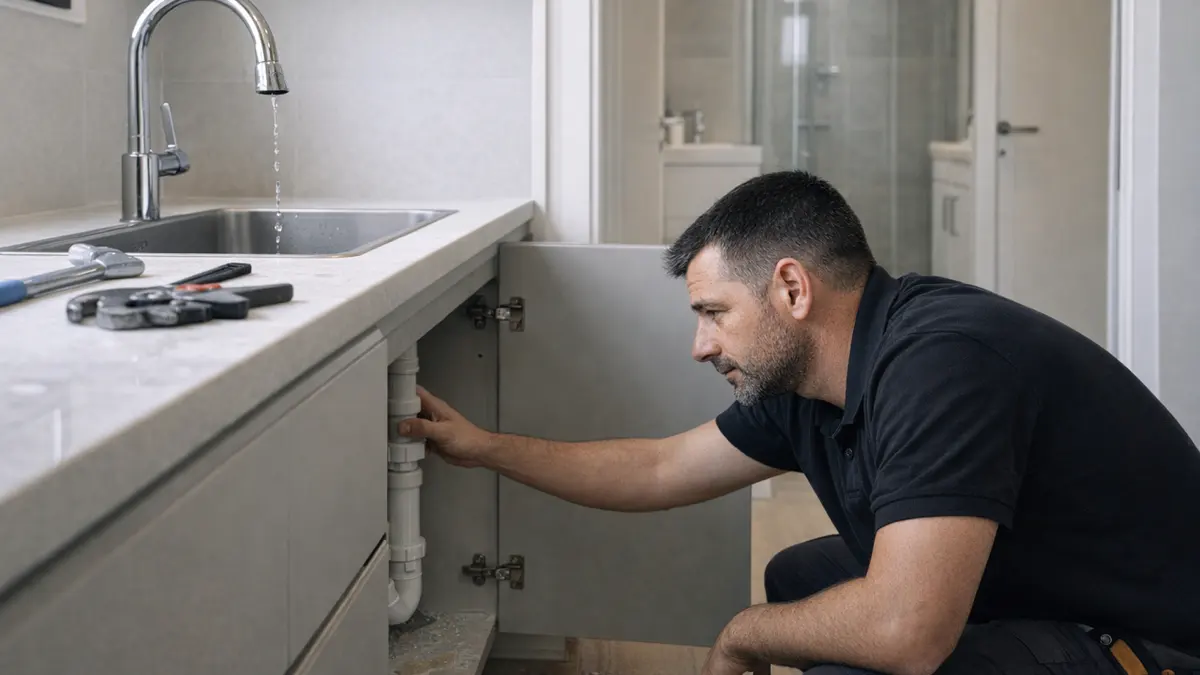
Most homeowners do not google "flexible hose replacement" or "toilet fill valve mechanism" — they google "sewer smell from kitchen sink", "weak hot water pressure", or "toilet keeps running". This guide is organized exactly that way: by the 10 most common problems in the language tenants actually use, with the real cause, a 5-minute check you can do yourself, when you must call a plumber, and the 2026 average Israeli price.
The guide applies to rentals, owned apartments and private homes. Some issues are trivial — ₪30 and five minutes; others require a licensed plumber with a camera; and a few route you straight to the building committee or the municipality.
1. "Sewer smell from the sink / bathroom / drain"
What it actually means: The P-trap (the U-bend under the sink) has lost its water, or there is a crack in the pipe inside the wall.
Common causes in Israel:
- Dry trap — a sink unused for 2–3 days (guest bathroom, summer home) evaporates out and gases flow freely. The most common cause
- Blocked roof vent — every building has a vent stack on the roof; a bird nest or rust blocks it, so gases cannot rise and instead come back through sinks
- Cracked pipe inside the wall — in apartments 30+ years old, cast-iron pipes corrode; gases exit straight into the wall cavity
5-minute DIY: Open the tap for a minute and pour 1–2 liters of water into the sink. Wait an hour. If the smell is gone — it was a dry trap. Once a week, run water through every "unused" sink.
When to call a plumber: If the smell returns within a day, affects multiple rooms, intensifies in summer, or a wet patch appears on the wall.
2026 price: Diagnosis ₪250–450; broken trap replacement ₪200–450; roof vent unblocking ₪500–1,200; in-wall pipe crack repair ₪1,200–3,500.
2. "The toilet keeps making noise — water is always running"
What it actually means: Water is leaking from the tank into the bowl continuously. This is 50–150 liters a day, around ₪20–60/month on your water bill.
Common causes:
- The rubber seal (flapper) at the bottom of the tank has aged or collected scale — #1 cause
- The float is stuck too high — water rises above the overflow pipe and drips into the bowl
- Heavy limescale on the fill mechanism — common in hard-water areas (Ashkelon, south)
5-minute DIY: Lift the tank lid. Check the black seal at the bottom sits flat. Flush, then watch the seal settle back. If not — clean with a cloth, reattach. Still leaking — replace the seal (₪30–80 at ACE/BIG/plumbing supplier). This is considered maintenance, not licensed electrical/gas work.
When to call a plumber: If replacing the seal and float did not help, or if you are unsure about a modern dual-flush mechanism.
2026 price: Full mechanism replacement by a plumber ₪280–550 including parts; diagnostic visit only ₪200–350.
3. "The toilet is leaking onto the floor from underneath"
What it actually means: The seal between the toilet and the drain pipe (wax ring or rubber gasket) has failed. Less commonly — a crack in the ceramic bowl, or loose mounting bolts.
Common causes in Israel:
- A toilet that has been "wobbly" for months — slow seal failure
- Mis-aligned drain after a renovation
- Wax gasket dried out (in summer homes or unoccupied apartments)
5-minute DIY: Wipe the entire base with white tissue. Flush once. After 5 minutes — where is the wetness? Only one corner — gasket; all around in 360° — possibly a cracked bowl. Do not attempt to replace the gasket yourself — it requires lifting the toilet, aligning, and re-compressing correctly.
When to call a plumber: Always. A chronic leak soaks through wood, insulation, the neighbour's ceiling, and becomes a real insurance claim issue.
2026 price: Gasket replacement + re-seating ₪450–900; full toilet replacement (if the ceramic is cracked) ₪1,200–2,800.
4. "Hot water pressure is weak, cold is fine"
What it actually means: A problem specific to the hot side — the main line from the water heater, the tap/cartridge, or the heater itself.
Common causes:
- Limescale inside the water heater tank (Israel's #1 cause) — restricts hot flow
- Scale in the cartridge or aerator of the tap itself
- A manual hot-side valve partially closed
- In villas with solar heaters — weak pressure line to the electric backup
5-minute DIY: Unscrew the aerator (the rotating tip of the faucet), soak it in 9% vinegar overnight, brush, reinstall. In 30% of cases this fixes it alone. Check pressure in the bathroom and toilet — if only one tap is affected, it's the tap; if the entire home, it's the heater.
When to call a plumber: If pressure is weak throughout; if pipes make rumbling sounds; if the heater is over 8 years old and has not been descaled.
2026 price: Heater descaling ₪400–900; cartridge replacement ₪200–450; water heater replacement ₪1,200–2,500.
5. "The water heater is not heating like it used to / goes cold after 10 minutes in the shower"
What it actually means: The heating element is scaled up, the thermostat is bad, or insulation in the tank has failed.
Common causes in Israel:
- Heavy scale on the heating element — after 3–5 years without descaling the heater runs at 40% efficiency
- Faulty thermostat — heater shuts off too early
- Insulation leak (you hear the heater "on all the time" but the water is lukewarm)
5-minute DIY: Find the manual heater switch (red button). Turn it on for 20–30 minutes. If the result is cold or lukewarm water — serious issue, call a plumber. Do not disassemble the heater yourself.
When to call a plumber: Immediately; a dead heater in mid-winter is not a two-day wait.
2026 price: Element descaling ₪400–900; element replacement ₪600–1,200; thermostat replacement ₪350–700; full heater replacement ₪1,500–3,500. Night/Shabbat call — +50–100%.
6. "The tap still drips after I replaced the washer"
What it actually means: Most Israeli taps (since ~2000) are ceramic cartridge, not old-style rubber washer. The old "just replace the rubber" trick does not apply — you replace the entire cartridge.
Common causes:
- Worn cartridge (15–20 years, shortened to ~10 in hard water)
- Sand or scale particle jammed inside the cartridge, preventing full closure
- Crack in the ceramic base (rare)
5-minute DIY (if you are handy): Close the apartment main valve. Open the tap (remove cover cap, undo bolt, lift handle). Underneath is a standard 25mm or 35mm cartridge. Note the size, buy an identical one (₪60–180 at ACE). Install. An hour of work saves ₪200–400.
When to call a plumber: If you are not comfortable with tools, or have a non-standard tap, or a wall-mounted bathroom mixer (sometimes requires removing a tile).
2026 price: Cartridge replacement ₪250–500; new basic tap ₪300–700 + labour ₪250–450.
7. "The sink / bathtub drains slowly"
What it actually means: Partial blockage — usually hair + soap in the bathroom, grease in the kitchen, scale in the toilet.
Common causes:
- Blockage in the trap (90% of bathroom cases)
- Blockage in the outlet pipe (60% of kitchens — frozen grease)
- Incorrect slopes (renovation error, rare)
- Deep blockage in the shared stack (requires a plumber with a long auger)
5-minute DIY: Do not pour chemical drain cleaners into acrylic sinks or old HDPE pipes — they destroy gaskets. Instead: 1) remove the P-trap (one or two screws, bucket underneath), clean out hair / grease / soap, reattach. 2) For kitchen grease — 1 liter boiling water + 2 tbsp baking soda + 0.5 cup vinegar, pour, wait 30 min, flush with hot water.
When to call a plumber: If the clog returns within a week (deep blockage); if drainage is slow throughout the whole home (stack issue); if you hear "gurgling" in the toilet when using the sink (vent problem).
2026 price: Trap cleaning (as part of visit) ₪250–450; auger on the stack ₪400–900; long auger to the city sewer ₪700–1,500; camera diagnosis ₪400–800.
8. "The toilet gurgles when the washing machine runs"
What it actually means: Partial blockage in the shared building stack, or a vent problem. The machine discharges a large volume of water quickly, and air gets sucked through the toilet instead of through the vent.
Common causes:
- Shared stack partially blocked (neighbours' hair, grease, wet wipes)
- Rooftop vent blocked (bird nest, leaves)
- Common stack trap blocked
5-minute DIY: Ask neighbours on the floor above and below if they see the same problem. If yes — this is a shared stack, vaad bayit (building committee) responsibility. If only you — apartment-level issue.
When to call a plumber: Always; do not settle for a regular auger — a shared stack needs proper equipment.
2026 price: Stack cleaning (vaad bayit responsibility) ₪800–2,500; roof vent unblocking ₪450–1,200; camera + deep clean ₪1,500–4,000. Israeli law: in most cases the vaad bayit pays for shared stack cleaning.
9. "Hot water suddenly goes cold in the middle of a shower"
What it actually means: Either the heater has emptied, a non-thermostatic mixer reacts to pressure drop when someone else opens a tap, or a gas valve is failing (on gas heaters).
Common causes in Israel:
- 50–120L electric heater has emptied — long showers, back-to-back usage
- Someone started the washing machine / flushed — cold-side pressure dropped
- Solar heater depleted (winter, multiple cloudy days)
- Old mixer without thermostatic compensation
5-minute DIY: After the cold blast, wait 45–60 minutes (time for a 100L tank to reheat). If fine — heater emptied, behavioral fix; consider shorter showers by 20 min; if cold returns in under 30 min — the mixer is the issue.
When to call a plumber: If this happens after every 5–10 minute shower — the heater is bleeding or the element is dead. In winter with a solar heater — consider an electric backup.
2026 price: Thermostatic mixer replacement ₪350–800; element descaling ₪400–900; new heater ₪1,500–3,500.
10. "White foam or 'milky' water comes out of the tap"
What it actually means: Almost always — air in the line. Not dangerous, does not need a plumber. Happens after Mekorot (water company) interruption.
Common causes:
- City water outage or pressure event — air enters as water returns
- Boiler/pipe replacement at a neighbour's
- Street repair by Mekorot
5-minute DIY: Run the tap 2–3 minutes — the foam clears. If not, try again in 30 minutes.
When to call a plumber: If the color is cloudy, brown/yellow and does not clear after an hour — there is a serious pipe problem (rust or contamination). Call immediately, do not drink or cook with it until checked. If it's street-wide — also Mekorot is responsible.
2026 price: Depends on diagnosis. Rusty pipe replacement — ₪1,500–6,500; external contamination — Mekorot's responsibility (free).
Which problems suit a "handyman" and which require a licensed plumber
Handyman or DIY is acceptable:
- Toilet seal or flush mechanism replacement (if you are comfortable with screws)
- Aerator cleaning
- Tap cartridge replacement (with experience)
- Trap cleaning on sink or bathtub
- Mounting a shelf or towel rail
Requires a licensed plumber with third-party insurance:
- Any water heater work (electric, gas or solar)
- Toilet replacement (handling the wax gasket and mounting)
- Work on the shared stack
- In-wall pipe work (opening, replacement)
- Connecting a new washing machine or dishwasher to the main water line
- Any work covered by home insurance — without a licensed plumber, the insurance will deny the claim
When to call and why not to wait
- Visible leak on the floor or wall — same day or next day. Moisture creates mold within 48 hours
- Strong, constant sewer smell — within 3 days; families with young children or pregnant women — immediately
- Wobbly toilet — within a week; waiting breaks the gasket and creates a leak to the neighbour's ceiling
- Clog that returns within a month — camera first, not another auger
- Heater dead in winter — immediately
- Foamy water that does not clear in an hour — immediately, do not drink
KABLAY is a marketplace connecting clients with independent specialists. KABLAY does not guarantee availability, the number or timing of responses, licensing, documents, price, quality, or outcome; check the specialist and proposed terms before contracting.
Bottom line
Most home problems are simpler than they sound. 3 of the 10 problems we described here resolve themselves with ₪30 and 5 minutes — dry trap in an unused sink, tank flapper, aerator cleaning. Another 3–4 need a plumber but in the ₪250–600 range. Only at the extreme end — heater replacement, stack repair, leak under the toilet — do you reach ₪1,500+.
The economic rule: a professional diagnosis at ₪250–450 is always worthwhile if the problem recurs. Use an expert not only to "do", but to "diagnose the actual cause" — it saves far more in the medium term. For older apartments in Tel Aviv, Haifa, Beer Sheva, or Ashkelon, schedule a full plumbing inspection every 3–5 years — including a camera on the main line, a catalogued report, and a maintenance plan.
Internal links
Useful pages on this topic
Frequently asked questions
- Which tasks fit a "handyman" rather than a plumber?
- Toilet tank seal replacement, aerator cleaning, trap cleaning, shelf mounting, furniture assembly — any action that does not touch the heater, in-wall pipe or main connection. For these, a handyman at ₪150–350 is more reasonable than a plumber at ₪400+.
- How much does a plumber visit cost in Israel 2026?
- Standard visit with diagnosis only: ₪250–450. Emergency visit at night / Shabbat / holiday: +50–100% (meaning ₪400–900 just for arrival). Additional labour priced by item.
- Who pays if the problem is in the shared stack — me or the vaad bayit?
- Per the Shared Buildings Law: all shared plumbing (vertical stack, collectors, connection to the city sewer) — vaad bayit's responsibility. Anything inside your unit — yours. It is worth arming yourself with a plumber's report that confirms the boundary before engaging the committee.
- Does home insurance cover plumbing repairs?
- Usually covers sudden damage (a burst pipe, leaking heater), not wear (an aged gasket). Depends on the policy. Keep every plumber's protocol — mandatory in a claim.
- Does a plumber in Israel need a license?
- A separate state license for plumbers does not exist in Israel (unlike electricians / gas technicians). However, third-party insurance is mandatory for any trade working in homes, and gas technicians require a Gas Authority license. Choose a plumber with proven insurance and 5+ years of experience.
- Can I replace a flexible hose (pop-up braided pipe) to the sink myself?
- Yes — technically and legally it is maintenance work. Close the main valve, unscrew the hose (two nuts), install a new one (₪15–40 at ACE), hand-tighten + a nut. Check for leaks for 24 hours. This is one of the simplest and most cost-effective DIY tasks.