🎨Painting and plaster
Mold in Israeli Apartments 2026: Causes, Professional Treatment, Prices, and Prevention — The Complete Guide
By KABLAY Editorial · · 14 min read
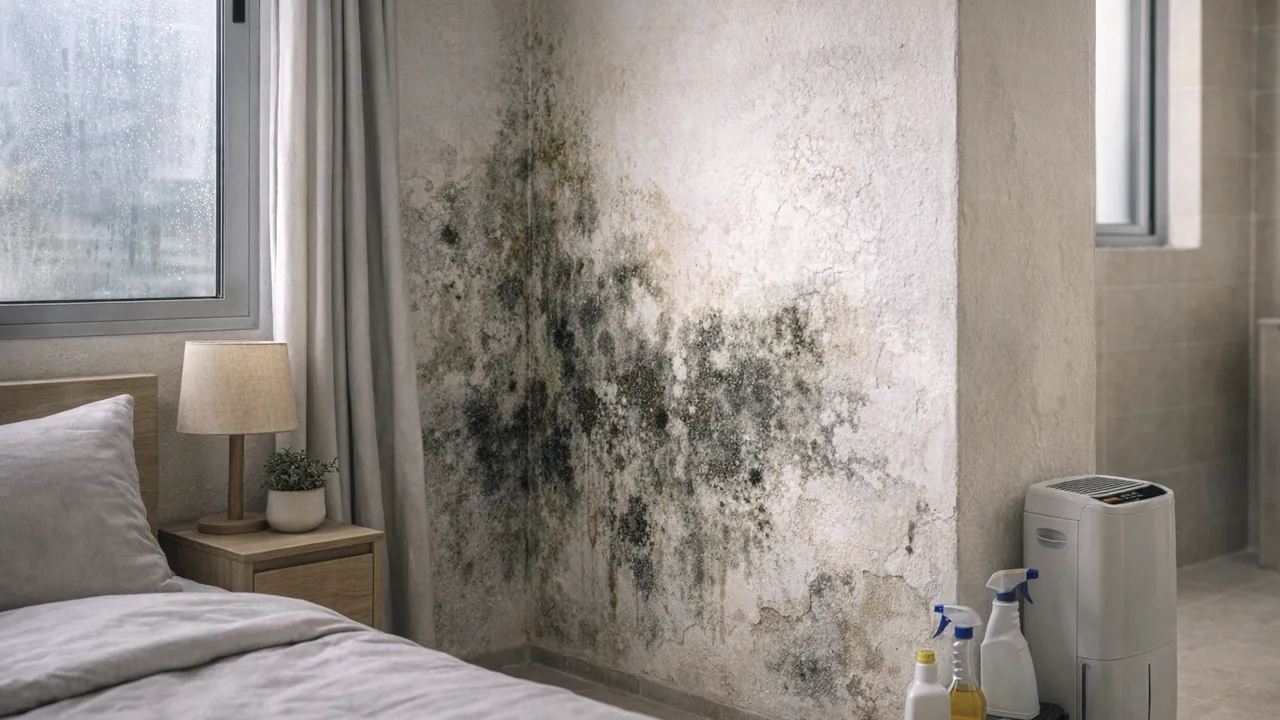
Mold in an Israeli apartment is not a "personal issue" — it is a systemic one. The combination of a humid Mediterranean climate, a 4-5 month rainy winter, intensive use of wall ACs that produce condensation, and dense concrete construction that does not "breathe" — creates a perfect environment for mold. According to the Ministry of Health, about 30% of apartments in Israel suffer from visible mold in at least one area, and the rate jumps to 45-55% in coastal neighborhoods (Herzliya, Bat Yam, Givat Olga, Netanya, Haifa).
This guide explains how to identify your mold type, when you can treat it yourself vs when you must call a specialist, 2026 prices for professional cleaning and repainting, what insurance covers and what it does not (the big gap that costs most clients thousands of shekels), and how to prevent the problem from coming back.
If mold in your apartment is more than just a paint issue: also look at the painting and plastering page and the practical guide on painting walls correctly.
1. Why mold is a distinctly Israeli problem
No other country in the region combines all these factors in one:
- High external humidity — on the coast (Tel Aviv, Netanya, Haifa) relative humidity is 65-85% most of the year. Mold starts growing on a wall holding over 60% moisture.
- Rainy, short winter — 400-600 mm of rain concentrated in 4 months (November-February). Leaks from a roof, poorly sealed windows, or an exterior wall — a classic mold source.
- Massive AC use — Israelis run AC about 6-7 months a year. An AC produces condensation on the wall behind it and inside the closet. If its drainage is clogged — water seeps into the wall.
- Concrete construction + partial external sealing — most buildings in Israel built before the 1990s never received quality external waterproofing. A north-west wall (which gets direct rain) absorbs water all winter and transfers it inward.
- Poor ventilation — bathrooms without a window or with a sealed window, kitchens without a working hood — produce permanent "humidity pockets".
2. The 5 most common mold locations in an Israeli apartment
Location 1: bathroom ceiling
The most common by far (60%+ of callouts). Cause: no fan, or a fan too weak / not vented outside. After a shower, water vapor condenses on the ceiling. Within weeks — small black spots appear, usually in corners. Black mold (Stachybotrys) is the type that often shows up here — health-dangerous under prolonged exposure.
Location 2: wall behind/next to the AC unit
Second most common. Cause: a clogged or badly installed AC drain. Water seeps into the wall and reaches the concrete. Result: a dark damp stain around the AC, sometimes with green-yellow mold. If neither the AC company nor the renovator addressed it — it returns every summer.
Location 3: external north/west wall (behind a closet or bed)
Most typical in 1960-1990 construction. The building's exterior wall is poorly waterproofed, absorbs rainwater in winter, and its low temperature causes internal vapors to condense. Result: black stains behind closets or beds, discovered only when you move the furniture. If there is an "old smell" in a room even when it is clean — the wall is likely the source.
Location 4: under windows (window sill)
Older aluminum windows (up to the 1990s) are usually not tight. Rainwater enters between the frame and the wall and accumulates in the sill. Result: mold on the bottom line of the window, usually black-green.
Location 5: kitchen — behind the sink, under the fridge
Chronic drip from a water pipe / dishwasher / water leaking after mopping the floor and entering under the lower panels. Mold here is usually pink-brown (Aureobasidium) — less dangerous, but a clear humidity signal.
3. The 3 types of mold common in Israel — visual ID and health risk
Type 1: black mold (Stachybotrys chartarum)
- Appearance: round black spots, usually with "wet" slime. Grows mainly on bathroom ceilings, external walls, and areas with prolonged leaks.
- Health risk: high. Produces mycotoxins that cause shortness of breath, chronic headaches, mental fogginess, and in people with asthma — severe attacks. Prolonged exposure in children under 3 can cause permanent respiratory issues.
- Action: do not DIY. Call a specialist immediately; until treated, close the room / turn off AC / do not sleep in that room.
Type 2: green mold (Cladosporium / Aspergillus)
- Appearance: green, yellow-green, or black-green spots. Usually dry and spotty. Grows on walls, windows, clothing closets.
- Health risk: moderate. Triggers allergies, sneezing, eye irritation. Worsens asthma attacks.
- Action: small area (less than 30×30 cm) can be DIY with vinegar / household mold remover. Large area — pro.
Type 3: pink-brown mold (Aureobasidium)
- Appearance: pink, brown, or purple streaks. Typically grows on bathroom seals, toilet joints, external piping.
- Health risk: low. Mostly an aesthetic issue and an indicator of persistent humidity.
- Action: DIY — vinegar, stiff brush, drying. Repeat every two months.
4. DIY vs professional: the red line
You can DIY if:
- Area is under 1 m²
- It is pink or green mold (not black)
- The wall/ceiling looks dry under the stain (not "puffed" or peeling)
- No strong mold smell in the room
- No asthma / severe allergy sufferers in the household
Safe DIY method:
- Wear gloves, an N95 mask, safety glasses, old clothes.
- Open a window for ventilation.
- Wet the stain with a solution of white vinegar (70%) + water (30%). Wait 10 minutes.
- Scrub with a stiff brush.
- Wipe with a white cloth that you then throw away.
- Repeat with bleach (10%) + water (90%).
- Dry with a hair dryer or fan until fully dry.
- After 48 hours — paint a coat of anti-mold paint (Dupont, Tambour Resistant, Nirlat AntiMold).
You must call a pro if:
- Area is over 1 m²
- It is black mold (round black spots)
- The wall/ceiling is "puffed", peeling, drywall is loose
- Strong mold smell even after ventilation
- Someone has asthma, allergies, infant, child under 3
- It returns after DIY treatment (sign the root cause is deep — hidden leak, external sealing breach)
- You see stains inside closets, behind furniture, in the living room (not just the bathroom)
5. Professional treatment: 4 stages
Stage 1: source diagnosis (₪250-500)
A serious pro never starts with cleaning. They first find the source, using:
- Moisture meter (measures % moisture in the wall)
- Thermal camera (reveals a cold-wet wall even under paint)
- Visual inspection of roof, AC, windows, surrounding piping
Without source detection, any treatment is temporary.
Stage 2: fix the source (variable cost)
- Seal a leaking window — ₪200-600
- Fix AC drainage — ₪150-400
- Fix pipe leak — ₪250-800 (by size)
- External wall sealing (shared building — via vaad) — ₪2,500-15,000 per full wall
- Aluminum window repair — ₪400-1,200
Stage 3: professional cleaning and sterilization (₪450-2,500 by area)
Includes:
- Removal of affected drywall where mold has penetrated (if any)
- Application of professional fungicide (not household bleach — materials like Remmers Adolit Feucht, Caparol Capatox)
- Second moisture-meter check after drying
- Drywall restoration if removed
Stage 4: anti-mold painting (₪400-3,500 by area)
An anti-mold primer + 2 coats of paint. Proven brands in Israel:
- Tambour Resistant — interior anti-mold paint (₪280-380 per gallon)
- Nirlat Fungi Guard — advanced interior (₪260-360 per gallon)
- Dupont AntiMold — imported, costs more but lasts 1.5× longer
- Caparol IndekoPlus — premium paint that is also acoustic
6. 2026 prices for professional mold treatment
Small jobs (up to 2 m²):
- Diagnosis only — ₪250-500
- Spot cleaning + spray + paint — ₪900-1,800
- Standard bathroom ceiling — ₪1,200-2,400
- AC area (wall + ceiling) — ₪1,400-2,800
Medium jobs (2-8 m²):
- Full wall in a room — ₪2,200-4,500
- Two walls (e.g., bedroom behind a closet) — ₪3,500-7,000
- Full bathroom (ceiling + walls) — ₪3,000-6,500
Large jobs (full rooms / whole apartment):
- Full 12-15 m² room — ₪5,500-11,000
- 80-100 m² apartment with distributed mold — ₪18,000-40,000
- Full external wall project + interior (requires vaad bayit) — ₪25,000-80,000
💰 Tip: do not accept a "flat" quote (₪ per room). A serious quote is per m² + materials list + diagnosis details. The spread between 3 quotes for the same job can reach 45%.
7. Insurance: what is covered and what is not (the big gap)
This is the section that saves you ₪10,000 or wastes you ₪10,000. In most Israeli home policies:
Usually covered:
- Mold from a sudden leak (burst pipe, washing machine fire, solar boiler leak)
- Adjacent damage (floor, furniture, electrical)
- Structural restoration after the leak
Usually not covered (the big gap):
- Mold from condensation — 70% of Israeli cases. AC, window, external wall — usually classified as "wear" or "poor maintenance".
- Mold from an undetected slow leak — if a small leak went unreported for months, the insurer can claim "negligence".
- Damage to personal items — in most basic policies.
What to do before filing a claim:
- Photograph everything — before cleaning anything.
- Order a plumber/electrician to document the source in writing.
- Save invoices for every action (diagnosis, source fix, cleaning, painting).
- File within 90 days of discovery (Israeli standard).
- Hire an insurance consultant (₪500-1,500) before agreeing to any offer from the insurer — they will offer less than what is due.
8. 10 common homeowner mistakes
- Painting "over" the mold — mold keeps growing under the paint and returns within 3-6 months.
- Using bleach only — kills surface mold, not the roots.
- No source detection — cleaning is temporary if the AC still leaks.
- Only fan / open window — helps prevention, not elimination.
- Ignoring a bathroom without a fan — if there is no fan, installation is mandatory (₪500-1,500) — otherwise any treatment will return.
- Using AC to "dry" humidity — AC only reduces humidity in its zone and creates condensation on the wall behind it. Not a real solution.
- Ignoring incorrect drain trap slopes — many Israeli bathrooms connect to the toilet line incorrectly, increasing odors and mold.
- Not cleaning the AC filter every 6 months — dirty filter = clogged drain = wall mold.
- Storing damp items in a closet — wet towels, swimsuits — feed mold inside the closet.
- Using non-anti-mold paint in a damp area — a ₪100-200 difference per room, but the wrong paint fails within a year.
9. Prevention: how not to return to this war
In every home:
- Install an effective bathroom fan (minimum 80 m³/h) if missing.
- Run the fan 30 minutes after every shower (not just during).
- Clean AC filter every 6 months (₪0 DIY).
- Clean AC drain pipe every 12 months (₪150-300 professionally).
- Keep a 5 cm gap between closet and external wall — allows airflow.
- Dry clothes outside or in a dryer — not on a rack in a closed room.
- Open windows daily, even in winter — at least 10 minutes.
In a coastal home (Tel Aviv, Netanya, Haifa, Bat Yam, Hadera):
- Consider a dehumidifier for sensitive rooms — ₪600-2,000 per unit. Electricity: about ₪40/month.
- Check external building sealing every 2 years (via vaad bayit).
- Use anti-mold paint in every bathroom and on external walls.
10. How to choose a mold specialist in Israel
- Asks questions before quoting — when did it start, where is the AC, was there recent rain, are there children/patients.
- Brings a moisture meter and thermal camera — not just a brush and bleach.
- Written quote with stages, materials, and warranty.
- Minimum 12-month warranty — 24 months is excellent for mold.
- Professional liability insurance — mandatory for mold (possible damage to furniture, electrical).
- Does not promise a "1-2 hour fix" — real mold is at least a day's work, with drying and material phases.
FAQ
Can I sleep in a room with mold?
Small pink/green mold — yes, if ventilated. Black mold or area over 1 m² — no, especially for children, elderly, asthmatics. Move to another room until treated.
Mold on the bathroom ceiling — cheapest fix?
Small problem (under 30×30 cm): vinegar + bleach + 1 coat of anti-mold paint. Cost: ₪150-250 including brushes, paint, gloves. But — without a fan, it will return. Add a fan (₪300-800).
Anti-mold paint vs regular paint — what is the difference?
Anti-mold paint contains fungicide compounds (usually zinc-based) that prevent mold spore germination on the surface. Regular paint does not. Price difference: ₪80-150 per gallon. For a full room — ₪250-500. Worth it.
After a full renovation, is the apartment "protected" from mold?
No. Renovation fixes existing issues but does not eliminate the climatic cause. Israeli construction + no habit change = return within 2-3 years. Anti-mold paint + working fans + dehumidifiers in damp areas — are what really matters.
Mold in a clothing closet — how to treat?
Remove everything. Clean the closet interior with vinegar + bleach. Dry 48 hours with a fan. Spray a fungicide solution (available at "Am Hamapatz" or housewares stores). If the closet is against an exterior wall — pull it 5 cm away, or add an insulation board (₪100-300 per m²).
Can mold return through fresh paint?
Yes, if you did not remove the roots. Spores live in concrete and drywall — regular paint coverage is only a temporary mask. Anti-mold + fungicide spray together = real protection.
Is mold always a health threat?
Not every mold is dangerous. Pink-brown in bathroom joints — aesthetic. Black on a bathroom ceiling — real risk, especially respiratory. If children have unexplained cough for weeks or headaches in that apartment — check for mold.
Summary
Mold in Israel is a systemic problem born mainly from climate + construction + behavior. The correct treatment is in three stages: source detection, sterilization with professional materials, and anti-mold painting. 2026 prices range from ₪900 for a spot fix to ₪11,000 for a full room, and for large jobs 3 quotes are mandatory. Insurance usually does not cover condensation mold — so prevention (fan, clean AC, dehumidifier on the coast) is the smart investment.
KABLAY is a marketplace connecting clients with independent specialists. KABLAY does not guarantee availability, the number or timing of responses, licensing, documents, price, quality, or outcome; check the specialist and proposed terms before contracting.
Internal links
Useful pages on this topic
Frequently asked questions
- Can I sleep in a room with mold?
- Small pink/green mold — yes, if ventilated. Black mold or area over 1 m² — no, especially for children, elderly, asthmatics. Move to another room until treated.
- What is the difference between anti-mold paint and regular paint?
- Anti-mold paint contains fungicide compounds (usually zinc-based) that prevent mold spore germination. Regular paint does not. Price difference: ₪80-150 per gallon, ₪250-500 per room. Worth it.
- Does home insurance cover mold?
- Usually covers mold from a sudden leak (burst pipe, boiler). Usually does NOT cover condensation mold (AC, window, external wall) — and that is 70% of Israeli cases. Before filing: documentation, invoices, insurance consultant.
- After a full renovation, is the apartment protected from mold?
- No. Renovation fixes existing issues but does not eliminate climatic causes. Israeli construction + no habit change = return within 2-3 years. Anti-mold paint + working fans + dehumidifiers — that is what actually works.
- Can mold return through fresh paint?
- Yes, if you did not remove the roots. Spores live in concrete and drywall — regular paint is only a temporary mask. Anti-mold paint + fungicide spray together = real protection.