🏠Stretch ceilings
Stretch Ceilings in Israel: Types, Benefits and Prices per sqm in 2026
By KABLAY Editorial · · 12 min read · Updated:
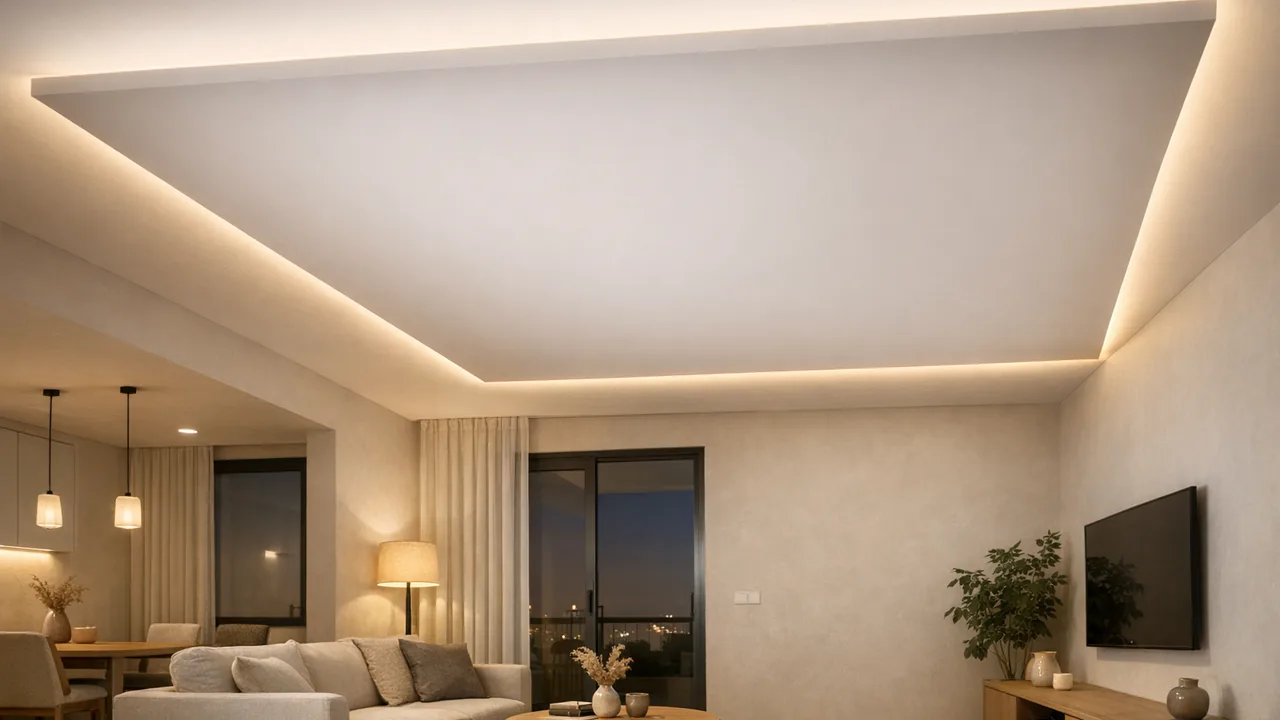
Stretch ceilings are one of the most popular finish options for apartments in Israel in 2026. Contractors estimate that in 6-7 out of every 10 apartments renovated in Tel Aviv, Haifa and Netanya today the client chooses a stretch ceiling over classic plastering and painting. The reason is simple: one working day — and you have a perfectly flat ceiling, with no dust, no week-long noise, and almost no design limits.
In this guide: what types of stretch ceilings exist and how they actually differ, how much they cost in Israel in 2026 (price per sqm and full per-room budgets), how installation works, when you should not install one, and how to pick an installer without overpaying.
If stretch ceilings are only one part of a larger renovation: also check the page for stretch ceilings and the article on renovation budgeting.
What a stretch ceiling is and why it is so popular
It is a thin sheet tensioned on an aluminium or plastic profile fixed around the perimeter of the room 3-10 cm below the base ceiling. The sheet covers imperfections, wiring and utilities and becomes a brand-new finished ceiling in 3-5 hours of installation.
The key advantage over plaster and paint: it does not crack when the building settles (critical for new Israeli construction), it protects against leaks from above (the sheet holds up to 100 liters of water per 1 sqm), it is easy to clean, and it lets you integrate downlights, hidden LED strips and multi-level structures.
Types of stretch ceilings: 5 main options
1. PVC film — the most popular option
A thin polyvinyl chloride sheet installed hot (heated to 60-70°C with a heat gun). Suitable for any heated space. Four finishes are available:
- Matte — flat, glare-free, visually indistinguishable from a well-painted ceiling. The most universal choice. Price in Israel: ₪110-160 per sqm installed.
- Glossy — mirror-like reflection that visually raises the ceiling. Ideal for small rooms, bathrooms and kitchens. Price: ₪120-180 per sqm.
- Satin — semi-matte surface with a soft reflection. The middle ground. Price: ₪130-180 per sqm.
- Lacquer (super-gloss) — maximum reflection, "second floor" effect. Price: ₪160-230 per sqm.
2. Fabric ceilings (polyester with polyurethane)
Strong seamless fabric up to 5 meters wide. Installed cold — no heating — which makes it suitable for unheated spaces (balconies, warehouses). Only matte finish is available. Price: ₪190-280 per sqm. Upside: resistant to sharp objects. Downside: does not hold water well in case of a leak from above.
3. Ceilings with photo print
Any high-resolution image on the sheet — cloudy sky, world map, art reproduction, a child drawing. Adds ₪120-250 per sqm on top of the base price. Common in kids' rooms, living rooms and commercial interiors.
4. Multi-level (two or three tiers)
Two or three planes at different heights with transitions. Visually zones space (living-dining), hides HVAC, and creates a recess for curtain rails. Price: +40-70 % over the base cost.
5. Floating ceiling with LED perimeter
The sheet is separated from the wall by a continuous light line — creating a "floating" look. The biggest design trend of 2026 in Israel. Price of the perimeter: +₪80-120 per running meter.
How much a stretch ceiling costs in Israel in 2026
Average price per sqm (installed)
- Matte PVC (baseline): ₪110-160
- Glossy PVC: ₪120-180
- Satin PVC: ₪130-180
- Lacquer (super-gloss): ₪160-230
- Seamless fabric: ₪190-280
Budget per typical room
- Bathroom 5 sqm: ₪800-1,400
- Kitchen 8-10 sqm: ₪1,100-2,000
- Bedroom 12 sqm: ₪1,500-2,500
- Living room 18-22 sqm: ₪2,700-4,500
- Full 3-bedroom apartment (60-80 sqm): ₪9,000-16,000
Tip: book the entire apartment in a single contract — most crews offer a 10-15 % discount when installing 60 sqm or more at once.
What drives the final price
- Number of downlights — each cut-out in the sheet costs ₪80-150
- Length of LED perimeter lighting
- Complexity of the room shape (corners, protrusions, niches, columns)
- Floor above 5 (extra charge for carrying materials up)
- City: in Tel Aviv and central Israel prices are 10-15 % higher than in Beer Sheva, Ashdod or the periphery
Benefits of stretch ceilings
- Fast installation — 2-4 hours per room, 1-2 days for a whole apartment
- No dust or construction mess — you can live in the apartment during the work
- Hides all imperfections — no need to skim and paint the base ceiling
- Leak protection from above — the sheet holds the water and it is drained through a downlight hole
- 15-25 year lifespan — quality European PVC does not discolor or sag
- Moisture-resistant — suitable for bathrooms and kitchens
- Easy to integrate lighting — recessed LEDs, perimeter strips, floating effect
Downsides and limitations
- Consume between 3 and 10 cm of ceiling height — an issue in older apartments with 2.4 m ceilings
- PVC cannot tolerate temperatures below +5°C or above +50°C — not for cold balconies
- Can be punctured by a sharp object (champagne cork, sharp end of a broom)
- Heavy light fixtures (over 3 kg) require a wooden or metal base plate installed before the sheet — cannot be added later without dismounting
- A mild PVC smell may be present for 1-2 days — dissipates quickly
How installation works: step by step
- On-site measurement (30-60 minutes, usually free). The installer measures the exact area and discusses the sheet type, lighting positions and perimeter options.
- Sheet manufacturing (3-10 days). The sheet is cut in the factory to exact room dimensions with the correct pre-tension allowance.
- Room preparation (30 minutes). Furniture is moved at least 50 cm from the walls; fragile items are removed.
- Perimeter profile installation (30-60 minutes).
- Heating and tensioning the sheet (1-2 hours). PVC uses a heat gun; fabric is installed cold.
- Downlights and ventilation (30-60 minutes).
Total: 3-5 hours per room, 1-2 days for a full apartment.
When a stretch ceiling is not the right choice
- Base ceiling is below 2.4 m and you are not willing to lose another 5-7 cm
- Unheated space — only fabric ceilings will work
- There is an active leak from above — fix it first, install the ceiling later
- A major roof or slab renovation is planned the same year
How to pick an installer in Israel: 5 rules
- Get at least 3 quotes. A 20-40 % spread is normal. A price that looks too low is a red flag — usually no-name Chinese sheet or no real warranty.
- Check the sheet manufacturer. Reputable brands: Pongs and Renolit (Germany), MSD (France), Clipso (France). No-name Chinese sheets are 1.5x cheaper but discolor and yellow within 3-5 years.
- Request a written warranty. Market standard: 10-12 years on the sheet and 2 years on installation.
- Read reviews not only on the company's own site but in independent sources. On KABLAY every review is tied to a real order — fakes are filtered out automatically.
- Do not pay 100 % upfront. Market standard: 30-50 % at order, balance after acceptance.
KABLAY is a marketplace connecting clients with independent specialists. KABLAY does not guarantee availability, the number or timing of responses, licensing, documents, price, quality, or outcome; check the specialist and proposed terms before contracting.
Bottom line
A stretch ceiling in 2026 is fast, clean and relatively affordable. A full 80 sqm apartment with quality European PVC and LED perimeter lighting will cost ₪10-16 thousand installed in 1-2 days. The golden rule: do not chase the lowest price (no-name Chinese sheet is a false economy), check the manufacturer certificate and request a written warranty. Your ceiling will then serve 15-20 years trouble-free.
Internal links
Useful pages on this topic
Frequently asked questions
- How long does a stretch ceiling last?
- A quality European PVC sheet (Pongs, Renolit, MSD, Clipso) keeps its look and properties for 15-25 years. No-name Chinese sheet can start to yellow and sag within 3-5 years — so saving on the material turns out to cost more in the end.
- Can I install a stretch ceiling in a bathroom?
- Yes — a PVC stretch ceiling is one of the best solutions for bathrooms in Israel. It is unaffected by moisture, does not grow mold and wipes clean easily. Just ensure proper ventilation and avoid bulbs over 35 W without a heat sink.
- What happens if the upstairs neighbors flood me?
- A PVC sheet holds up to 100 liters of water per 1 sqm — it stretches into a bag but does not tear. The installer drains the water through a downlight opening, dries the sheet and restores it to its original shape — often without replacement.
- How much ceiling height does a stretch ceiling take?
- Minimum 3 cm if no downlights are recessed and the base ceiling is flat. Market standard: 5-7 cm. With recessed downlights and multi-level designs: 8-12 cm.
- How do I hang a heavy chandelier on a stretch ceiling?
- Any chandelier can be hung, but a plywood or metal base plate must be fixed to the base ceiling BEFORE the sheet is installed. If it was forgotten, the sheet has to be taken down and reinstalled. That is why the chandelier location is discussed during the initial measurement.
- What is the difference between a stretch ceiling and a drywall drop ceiling?
- A stretch ceiling is a single sheet installed in 3-5 hours with a 15-25 year lifespan and water-retention capability. A drywall ceiling is a multi-layer system on metal profiles that requires skimming and painting, takes 3-7 days, and usually needs full replacement after flooding. For most residential cases stretch is both cheaper and more convenient.