🔧Plumbing
Replacing a Water or Sewer Riser in Holon: Building Committee, Responsibility, Wall Opening and 2026 Prices
By KABLAY Editorial · · 12 min read
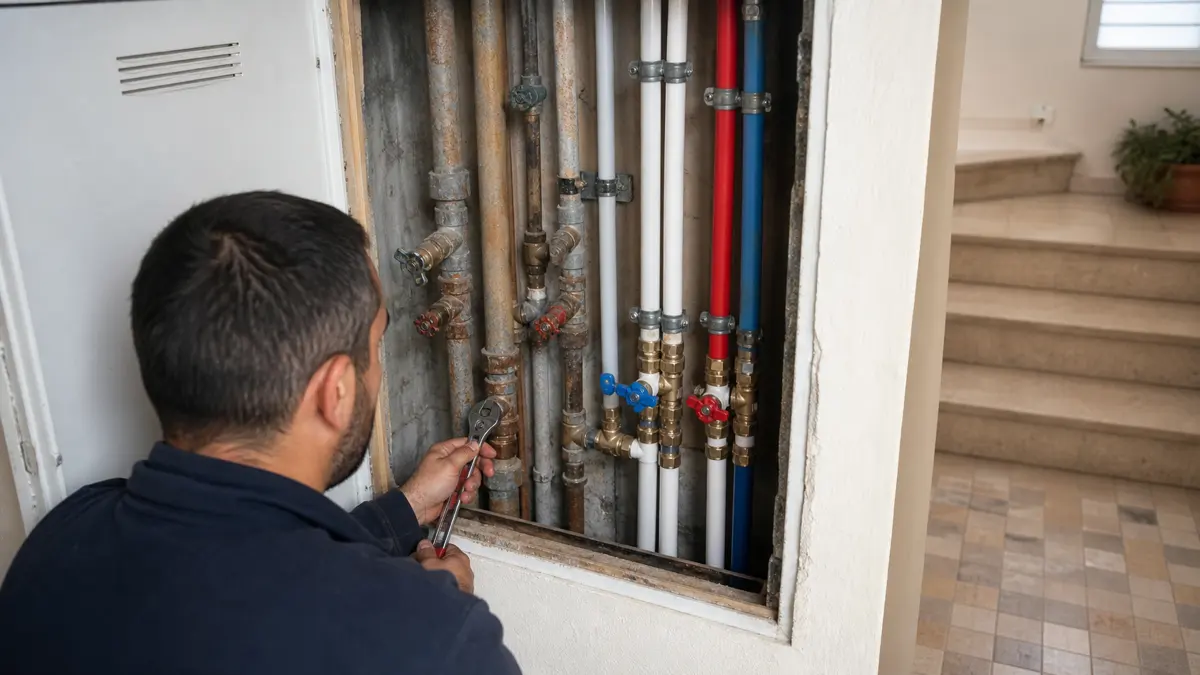
In Holon, especially in older apartment buildings and buildings that went through TAMA 38 or partial renovations, many plumbing faults sit on the border between "mine" and "the building’s". Moisture near a toilet, low pressure, sewer smell, a leak in a service cabinet or peeling wall paint can come from a private pipe, but also from a shared water or sewer riser.
This article continues the Holon plumber guide for older buildings and TAMA 38 projects and connects it to the task page for pipe rehabilitation. The practical questions are: when do you replace a riser, who approves it, what does it cost, and how do you avoid opening a wall unnecessarily?
If the issue already involves a shared riser: open plumbing in Holon, continue to sewer riser replacement or pipe rehabilitation, and prepare photos for the building committee.
What is a riser and what is private piping?
A riser is the shared vertical line running between floors: cold water, hot water, sewer or sewer vent. Branches come out from it into apartments. Usually, the section inside the apartment after the branch is private, while the vertical line serving several apartments is shared. In practice, the boundary is not always clear without opening, camera inspection or pressure testing.
Signs the issue is in a shared riser
- Moisture repeats in the same vertical area in several apartments.
- Sewer smell comes from a service cabinet or shaft, not only one trap.
- Water pressure is weak for several neighbors on the same side of the building.
- A leak gets stronger when a neighbor above uses water.
- Blockages return after normal sink or shower cleaning.
- An old, rusty or crumbling pipe is visible in a service shaft.
Why this matters especially in Holon
- Older buildings — some mid-century and 1970s-1990s buildings still have old metal sections.
- Partial renovations — one apartment replaced pipes, another did not, and transitions become weak points.
- TAMA 38 — added floors and shaft changes can expose problems that were not fully handled.
- Compact apartments — service walls sit close to kitchen, bathroom and toilet, so inaccurate opening affects several areas.
Checks before opening a wall
- Document the signs: photos of moisture, mold, leak, water meter or shaft area.
- Ask neighbors above and below about similar signs or recent repairs.
- Check the water meter when everything is closed in the apartment. Movement points to a private line or feed up to the branch.
- Ask for non-destructive diagnosis: pressure test, sewer camera, wall moisture check or dye test when needed.
- Get building committee approval before work on a shared line, especially if water must be shut off for several apartments.
Treatment options
Point repair
Suitable when there is a small hole, open joint or accessible section. It is cheaper, but not always correct when the whole riser is failing. A point repair on a dead pipe can simply move the leak to the next joint.
Replacing a riser section
A common middle solution: replace the section between floors or inside a service shaft. It requires coordination with relevant apartments, water shutoff and wall or tile repair after the work.
Full riser replacement
When several floors have the same issue, or the pipe is old along its length, full replacement can be cheaper over time. This is a building committee project, not one apartment’s private repair.
Internal rehabilitation without full replacement
In some sewer lines, sleeve/relining work can rehabilitate the pipe without dismantling everything. It requires camera inspection and a report, and it does not fit every diameter or pipe condition.
2026 prices in Holon
- Visit and riser/moisture source diagnosis: ₪250-450
- Pressure test or focused measurement: ₪250-600
- Sewer camera inspection: ₪700-1,800
- Local wall opening and basic closing: ₪600-1,800
- Point repair on a water pipe: ₪700-2,500
- Replacing a water-riser section between floors: ₪2,500-8,000
- Replacing a sewer-riser section: ₪3,500-12,000
- Full riser replacement in a small building: ₪12,000-45,000+
- Tile, plaster and paint finishing after opening: ₪800-5,000+, depending on finish
Who pays?
If the fault is in a private pipe after the branch into the apartment, the apartment owner usually pays. If the fault is in a riser serving several apartments, it is usually a shared building expense through the committee. If there is uncertainty, do not start a large repair without documentation: photos, measurements, a plumber report and sometimes an insurance or assessor opinion.
How to get a useful quote
- Ask for a breakdown: diagnosis, opening, parts, labor, closing and finish.
- Clarify whether the price includes water-shutoff coordination and how long the building will be without water.
- Ask which pipe material will be installed and what warranty it carries.
- Request before/after photos and a short note for the building committee.
- Do not compare only price; access, warranty and wall finish matter just as much.
How to post the job on KABLAY
Write "suspected water/sewer riser in Holon", add the neighborhood if known, floor, whether neighbors have signs, whether it is water or sewer, and whether the building committee is already involved. Add photos of the wall, shaft, meter and damage. If you have a previous report or camera footage, include it so plumbers can quote more specifically.
Summary
Replacing a riser in Holon is not just another pipe repair. It combines diagnosis, shared responsibility, apartment access, wall opening and aesthetic closing. The better you isolate the source before opening, the more money you save and the fewer arguments between residents.
Internal links
Useful pages on this topic
Frequently asked questions
- How do I know whether the issue is a riser or a private pipe?
- Check whether neighbors on the same vertical line have signs, whether your private meter moves, and whether moisture depends on another apartment using water. Sometimes a pressure test or camera is needed.
- Who pays for riser replacement in Holon?
- If it is a shared riser serving several apartments, it is usually a building committee expense. If the fault is in a private pipe after the branch into the apartment, the owner pays.
- Do you always need to open a wall to diagnose?
- Not always. Start with documentation, pressure testing, meter checks, sewer camera or moisture checks. A precise opening is better than broad demolition without diagnosis.
- How long does replacing a riser section take?
- An accessible section can be completed in a workday, but neighbor coordination, water shutoff and wall or tile repair can extend the project to several days.