⚡Electrical work
EV charging station installation in Netanya 2026: full technical guide — equipment, legal, prices, and cliff-top tower challenges
By KABLAY Editorial · · 14 min read · Updated:
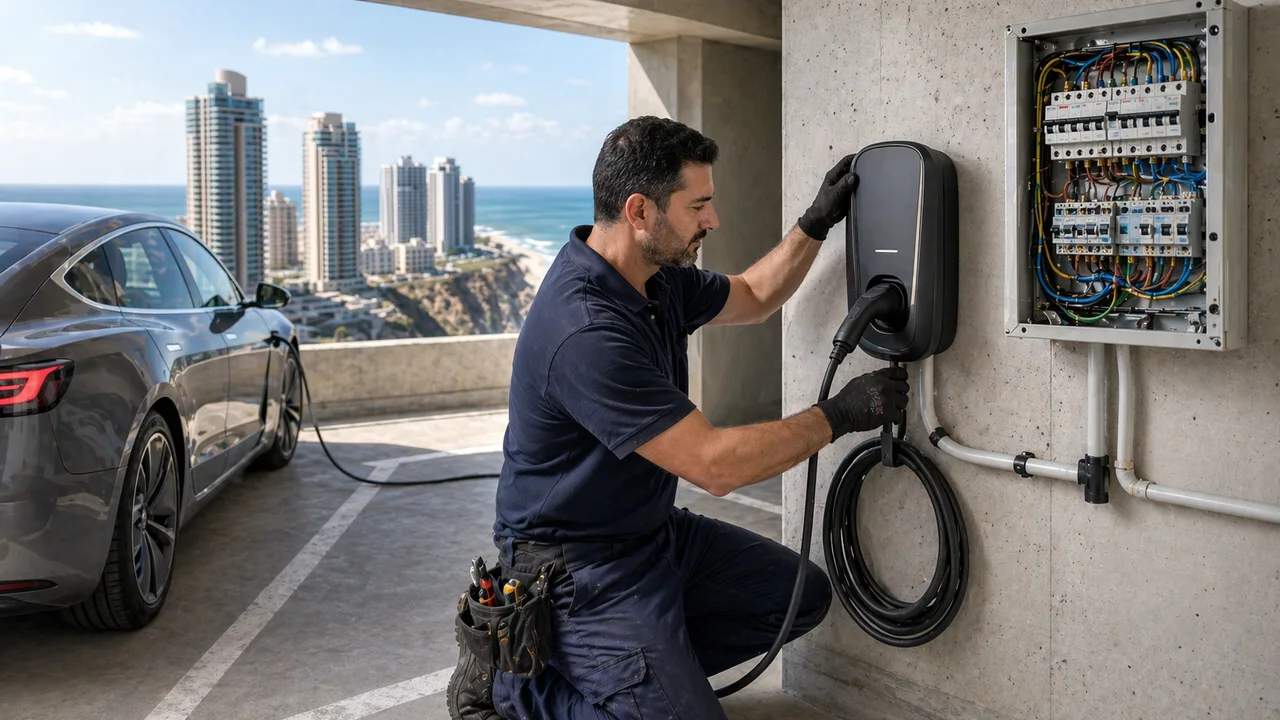
In Netanya, if you own an EV, you're not alone. Tesla density per square kilometer in the city is higher than the national average, and public charging pressure rises accordingly. Many residents turn to installing a home station — and that's where Netanya-specific complexity begins. A 30-floor tower in Tsuk Or, an apartment in Ir Yamim with shared parking, a shikun in Kiryat Nordau, or a villa in Gvat Zion — each is a completely different electrical project with different cost and different process.
This guide is technical. It covers everything you need to install a legal, safe, and efficient charging station in Netanya in 2026: which station type fits your car, legal requirements, vaad bayit coordination, what happens if your panel is too small, and real prices. All electrical work in Israel must be performed by a licensed electrician, with Form 4 for any significant panel change.
1. Why Netanya is the "EV capital"
- Affluent demographics — the French community, vacation-home owners, high-tech workers in Ir Yamim. A segment that adopted Tesla, BYD, Polestar, Kia EV6 early.
- New construction — buildings built after 2020 are legally required to include basic infrastructure (electrical conduit to private parking) — the 2020 amendment to the Planning and Building Regulations. Moving from "empty conduit in concrete" to "full connection" is still a project, but much simpler than in old construction.
- Proximity to Tel Aviv and tech hubs — 50-70 km daily commute. An EV with home charging = ₪1,000-1,500/month more economical than gasoline.
- Dense public charging infrastructure in Netanya itself — but it runs out during peak hours and summer beach season. A home station = independence.
2. Legal framework — what's allowed and what needs approval
A. General rule
EV charger electrical work should be planned and installed by an electrician with a valid license matching the installation. DIY installation can be unsafe, breach insurance terms and trigger correction or enforcement requirements depending on the case.
B. Inspection and documents
Panel changes, capacity upgrades, three-phase work or complex cable routes may require an electrical inspection, signed documentation or Electric Corporation approval. Ask the electrician which document is needed before commissioning the job; costs vary by building and scope.
C. Vaad bayit approval (for shared buildings)
If the station is installed in shared building parking — a written approval from the vaad bayit is required. Under recent case law, the vaad cannot refuse without reasonable cause, but can require:
- An inspection performed by a professional electrical engineer.
- All work cost paid by the tenant.
- A dedicated meter (so the electrical cost doesn't fall on other tenants).
- Professional liability insurance for fire or damage.
Time from request to approval: 30-90 days in most buildings. In upscale buildings in Tsuk Or or Galei Yam with an external manager — sometimes 2-4 weeks.
D. Coordination with the Electric Corporation
If a connection size upgrade is required (1×40A → 3×25A or more), the tenant files a request with the Electric Corporation. Single-phase to three-phase conversion: 30-90 days from payment (the connection itself ₪2,500-6,500 depending on scope). In new buildings the total size is already suitable; in older buildings (pre-2000) this is harder — sometimes the building itself can't support the addition.
3. 4 station types — which fits your car
Charging stations are categorized by power and phase:
3.7 kW (reinforced domestic outlet)
- Single-phase 16A. Not a dedicated station but a reinforced "industrial" outlet (CEE 7 type).
- Suitable for: a family's "second" car driven less than 40 km/day.
- Full charge time for Tesla Model 3 LR (82 kWh): ~22 hours. BYD Atto 3 (60 kWh): ~16 hours.
- Installation cost: ₪1,200-2,500 (existing single-phase + dedicated line).
7.4 kW (standard)
- Single-phase 32A. Requires minimum 1×40A connection (or 1×25A with dynamic load management).
- Suitable for: most EV owners. Full overnight charge.
- Charge time Tesla Model 3 LR: ~11 hours. Atto 3: ~8 hours.
- Popular stations: Wallbox Pulsar Plus, ABB Terra AC, EO Mini Pro 2, Tesla Wall Connector, Schneider EVlink, Beitili (Israeli).
- Hardware price: ₪3,500-9,500.
11 kW (light three-phase)
- Three-phase 16A. Requires 3×25A connection.
- Suitable for: Tesla Model S/X, Porsche Taycan, Audi e-tron. Many cars are single-phase only — check the onboard charger.
- Charge time Tesla Model 3 LR: ~7.5 hours (the car is limited to 11 kW AC). Model S: ~8 hours. Taycan: ~5 hours.
- Hardware price: ₪5,500-12,000.
22 kW (full three-phase)
- Three-phase 32A. Requires 3×40A connection, usually only in private villas.
- Suitable for: families with 2 EVs, or powerful cars with 22 kW AC charger (Porsche Taycan, Audi e-tron GT).
- Charge time: ~2.5-4 hours for most cars.
- Note: most EVs sold in Israel in 2026 are limited to 7-11 kW AC, even if the station is 22 kW. 22 kW only matters if your car supports it.
- Hardware price: ₪9,000-18,000.
💡 Critical tip: check your car's onboard AC charger before ordering 22 kW. Most Tesla, BYD, Hyundai, Kia are limited to 11 kW. 22 kW in them = wasted money.
4. Netanya's unique complexity by neighborhood
Cliff-top towers (Tsuk Or, Galei Yam, Neot Golda)
The most complex neighborhood for installation. Parking is usually in a 2-4 floor basement below the apartment; the building's main panel is usually on the ground floor. Profile:
- 40-80 meter cable length from panel to station. Voltage drop becomes a concern. Heavier cable needed: 10 mm² instead of 6 for single-phase, or 16 mm² for three-phase.
- Cable route passes through common areas — lobby, elevator, parking. Requires detailed vaad bayit approval.
- Meter from the apartment or from a shared meter? Key question. Apartment meter = you pay for electricity but complex wiring. Shared meter = public parking pays (and returns to you through vaad fees) — less common option.
- Installation prices: ₪14,000-32,000 for a full project including cable, breakers, station, Form 4.
- Newer Tsuk Or projects already have conduit pre-cast in concrete — saves 30-40% of cable installation cost.
Ir Yamim
Part of the buildings built after 2020 with ready infrastructure. Others (2012-2019) without:
- Check in the purchase contract or with the developer (Africa Israel, Aura) if conduit is ready for your parking.
- If yes: relatively simple installation (₪6,500-12,000 for 7.4 kW station).
- If not: ₪11,000-22,000 depending on cable length and vaad approval.
- Advantage: in Ir Yamim many residents already installed — the vaad is already familiar with approval. Less friction.
Ahuza / city center / Kiryat Nordau / Kiryat Eliezer
The old neighborhoods. Here the problem is most severe:
- Most apartments have 1×25A or 1×40A connection — not enough for 7.4 kW when an AC + washing machine are also running.
- Aluminum wiring in old systems — old aluminum connections (1960-1980) make the project complex. An aluminum specialist needed.
- Parking usually on the street or in a shared lot — no private parking, making it nearly impossible to install a home station. Solution: shared building station, or public charging only.
- Three-phase upgrade required in 80% of cases. ₪4,500-9,500 for a full project including upgrade + station + Form 4.
Ramat Poleg / Neot Shaked / Neot Ganim
Most buildings from 1990-2010. Private parking in many lots, reasonable electrical connection:
- Usually existing 3×25A connection or easy upgrade.
- Fewer vaad constraints (smaller buildings, faster decisions).
- 7.4 kW installation price: ₪7,500-14,000.
Marina / Gvat Zion / HaNofesh
Private villas. The simplest:
- Usually already 3×40A with a large panel.
- 11 or 22 kW easily installable.
- 22 kW price: ₪12,000-22,000 (expensive hardware + relatively simple installation).
5. Step-by-step: from decision to charging
- Check your car — what's the onboard AC charger? (Tesla Model 3 = 11 kW / Tesla S = 16.5 kW / BYD Atto 3 = 7 kW / Polestar 2 = 11 kW). This determines the station type.
- Check your existing panel — what's the connection size? How many free breakers? A professional electrician checks in 30 minutes (₪300-500). If the panel is full — a panel upgrade (₪2,500-4,500) is needed before adding a station.
- Load calculation — sum of the home's maximum consumption + charging station. If load exceeds 80% of connection size, a connection upgrade is needed.
- Vaad bayit approval (for towers) — written request + plan + electrical engineer approval (₪500-1,500) attached to the request.
- Hardware order — station + cable + breakers + Type B RCD (mandatory for AC Mode 2 charging stations). Delivery time: 1-3 weeks.
- Installation — 1-3 working days for the electrician, depending on complexity.
- Form 4 — a certified electrical inspector arrives, inspects the installation, signs. 2-5 days after installation.
- Activation with Electric Corporation — if there was a connection upgrade, activation takes 5-10 business days. If not — the station works immediately after Form 4.
6. Choosing a station: features to check
- Power (3.7 / 7.4 / 11 / 22 kW) — per the car.
- IP rating — IP54 minimum for outdoor, IP65 preferred. In Netanya with salty air — IP65 mandatory.
- Dynamic load management (DLM) — the station "knows" how much the total connection can supply and reduces charging load if the home uses a lot. Critical for apartments with small connections.
- Communication: WiFi / 4G / Bluetooth for app management.
- OCPP 1.6/2.0 — standard protocol for "smart" stations. Important if there's more than one station in the building (load coordination).
- RFID card / app unlock — protects against unauthorized use (important in shared building parking).
- Internal cable length — 5 / 7.5 meters, more convenient for wide parking spots.
- Manufacturer warranty — 2-3 years minimum, 5 years premium.
7. 2026 prices in Netanya — full breakdown
Hardware (station only):
- 3.7 kW (reinforced outlet) — ₪1,200-2,500
- 7.4 kW (Wallbox Pulsar Plus, Tesla Wall Connector) — ₪3,500-6,500
- 7.4 kW premium (ABB Terra, EO Pro) — ₪6,500-9,500
- 11 kW (three-phase) — ₪5,500-12,000
- 22 kW (three-phase premium) — ₪9,000-18,000
Installation (labor only, no upgrades):
- Private villa / cottage — ₪1,500-3,500
- Apartment in a building with ready infrastructure — ₪2,500-5,500
- Medium building without infrastructure, 20-30 m cable — ₪5,500-9,500
- Tower with 40-80 m cable — ₪9,500-18,000
Upgrades (as needed):
- Existing panel replacement (1×40A → 3×25A) — ₪3,500-7,500
- New Electric Corporation connection (three-phase) — ₪2,500-6,500
- Form 4 — ₪800-1,400 for apartment / ₪1,500-2,500 for tower
- Electrical engineer plan (for towers) — ₪1,500-3,500
Typical Netanya packages:
- Villa in Ramat Poleg, 7.4 kW, existing panel sufficient: ₪7,000-14,000
- Apartment in Ir Yamim (ready infrastructure), 7.4 kW: ₪10,000-18,000
- Apartment in Tsuk Or / Galei Yam (tower), 7.4 kW, vaad approval, 60 m cable: ₪18,000-32,000
- Apartment in Kiryat Nordau with three-phase upgrade, 7.4 kW: ₪14,000-24,000
- Villa in Marina, 22 kW: ₪15,000-28,000
8. 2026 grants and rebates
- Government or municipal grant programs: if an active program exists, check the official conditions before buying equipment or booking installation.
- Netanya municipality: occasionally offers additional ₪500-1,500 grants for new residents or Ir Yamim residents. Check the municipal website.
- Electric Corporation: under special programs, sometimes exempts connection fees for public-residential stations. Mainly relevant for vaad bayit with multiple stations.
9. 7 mistakes customers make
- DIY installation of a 16A station on a domestic outlet — overloads the apartment line, creates fire risk and can cause insurance problems.
- 22 kW station and a car that only takes 7 kW — ₪12,000 wasted. Check first.
- Saving on too-thin cable — voltage drop reduces charging power 10-20% and causes overheating.
- Not checking the building panel before installation — in some buildings, even if the apartment panel is fine, the building main panel doesn't support the addition.
- Skipping Form 4 — installation "works" but isn't legal. Big problem with insurance or inspection.
- Electrician without a valid license — safety, legal and insurance risk. Check the license before regulated work.
- Choosing a non-DLM station in an apartment with a small connection — at peak hours the home "trips" or the station doesn't work. DLM solves it.
10. KABLAY — how to find an EV-experienced electrician in Netanya
EV charging station installation requires specific experience not every electrician has. On KABLAY:
- Tag "EV charging station installation" when choosing the task.
- Specify your car model — it helps the electrician assess needs.
- Specify the neighborhood (Tsuk Or / Ir Yamim / Ramat Poleg / Kiryat Nordau) — electricians with cliff-top tower experience aren't the same as those who work in Nordau shikunim.
- Electricians can tag: "certified charging station installer", "vaad bayit tower experience", "22 kW station installer".
- Get 3 quotes — the spread between electricians for the same job can reach 30-40% depending on neighborhood.
Summary
KABLAY is a marketplace connecting clients with independent specialists. KABLAY does not guarantee availability, the number or timing of responses, licensing, documents, price, quality, or outcome; check the specialist and proposed terms before contracting.
Internal links
Useful pages on this topic
Frequently asked questions
- What station fits a Tesla Model 3 Long Range?
- Model 3 LR is limited to 11 kW AC. Home with single-phase (1×40A) → 7.4 kW single-phase station. Home with three-phase (3×25A) → 11 kW three-phase station (charge time 7.5 hours vs 11). 22 kW is pointless — the car doesn't accept more than 11 kW AC charging.
- Can the vaad bayit refuse installation?
- Not without reasonable cause, per case law. They can require: an electrical engineer approval, professional liability insurance, a dedicated meter installation (to not burden shared electricity). The process takes 30-90 days. If the vaad refuses without justified cause, you can approach the local magistrate court.
- What's the difference between installation in single-phase vs three-phase apartments?
- Single-phase (1×40A) supports max 7.4 kW (32A). Three-phase (3×25A) supports 11 kW (16A per phase). Upgrade from single-phase to three-phase costs ₪3,500-7,500 + ₪2,500-6,500 for Electric Corporation connection + Form 4 (₪800-1,400). Total ₪6,800-15,400 just for the upgrade — before the station itself. Worth only if planning a fast EV (Tesla S, Porsche, Audi e-tron) or two EVs.
- How long does a full Tsuk Or tower project take?
- 2-4 months total. 1 week for inspection + planning. 4-8 weeks for vaad bayit approval. 2-4 weeks for hardware delivery. 1-3 days for installation. 1-2 weeks for Form 4. If an Electric Corporation connection upgrade is needed — another 4-8 weeks.
- How much does the investment actually save monthly?
- An EV consumes ~5-7 kWh per 100 km. At 30,000 km/year that's 1,500-2,100 kWh. Israeli home electricity price: ₪0.60-0.75/kWh on green-night tariff. Annual home cost: ₪900-1,570. Gasoline for same mileage in a petrol car: ₪13,000-16,000. Savings: ₪11,000-14,500 per year = ₪900-1,200 per month. Payback on a ₪15,000 average station: 12-18 months.